If you have ever started a search engine optimization campaign and caught yourself checking Google search results a week later, you are not alone. My name is Ben Tippett. I run Perth Digital Edge out of Wanneroo, and in ten years of running SEO campaigns for Perth businesses, that question comes up more than any other. Tradies in Balcatta, dentists in Joondalup, ecommerce brands in Fremantle. Everyone wants the same thing: a straight answer about when the work pays off.
The problem is that “how long does SEO take” does not have a single clean number. Some pages shift inside weeks. Others take months of consistent effort before anything moves. I have watched campaigns where early SEO progress appeared in 30 days, and others where real traction did not land until month eight, even though the SEO team was doing strong work from day one. The difference comes down to where the site starts, how competitive the market is, and whether the business treats search engine optimization as a short burst or a long term strategy.
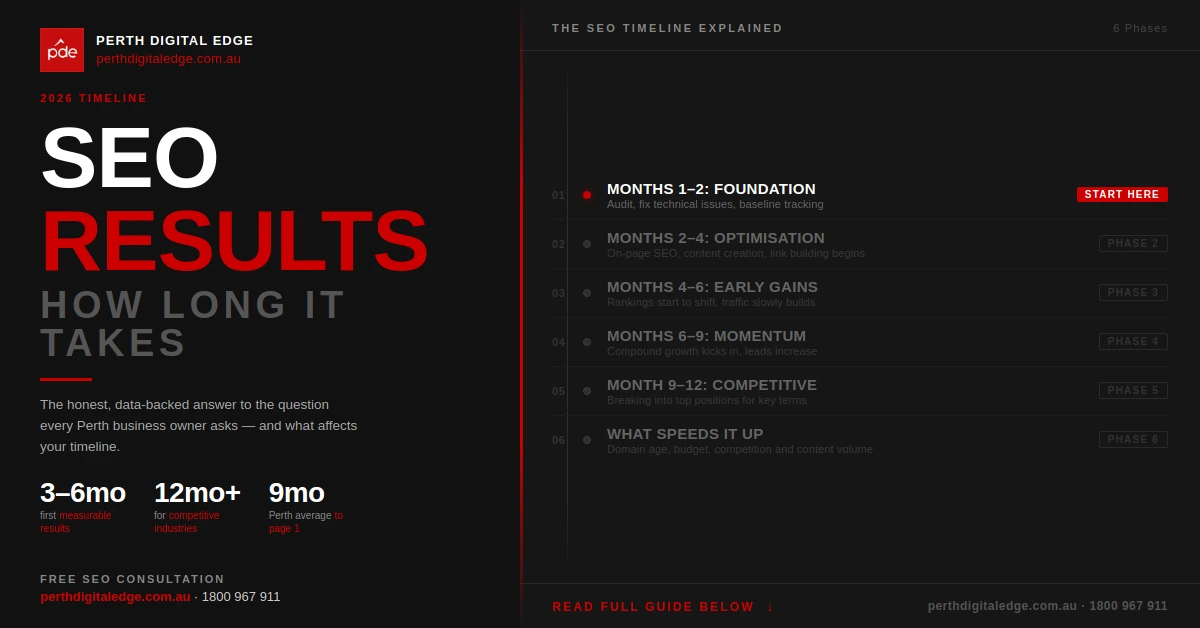
So here is the honest version, shaped by the campaigns we have actually run. In most cases, a business should expect visible SEO progress inside three to six months, stronger SEO results across six to twelve, and the most durable SEO outcomes when the work continues beyond that. The more useful version is understanding the key factors influencing that timeline and figuring out which of them you can actually control.
Why There Is No Single SEO Timeline
A security company in Perth came to us after twelve months with another SEO agency. They had been told rankings would appear within 90 days. Nothing happened. Not because the keywords were impossible, but because the previous agency never fixed duplicate content issues burying half the site from Google’s index. Castle Security had the content and the services. The site was invisible to search engines because the technical layer was broken.
That is why neat timelines fall apart. Search engines, including Google and other search engines like Bing, are evaluating a moving target. Your site changes. Competitors update pages. Search engine algorithms shift. New relevant content gets published. New high quality backlinks appear on competing domains. Search intent evolves. Even the same keywords can behave differently over time if the search engine results pages become more commercially focused.
A new site with no domain authority, thin content, weak internal links, and no history in Google Search Console will usually take longer than an established domain with clear content strategy. A Rockingham plumber targeting low competition keywords may see earlier gains than a Perth car dealership chasing broad national phrases. SEO is not one switch. It is a stack of improvements, and the sooner those improvements are handled in the right order, the sooner search engines understand the site and the more confidence they have in ranking it.
What Businesses Usually Mean When They Ask How Long SEO Takes
Most people sitting across from me are not asking when they will be number one for every target keyword. They are asking when the SEO efforts will start feeling real.
That might mean more organic traffic on their service pages. It might mean better search rankings for the phrase that actually brings phone calls. It might mean local search visibility improving through Google Business Profile. It might mean opening Google Analytics and Google Search Console and saying, “Something is clearly different.”
That distinction matters because SEO success is rarely one dramatic jump. You might see search traffic rise before enquiries do. You might see low competition keywords move first while harder phrases stay stubborn. You might fix technical SEO factors in month one and not see the benefit until month three, once the crawl and re-evaluation cycle works through. A good SEO strategy accounts for that reality.
The Typical SEO Timeline In Real Terms
Rather than give you a theoretical breakdown, here is what the typical SEO timeline actually looks like based on campaigns we have run from our office in Wanneroo.
In the first month, the work is mostly diagnostic. SEO audits, keyword research, competitor analysis, technical SEO review, content mapping, and priority fixes begin. The goal is not instant search rankings. It is getting the site into a state where it can support rankings later. When Project Concrete came to us, their site was so poorly structured that search engines could not distinguish one service page from another. Month one was rebuilding the architecture and mapping target keywords to the right pages. That diagnostic month led directly to 14 page-one keywords and 62 conversions in month two.
In months two and three, the first visible signs of SEO progress often appear. Technical issues are being resolved. New content is live. Internal links are cleaner. Some low competition keywords and long tail keywords may start moving. Organic search traffic may begin to lift, especially for pages with latent potential sitting underneath technical problems.
Eco Style Pool Renovations shows what is possible when everything aligns early. They came to us with a half-built website and zero organic traffic. We completed the build, created location-specific landing pages, and launched a content strategy alongside link building. They hit top 3 for “pool resurfacing Perth” and “pool restoration Perth” within three months. Monthly users went from zero to over 1,000. Not typical for every business, but it shows what happens when technical SEO, content quality, and targeting come together on a site with no baggage.
Between months four and six, the campaign usually becomes easier to judge. Stronger movement in search results, more consistent indexing, and clearer signs of SEO momentum. Not every business will be thrilled by this point, but there should be measurable evidence that the SEO efforts are shifting the site’s direction.
Between six and twelve months, stronger SEO outcomes usually appear if the work has been consistent. Castle Security’s campaign reached full stride around the twelve-month mark: 364% increase in organic traffic, 109 page-one keywords, and top-3 positions for their most commercially valuable phrases. That happened because twelve months of technical remediation, entity SEO, content marketing, and link building compounded into something search engines trusted.
After twelve months, the campaign reveals what kind of returns it can deliver. Bears Fencing, a family-run operation in Dunsborough, hit number one within three months and still holds that position six years later. Westside Auto Wholesale, competing in one of Perth’s most aggressive markets, reached 1.4 million organic visitors and a 4,900% return on investment. Those numbers are the product of sustained work over years, not weeks.
What Happens In The First 30 Days
This is where a lot of frustration starts, and I understand why.
A business signs with an SEO agency, expects quick movement, and then discovers the first month is full of work they cannot always see. That does not mean nothing is happening. It means the SEO process is being set up properly.
In a serious first month, the SEO team should be running SEO audits, reviewing broken links, checking technical SEO factors, mapping target keywords to the right pages, reviewing internal links, auditing Google Search Console and Google Analytics data, assessing domain age and authority, and deciding which pages deserve priority. They should also be reviewing search intent. If a page does not match user intent, it can be well-written and still struggle because search engines understand the mismatch between what the page offers and what the searcher needs.
At Perth Digital Edge, this stage is where the campaign either gets sharper or starts wasting time. If the keyword research is shallow or technical SEO issues are ignored, the business may still get some SEO results later, but they tend to be slower and less durable. Project Concrete is the clearest proof: that one month of structural work produced immediate returns because nothing was skipped.
Why Technical SEO Can Change The Timeline
Technical SEO is not glamorous. Nobody rings our office in Wanneroo excited about canonical tags. But it often decides how quickly the rest of the campaign gains traction.
If search engines cannot crawl the site cleanly, if important pages are buried four clicks deep, if broken links are scattered across the navigation, if mobile performance is weak, if Core Web Vitals are poor, or if structured data is missing where it would help, the site forces search engines to work harder than they should. That slows everything down.
Technical SEO compresses the timeline because it removes friction. Sometimes that means improving site speed. Sometimes it means fixing indexing problems, updating internal links, or resolving duplicated content. Sometimes it means making local service pages clearer so search engines understand how a “roof restoration Fremantle” page differs from a “roof repairs Joondalup” page.
I have taken over accounts where the previous agency spent months writing blog posts while half the client’s service pages were not even indexed. Invisible to Google and to other search engines entirely. Fixing those technical issues delivered ranking improvements within weeks. If an agency’s SEO efforts skip the technical layer, everything built on top sits on unstable ground.
Why Keyword Difficulty Matters So Much
The question “how long does SEO take” has to be answered against the difficulty of the keywords you are trying to win. That is non-negotiable.
A Midland mechanic targeting “brake repair Midland” faces a very different timeline than a national finance company targeting “best car loans Australia.” Keyword difficulty shapes the timeline because it shapes how much authority, content depth, and relevance the site needs before it can compete in those search engine results pages.
This is where keyword research becomes more than a list. A good SEO strategy chooses the right mix of priority keywords: easier wins, commercially useful terms, and longer-term target keywords that may take much longer to move. Without that balance, the business may spend months chasing the same keywords with very little visible progress simply because the bar is too high for the site’s current authority.
When Castle Security came to us, every competitor in Perth was fighting over the same handful of generic security terms. Instead of joining that scrum, we pulled data from Google Search Console and identified clusters of long tail keywords around specific security concerns that Perth homeowners were searching but nobody was targeting. We built content around those gaps first. The easier terms moved within months, which built domain authority, which then helped the harder terms follow. That layered approach is how SEO experts and SEO professionals handle keyword difficulty without burning budget on terms the site cannot yet win.
Content Quality And Relevant Content Still Matter
Search engine optimization is not only technical. Search engines still need something worth ranking.
A page needs to match user intent, reflect the target keywords naturally, and give search engines enough context to understand what it covers. You cannot just add relevant keywords and expect the page to perform. Thin content or generic service pages rarely hold positions for long. Search engines are much better now at identifying whether a page genuinely helps the searcher or simply exists to capture a click.
This is where SEO typically loses time. The business wants quick movement, but the content is too weak to support the keyword targets. The SEO team can improve title tags, meta descriptions, internal links, and technical SEO, but if the page does not deserve the ranking, progress stalls. I have seen it with businesses across Perth, from Subiaco consultancies to Osborne Park trade suppliers. The technical work is solid, but the pages read like they were written to fill space rather than answer the question a searcher is actually asking.
High quality content means clearer page structure, stronger relevance, better supporting topics, and enough depth to properly address the query. In local search, it may mean better service-area logic and cleaner landing page differentiation. Relevant content gives the rest of the SEO work something real to support.
The Role Of Backlinks And Off Page SEO
Off page SEO can either help the timeline or hold it back.
If your site has limited link quality and very few high quality backlinks from relevant sites, search engines may understand your pages but still not trust them enough to rank higher for harder terms. That is especially true in competitive spaces where the pages already holding those positions have stronger backlink profiles.
Link building matters because it signals credibility. Not all links help, though. Quality backlinks from relevant sites matter far more than volume. A handful of links from respected industry publications or local Perth business directories can move the dial more than dozens of placements on irrelevant domains. This is why good SEO specialists focus on link quality, not link count.
Bears Fencing is a useful example. Small budget, niche market, a fencing contractor in the South West competing against larger Perth-based companies. We focused the off page SEO work on local directories and trade-specific sites that carried genuine authority. That targeted approach helped them reach number one within months and maintain it for six years. Volume would not have done that. Relevance did.
Why Local SEO Can Be Faster Than Broader SEO
Local search often moves on a different clock.
A business with a properly configured Google Business Profile, solid local pages, strong internal links, and sensible geographic targeting can sometimes see earlier gains than a national campaign. Local search is more specific, the search intent is tighter, and the competition is usually narrower.
This comes up constantly with Perth service businesses. A page targeting “commercial electrician Joondalup” behaves very differently from “electrician Australia.” One needs months of link building and content creation. The other may respond more quickly to strong page structure and clean Google Business Profile signals.
Fremantle Roofing Services operate across Perth’s coastal suburbs and needed visibility in specific corridors. We built suburb-targeted landing pages and paired them with a Google Ads campaign for immediate coverage while organic work built underneath. 41 of 49 targeted keywords reached page one, 20 in the top 3, and qualified leads increased 300%. Their paid spend was eventually made redundant because organic search handled the volume. How long does it take for local SEO to deliver? In their case, months rather than years, because the effort targeted the right geographic search patterns.
Why SEO Usually Feels Slow At First And Faster Later
There is a reason campaigns feel sluggish early and pick up speed later. SEO momentum compounds.
At the start, every improvement is isolated. A few technical fixes. A few better pages. Some keyword research translated into on page seo changes. Maybe the first wave of content creation. Search engines need time to crawl, process, and compare all of that against every other site competing for the same search results.
Later, those improvements reinforce one another. Stronger internal links help priority keywords rank higher. More relevant content supports better search intent matching. Higher quality backlinks strengthen page trust. Search engines understand the site more cleanly. Organic search traffic grows, which produces better performance data in Google Analytics, which makes it easier to refine the SEO strategy further.
Westside Auto Wholesale showed us exactly how this works. Used car sales in Perth is aggressive. Dealerships from Midland to Rockingham fight over the same terms. Early months were about restructuring vehicle listing pages and getting the on page seo right for 130 niche keywords. Then the compound effect hit. 124 of those 130 keywords reached page one. 81 hit the top 3. Organic traffic reached 1.4 million visitors. Over 120,000 leads. A 4,900% return on investment. That came from months of consistent effort stacking, not a single tactic.
What Usually Slows SEO Down
If you want to understand how fast SEO can work, it helps to understand what drags it backward.
Weak technical foundations are a major issue. So are poor page structures, thin content, inconsistent effort, and unrealistic target keywords. Businesses also lose time when they keep changing direction, rewriting pages without a plan, or switching agencies before a strategy has time to produce SEO results.
Another drag is split focus. Some campaigns try to cover too much at once: national phrases, local search, ecommerce categories, content marketing, off page seo, and PPC advertising all running simultaneously with too few resources. SEO experts and any good SEO agency will usually narrow the field. Better to allocate resources wisely than scatter them across ten priorities and see none land.
Poor measurement also costs time. If Google Search Console and Google Analytics are not configured properly, the business may miss real SEO progress or misread what is happening. I have seen businesses abandon campaigns that were genuinely working because nobody set up conversion tracking, so leads were coming in but the reporting did not reflect it.
How To Tell If SEO Is Actually Working
This is the question underneath the timing question.
SEO is working when the site becomes more visible for the right searches, not just any searches. It is working when search rankings improve for commercially important pages. It is working when organic search traffic grows in relevance. It is working when Google Business Profile visibility strengthens in local search. It is working when search traffic reaches the pages built to generate leads.
Sometimes early SEO success is not dramatic traffic spikes. Sometimes it is cleaner indexing, stronger rankings for low competition keywords, fewer broken links, or the first signs that search engines understand the site better than before. Those indicators matter if they are moving the campaign in the right direction.
Perth Security Services shows what “working” looks like across multiple signals. They now hold 200 high-value keywords on page one, bring in 5,500 new users every quarter, and saw a 55% increase in conversion events. Those numbers did not all appear at once. The keyword positions moved first. Then the traffic followed. Then the conversions. A good SEO team should be able to explain those stages clearly.
Why SEO Is Not A One Time Task
SEO is an ongoing process because the search environment does not stay still.
Competitors publish new pages. Search engine algorithms evolve. User intent changes. New technical SEO factors become more relevant. Search engine results pages change shape. New relevant sites enter the conversation. Existing content ages.
This is why search engine optimization should not be treated like a project with a finish line. A site can make strong gains and still need ongoing work to protect them. That may include content updates, new content creation, technical maintenance, off page SEO support, and continued keyword research as new opportunities surface. The resources SEO demands do not disappear once rankings arrive.
Trade Heroes, a tradie directory platform we built from scratch, illustrates this well. The site reached 28,000 users in its first year and 6,000 organic users per month, strong enough to win a Web Excellence Award in the SEO category. Those numbers only held because the content strategy, technical SEO, and link building continued after launch. SEO tools, SEO audits, and regular SEO tasks keep the gains compounding rather than eroding.
What Perth Digital Edge Usually Tells Clients
When clients ask how long does SEO take, I give them the version I would want to hear if I were spending my own money.
Expect early signs of movement within a few months. Expect stronger SEO progress over six to twelve months. Expect the most meaningful SEO outcomes when the campaign is handled with consistent effort and a long term strategy. Expect low competition keywords to move sooner than hard commercial terms. Expect technical fixes to matter more than they appear to. Expect content quality to matter more than content volume.
Every client we have worked with, from Stelios Jewellers in Perth’s retail space to Energetics Institute in the health sector, started with the same question. The ones who saw the strongest returns committed to the SEO process rather than walking away at the first quiet month. Stelios saw a 115% traffic increase and 92 page-one keywords. Energetics saw a 61.5% organic traffic increase and 40 high-value page-one positions. Neither result appeared in week one. Both appeared because the work was sustained.
Frequently Asked Questions
These are the questions Perth business owners ask most often about the SEO timeline.
How Long Does SEO Take To Start Working?
Most sites begin to show some SEO progress within three to six months, especially if technical SEO, keyword research, and page targeting are handled properly from the start. Bigger gains usually take longer. Project Concrete saw 14 page-one keywords in month one after a full site rebuild, but that speed came from getting the structural work right before anything else.
How Long Does SEO Take For A New Website?
A new site usually takes longer because it starts with low domain authority, limited trust, and little indexed content. It often needs stronger technical and content work before search engines start ranking it consistently. Domain age does play a role, but a well-structured new site with strong content can still outpace an older site that has been neglected.
Can SEO Work Faster For Local Search?
Yes. Local search can sometimes move faster if the Google Business Profile is properly set up, the local pages are well-targeted, and the priority keywords are specific enough. Fremantle Roofing Services landed 41 of 49 targeted keywords on page one by focusing on suburb-specific roofing queries rather than broad national terms.
Why Does SEO Take So Long?
SEO takes time because search engines need to crawl, process, compare, and build trust in the site. The work also relies on consistent effort across technical SEO, content creation, internal links, and off page SEO. Ranking factors are cumulative, and search engine algorithms reward sites that demonstrate sustained relevance rather than short bursts of activity.
Can PPC Advertising Replace SEO?
PPC advertising can deliver immediate visibility, which is useful while SEO builds, but it does not create the same compounding returns as organic search. Many businesses use both. Fremantle Roofing ran Google Ads alongside their SEO campaign initially, then phased out paid spend once organic search traffic handled the volume. The two channels serve different purposes and different timelines.
How Do I Know If My SEO Agency Is Actually Making Progress?
Look at organic search traffic trends, keyword movement for commercially relevant terms, and whether those improvements are translating into real business outcomes like enquiries, calls, or sales. Your SEO agency should be reporting from Google Analytics and Google Search Console with enough context to show cause and effect, not just raw numbers. If the reporting is vague, that is worth questioning.
Start With A Realistic SEO Review
If you are trying to work out how long SEO will take for your site and your target keywords, Perth Digital Edge can help you get a clear picture before you commit.
We will look at your current site, your search potential, your technical health, and the key factors most likely to shape your SEO timeline. Just an honest assessment based on ten years of running campaigns for Perth businesses from Joondalup to Rockingham.
Ready To Find Out Where Your Site Stands?
Book a realistic SEO review with Perth Digital Edge and get a clear picture of your site’s potential and the timeline that fits your market.