

Programmatic advertising gets talked about like it is either the future of everything or a machine built to empty your budget.
Usually, it is neither.
It is a buying system. Fast, flexible, and very easy to misunderstand. The software can buy ad space in milliseconds. It cannot decide whether the audience is commercially useful, whether the message fits the placement, or whether the campaign should exist at all.
That part still needs judgement.
For Perth and WA businesses, that matters more than most generic explainers admit. Western Australia does not behave like one flat metro market. A campaign aimed at engineers tied to the resources sector, a financial audience around the CBD, and homeowners in a new estate corridor should not be built with the same assumptions. If you treat the whole state like one audience pool, the platform will still spend the money. It just will not spend it wisely.
At Perth Digital Edge, we have seen that difference first-hand. In one campaign for a local fencing contractor, we used property development data to focus the buy around new housing estates instead of broad household targeting, and quote requests lifted because the campaign reached people at the exact point fencing became an immediate need. In another case for a financial services firm, we built audience segments around ASX-related behaviour and local investment interest rather than relying on generic “finance” audiences. Those are small details, but they are exactly where programmatic either becomes useful or turns into expensive noise.
What Programmatic Advertising Actually Means
At the simplest level, programmatic advertising is the automated buying and selling of digital advertising space.
Instead of phoning a publisher, asking for rates, reserving advertising space, and manually placing a campaign, advertisers use programmatic advertising platforms to buy digital ad inventory across websites, apps, video environments, native placements, connected TV, and other digital channels.
The key word is automated.
The transaction is automated. The thinking is not.
A programmatic ad can appear on a publisher site, inside mobile apps, before video content, across programmatic video environments, or through other programmatic advertising channels. The system checks the available ad space, weighs up audience data, contextual signals, and campaign rules, then decides whether to bid. If it wins, the ad server helps deliver ads instantly.
That is the attraction. Speed, reach, and flexibility. But it also means bad decisions can scale very quickly.
Why Businesses Started Using It
Programmatic did not become popular because the industry wanted more jargon.
It became popular because digital advertising got messy.
The average target audience is spread across multiple websites, mobile apps, ad networks, streaming platforms, social environments, online publishers, and every other corner of the web. Manual media buying was never built for that level of fragmentation. Programmatic media buying gave advertisers a way to buy ad inventory across multiple ad exchanges and multiple platforms without having to negotiate each placement one by one.
That is a real advantage. It also creates a temptation to think scale is the same thing as strategy.
It is not.
Buying more available ad space does not automatically mean better campaign performance. Sometimes it just means you found more ways to lose money.
How Programmatic Advertising Works
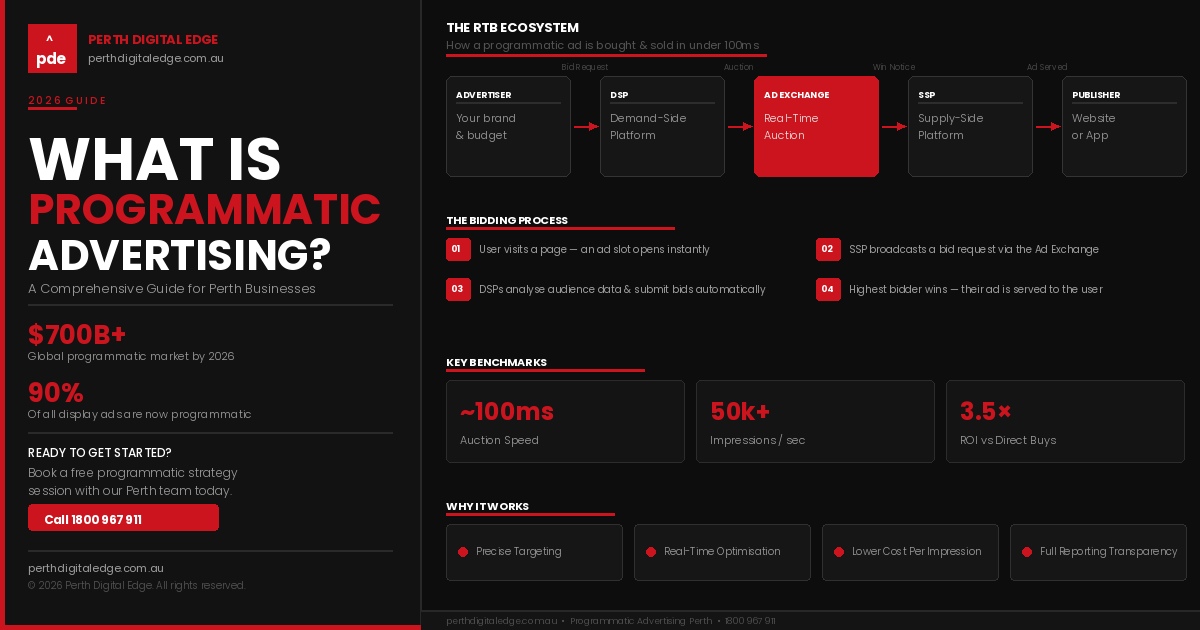
The easiest way to understand how programmatic advertising works is to walk through the ad buying process from start to finish.
First, the advertiser defines the campaign goals. This is where the marketing team decides what the campaign is meant to do. Leads, sales, awareness, registrations, app installs, or another result. That decision shapes the budget, ad formats, bidding strategy, campaign setup, and the key performance indicators used later.
Next, the campaign goes into a demand side platform.
A demand side platform is the tool advertisers use to buy digital advertising across the open web. It connects to multiple ad exchanges and gives buyers access to digital ad inventory from publishers, apps, streaming environments, and other online publishers.
On the other side, publishers use supply side platforms SSPs to sell ad inventory. These supply side platforms help publishers make their advertising inventory available to buyers. Put simply, demand side platforms help advertisers buy ad space and supply side platforms help publishers sell ad space.
Then the auction begins.
When a page, app, or stream loads with ad space available, the system checks whether the impression fits the campaign rules. This is where real time bidding comes in. In real time bidding RTB, advertisers bid for the chance to show a digital ad to that user in that moment. The auction happens in milliseconds.
If the bid wins, the ad placement is secured and the ad server helps deliver ads immediately.
Then the feedback loop kicks in. Was the ad impression viewable? Did the user click? Did the placement look credible? Did the audience respond? That performance data then feeds back into optimisation.
This is the part that makes programmatic powerful. It is not just automated buying. It is automated buying with live feedback.
Where Good Campaigns Usually Win
This is the part generic articles usually skip.
The difference between a decent campaign and a waste of ad spend is rarely the platform itself. It is usually the combination of audience logic, placement control, creative fit, and timing.
Take that fencing contractor example again. A broad home improvement audience could have spent money all over Perth with very little urgency. Instead, using property development data let us target households and locations where fencing was much more likely to become an immediate purchase. That is not a platform trick. That is a market judgement.
The same goes for the financial services example. Buying broad finance audiences often pulls in plenty of curiosity and not much intent. Building segments around ASX-related behaviour and local investment communities made the targeting tighter and more commercially relevant. Again, not glamorous. Just sharper.
That is what good programmatic buying looks like in the real world. Less “look at our AI” and more “we bought the right attention”.
The Main Types Of Programmatic Buying
Not all programmatic buying happens the same way.
The open auction is the most common model. This is where ad inventory is offered through ad exchanges and multiple advertisers can bid in real time. It is flexible and widely used.
Private marketplace deals are more selective. These are invitation-only auctions where certain buyers get access to certain publishers. They are useful when a brand wants tighter quality control or access to premium inventory.
Preferred deals give advertisers first access to advertising space at a fixed price before it enters an open auction.
Programmatic guaranteed is closer to a direct arrangement, but the delivery and campaign management still use programmatic software.
Each model suits different campaign goals, budgets, and risk tolerance.
The Main Programmatic Advertising Channels
Programmatic is not one ad format.
Programmatic display is the most familiar, covering banner ads and standard web placements.
Programmatic video has grown sharply, especially as streaming and connected TV have opened up more advertising inventory.
Native ads matter because they can feel more natural inside content environments.
Mobile apps are a major source of digital ad inventory and can work extremely well when the audience fit is right.
Connected TV gives advertisers a way to reach streaming audiences with more targeting control than traditional television ever allowed.
In some cases, even digital billboards can be bought programmatically.
This breadth is one of the clearest benefits of programmatic advertising. It lets advertisers reach a target audience across digital channels rather than relying on one placement type alone.
The Platforms Behind The Buy
To understand the system properly, it helps to know the main components.
The demand side platform is where the advertiser manages ad buying.
Supply side platforms SSPs help publishers sell ad space.
Ad exchanges are the marketplaces where bids and inventory meet.
Ad networks still exist and can aggregate certain types of inventory.
The ad server helps deliver ads and track what happens afterwards.
Data management platforms used to sit more centrally in this ecosystem, especially for organising third-party audience data. Now, first-party customer data and more privacy-aware systems are taking on a bigger role, but the core idea remains the same: better audience information usually leads to better buying decisions.
The Benefits Of Programmatic Advertising
The benefits of programmatic advertising are real, but they only show up when the campaign is managed properly.
The first is reach. Advertisers can buy ad space across multiple platforms, multiple ad exchanges, and multiple digital channels without booking each one manually.
The second is precision. Customer data, contextual targeting, and audience rules can help advertisers reach a more commercially useful target audience.
The third is speed. Campaigns can be adjusted quickly while they are live.
The fourth is visibility. Digital marketers can monitor campaign performance, ad viewability, key performance indicators, and budget flow in much more detail.
The fifth is flexibility. Brands can move between display, video ads, native ads, connected TV, mobile apps, and other placements as the campaign evolves.
The Risks And Limitations
Programmatic is useful. It is not foolproof.
Ad fraud is one risk. Poor-quality ad inventory and invalid traffic can quietly drain budget.
Weak targeting is another. A broad audience can generate plenty of ad impressions and almost no commercial value.
Bad creative is a third. Even strong buying logic cannot rescue an ad that says nothing worth noticing.
Then there is overconfidence in automation. The software can automate the buy. It cannot save a weak offer, a vague campaign goal, or a poor brief.
Privacy changes add another layer. As cookies and tracking tools become less dependable, digital marketers need to use first-party customer data, contextual targeting, and stronger measurement discipline.
Programmatic Advertising Vs Google Ads
This comparison matters because businesses often think they have to choose one.
Google Ads is excellent when the goal is to capture direct search intent. It gives advertisers access mainly to Google-managed environments such as search, YouTube, shopping, and the Google Display Network.
Programmatic buying goes wider. It lets advertisers buy digital advertising across a broader range of ad exchanges, publishers, placements, and channels.
If the job is capturing a person already searching, Google Ads may be the better fit. If the job is reaching a defined audience across premium inventory, video, native, connected TV, and broader display environments, programmatic may be the better option.
Often the smartest answer is not either-or. It is role clarity.
When Programmatic Makes Sense
Programmatic is not reserved for giant brands, but it is not right for every situation either.
It makes sense when you need broader reach, stronger audience control, or access to inventory across multiple channels. It is often useful for B2B, eCommerce, multi-location businesses, awareness campaigns, retargeting, and campaigns that need to work beyond direct search.
It can also make sense for WA businesses when the target audience is hard to isolate through search alone. Industry-linked demand, local service opportunities, FIFO-adjacent households, or very specific local pockets can often be reached more effectively through data-led buying than through broad manual placements.
Where it tends to struggle is when the budget is too small, the audience is poorly defined, or the campaign goals are vague.
Frequently Asked Questions About Programmatic Advertising
What Is Programmatic Advertising In Simple Terms?
It is the automated buying and selling of digital ad space through software instead of manual deals.
What Is A Demand Side Platform?
A demand side platform is the tool advertisers use to buy digital advertising across exchanges, publishers, and channels.
What Are Ad Exchanges?
Ad exchanges are marketplaces where publishers make ad inventory available and advertisers bid on it.
Is Real Time Bidding The Same As Programmatic?
No. Real time bidding is one buying method inside programmatic. Not all programmatic deals rely on open auction RTB.
What Types Of Ads Can Be Bought Programmatically?
Display, native, programmatic video, connected TV, audio, app placements, and in some markets digital billboards.
Conclusion
Programmatic advertising is not a trick, and it is not a shortcut.
It is a way to buy digital advertising more flexibly across ad exchanges, platforms, and digital channels using data, bidding logic, and campaign controls. When it is run well, it can reduce wasted ad spend, improve campaign performance, and help advertisers buy attention in places that are much harder to reach through traditional advertising alone.
If you want to understand whether programmatic media buying fits your business, talk to Ben Tippett at Perth Digital Edge. We can help you work out where it sits in your digital marketing mix, how it compares with Google Ads, and whether it is the right next step for your market.