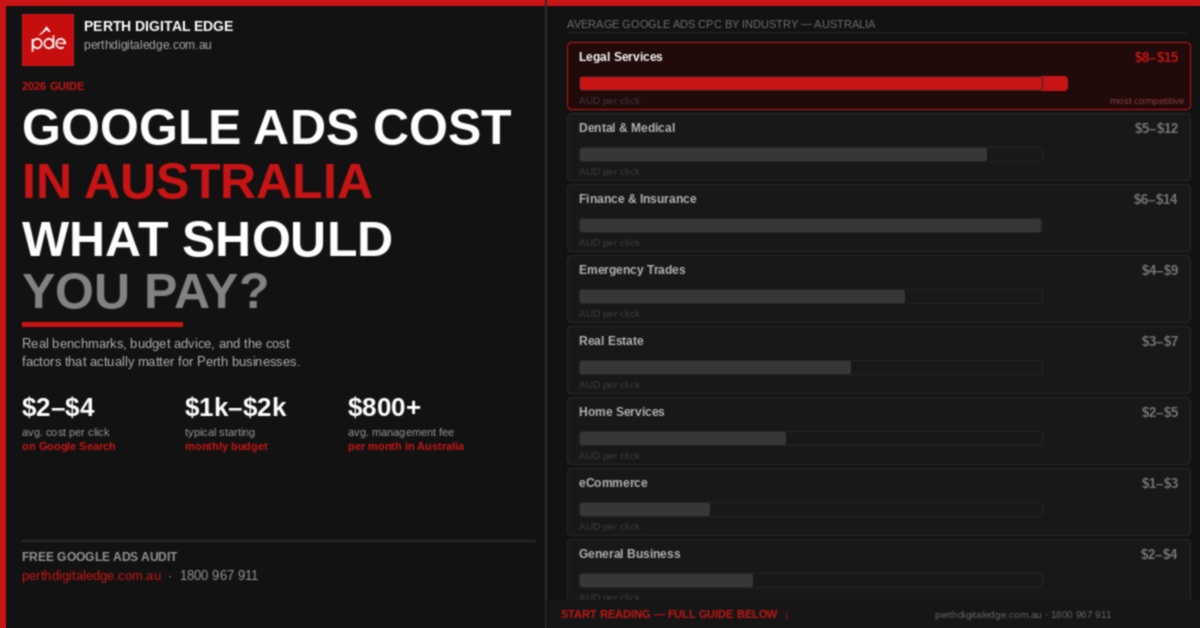
If you want the short answer, most Australian businesses see Google Ads cost land somewhere around $2 to $4 per click for Search campaigns, with Display campaigns often cheaper. Monthly spend is a much wider range. A small local operator might begin around $1,000 to $2,000 per month, while a more established business in a competitive market may need $3,000 to $15,000+ per month just to generate enough volume and data to optimise properly.
That headline figure matters, but it is not the number that decides whether a campaign is viable. A Perth electrician, a Subiaco family lawyer, a Joondalup dental clinic, and a WA mining services firm can all run inside Google Ads and face completely different economics. The real variables are not just average CPC. They are buyer intent, lead value, keyword pressure, local competition, landing page quality, and how tightly the account is managed.
That is why the better question is not simply how much does Google Ads cost in Australia. It is what does it cost to generate a profitable lead or sale in your market.
This guide breaks that down in practical terms, so you can set a more realistic Google Ads budget, understand where costs rise, and avoid the mistakes that make campaigns look more expensive than they really are.
How Much Does Google Ads Cost In Australia?
A useful benchmark for Search ads is $2 to $4 AUD per click. That gives you a starting point, not a budgeting formula. Plenty of campaigns come in above that. Plenty come in below it. Once you move into more aggressive categories like legal services, finance, dental, emergency trades, or high-value B2B, the average cost per click can climb fast.
Monthly budgets vary for the same reason. Some businesses can gather meaningful data on a modest spend if they are targeting a narrow service area and a small set of high-intent keywords. Others need a larger monthly ad spend simply because the market is denser, the search volume is broader, or the sales cycle is longer.
In Perth, this gets even more uneven at suburb level. A campaign aimed at central, high-competition areas like Subiaco, West Perth, or Osborne Park may behave very differently from one focused on Rockingham, Midland, or outer-metro service zones. The more competitive the area and the more valuable the enquiry, the harder advertisers tend to bid.
So yes, average numbers are useful. But using national averages alone to set your Google Ads spend is a quick way to either undershoot the budget or waste it.
What Actually Pushes Google Ads Costs Up Or Down?
Most businesses assume cost is mainly about bidding higher or lower. In reality, cost moves when multiple parts of the campaign interact badly or well. The businesses that keep their account efficient usually do four things well: they choose the right keywords, control waste tightly, match ads to intent, and send traffic to pages built to convert.
Keyword Pressure Changes Everything
The fastest way to distort Google Ads pricing is to chase broad, expensive keywords without enough control. High-volume phrases look attractive because they promise reach, but they often bring weaker traffic, more irrelevant searches, and lower conversion rates.
A Perth accountant targeting a broad term like “tax help” may pull in a messy mix of research queries, DIY users, and low-intent clicks. Targeting a tighter phrase with clearer intent can lower volume, but improve lead quality and make the campaign more commercially viable.
That is why good keyword research is not just about finding popular terms. It is about choosing terms that match the service, the buyer stage, and the likely conversion value.
Local Intent Can Make A Campaign More Efficient
Some campaigns become expensive because the targeting is too wide for the business model. If your service area is concentrated in Fremantle, Cockburn, Melville, and surrounding suburbs, you should not be soaking up spend from clicks outside the area just for the sake of visibility.
The same applies in WA-wide campaigns. A FIFO recruitment firm, a mining services provider, or a transport business targeting broader regional demand needs a very different account structure from a local service business trying to drive calls in one metro corridor. Better geographic location control usually means stronger relevance, and stronger relevance often improves results.
Lead Value Changes What “Expensive” Means
A click is only expensive if it cannot pay for itself.
That is why industries like law, finance, or specialist medical services often tolerate higher CPCs. One good lead can justify a far higher click cost than an eCommerce product with a small margin. So while the average cpc matters, it cannot be looked at without context.
A $12 click that consistently drives qualified commercial enquiries may be healthier than a $2 click that goes nowhere. Businesses that focus only on lowering cost per click often end up hurting lead quality.
Weak Traffic Is Often Self-Inflicted
Many campaigns look expensive because they are attracting the wrong traffic. That usually comes back to one of these issues:
- loose match types
- poor negative keywords
- weak ad copy
- generic landing pages
- unclear conversion tracking
- broad audience settings
- no meaningful review of search terms
None of those are market problems. They are management problems.
Why National Benchmarks Only Tell You So Much
Most articles on ads cost in Australia stop at broad averages. That is fine for surface-level research, but it is not especially useful if you are actually trying to set a working budget.
A business owner in Perth does not just need to know that average CPC exists. They need to know:
- whether their niche is likely to be cheap, moderate, or aggressive
- how many clicks they might need before they can judge campaign performance
- whether their service area is too broad
- whether mobile ads or desktop traffic are more likely to convert
- whether their offer can support a target CPA that makes sense
That is where budget planning gets practical.
If your average sale value is low, your Google Ads campaign has less room for inefficiency. If your service is high-margin and the sales team closes well, you can often carry a more aggressive bidding strategy and still produce a healthy return.
That is why a smart Google Ads budget starts with business economics, not with a generic “small businesses should spend X” rule.
What A Realistic Starting Budget Looks Like
Most businesses should treat their first budget as a testing budget, not a finished budget.
A small local campaign may start with $1,000 to $2,000 per month if the targeting is narrow and the service has clear commercial intent. If the market is more competitive, or if you need enough volume to learn quickly, the budget often needs to be higher.
Here is the practical issue: campaigns that are underfunded do not just grow slowly. They often fail to generate enough data to make good decisions. That creates a false impression that Google Ads is unpredictable, when the real problem is that the account never had enough room to learn.
A better way to think about monthly Google Ads budgets is:
- define the service or offer you want to promote first
- estimate the value of a lead or sale
- decide what a reasonable target CPA looks like
- then set a budget that can actually produce enough clicks and conversions to test that assumption
For some Perth service businesses, that means starting with one tightly scoped campaign rather than spreading budget across every service line, suburb, and keyword variation at once.
Where Money Gets Burned Faster Than It Should
Some campaigns become expensive because the market is competitive. Others become expensive because the account is leaking budget from every angle.
The most common budget drains are:
Broad Keyword Selection
Broad targeting without enough control usually inflates spend. It brings in weaker traffic, muddier search terms, and lower conversion intent.
Generic Landing Pages
A user clicks because the ad promised something specific. If they land on a vague page with weak service relevance, poor structure, or no clear next step, the click was always going to struggle.
Weak Conversion Tracking
Without reliable tracking, businesses end up optimising for the wrong signals. Clicks look healthy, but lead quality is unclear. The account then scales what is easy to measure, not what makes money.
Poor Match Between Ad And Search Intent
A lot of wasted spend comes from this one problem alone. If the ad is too broad for the search, or the offer does not line up with what the user expected, the click quality drops.
Too Much Coverage Too Early
Trying to target all of Perth, every service, every keyword theme, and multiple campaign types at once is one of the quickest ways to thin out performance. Strong accounts usually earn expansion after the early data is clean.
How To Bring Google Ads Costs Down Without Crippling Results
Trying to reduce ads cost by chopping bids is often the bluntest and least useful move. Lowering cost properly is about tightening fit, not just squeezing spend.
Use Tighter Keyword Themes
Campaigns usually become easier to control when ad groups are built around close intent, not giant keyword buckets. That improves keyword relevance, strengthens ad messaging, and makes landing page alignment easier.
Add More Negative Keywords
Good negative keywords save money quietly. They stop your ads appearing for searches that look related on the surface but have no real sales value.
Build Better Landing Pages
A stronger landing page experience does more than improve conversions. It helps support ad relevance and account efficiency. The page should match the search, reinforce trust quickly, and make the next step obvious.
Segment By Service Or Location
A Joondalup-focused campaign should not always look identical to one aimed at Fremantle or Perth CBD. Search behaviour, competition, and local intent can shift enough to justify separate structures.
Review Search Terms Relentlessly
One of the easiest ways to find budget waste is to look at the actual search queries that triggered your ads. Businesses that do this well usually make faster gains than those who obsess over bid tweaks alone.
Choose The Right Bidding Strategy For The Stage
Manual bidding can make sense early when control matters and data is limited. Automated bidding and smart bidding strategies can become stronger once tracking is reliable and the campaign has enough conversion history. Using automation too early is a common mistake. So is avoiding it long after the account has matured enough to benefit.
Google Ads Management Fees And Why They Matter
Google Ads management fees are separate from ad spend, and they should be judged by what they prevent as much as by what they cost.
Most businesses are not paying only for account access. They are paying for:
- campaign setup
- account structure
- keyword selection
- negative keyword control
- ad writing
- bid management
- conversion tracking
- reporting
- performance analysis
- ongoing optimisation
In Australia, management fees commonly sit somewhere around $800 to $2,500 per month, depending on account size and complexity. Some providers charge a flat fee. Others charge a percentage of spend. Some blend both.
What matters more than the pricing model is whether the management improves outcomes. A cheap provider who allows bad traffic, weak reporting, and poor campaign structure can cost more in lost budget than a stronger agency fee ever would.
If you are weighing whether to manage campaigns internally or get specialist help, our Google Ads Management Perth service is built for businesses that want tighter control, clearer reporting, and stronger commercial performance from their Google Ads account.
Is Google Ads Worth It For Perth Businesses?
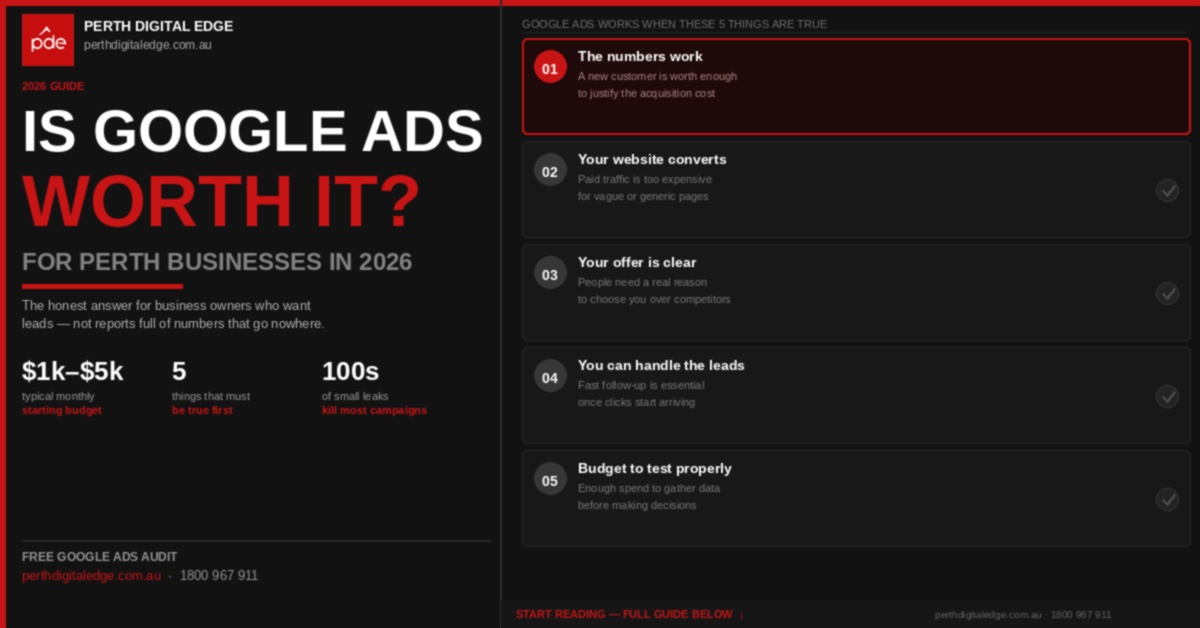
It can be, but only when the campaign is built around commercial intent and real conversion logic.
Google Ads is strong when you need immediate visibility, when your service already has search demand, and when the economics of a lead make paid acquisition worthwhile. It is particularly effective for service businesses, high-intent local search, urgent need categories, and campaigns where fast testing matters.
Where businesses get disappointed is when they expect the platform to rescue a weak offer, a poor landing page, or an unfocused account structure. Google Ads is a lever, not a substitute for strategy.
The question is not whether Google Ads worth it in theory. The question is whether your campaign can turn paid clicks into revenue at a cost your business can absorb.
If the answer is yes, paid search can be one of the fastest-growth channels available. If the answer is no, the budget should not be scaled until the fundamentals are fixed.
Frequently Asked Questions
A few questions come up consistently when businesses are planning their first campaign or trying to understand why their current account feels expensive.
What Is The Average Cost Per Click For Google Ads In Australia?
For search ads, the average usually sits around $2 to $4 AUD per click, although competitive industries can run much higher.
How Much Should A Small Business Spend On Google Ads?
Many small businesses start around $1,000 to $2,000 per month, but the right figure depends on market competition, service area, and conversion value.
Why Do Some Industries Pay More For Google Ads?
Industries with stronger buyer intent and higher customer value usually attract more bidders. That drives up keyword pressure and increases CPC.
How Can I Lower My Google Ads Costs?
You usually lower costs by improving relevance, filtering bad traffic, tightening keyword targeting, using better landing pages, and reviewing search terms more closely.
Do Google Ads Management Fees Include Ad Spend?
Usually not. Google Ads management fees are generally separate from the money paid directly into the ad platform.
Is Google Ads Better Than SEO?
They solve different problems. Google Ads gives immediate search visibility. SEO builds organic presence over time. Many businesses benefit from both.
Conclusion
The average Google Ads cost in Australia is a helpful benchmark, but it is not the number that should drive your decisions. What matters more is how your specific market behaves, how valuable a conversion is to your business, and how efficiently your campaign turns ad spend into qualified enquiries or sales.
A Perth campaign targeting a narrow service area, a WA-wide B2B campaign, and a high-intent local lead generation campaign will all carry different cost structures. That is normal. The goal is not to chase the cheapest clicks. The goal is to build a campaign where the click cost, lead quality, and conversion rate work together.
If you want a clearer picture of what Google Ads should cost for your business, and how to avoid common budget leaks from the start, visit our Google Ads Perth page to see how we help businesses build more efficient campaigns.