Sometimes yes. Sometimes absolutely not.
That is the part people usually skip.
Google Ads can be brilliant when the offer is strong, the service is in demand, and the website knows how to turn a click into a call, form, or sale. It can also feel like feeding fifty-dollar notes into a shredder if the targeting is loose, the landing page is generic, or the business is chasing the wrong traffic.
That is especially true in Perth. A Joondalup electrician, a Subiaco family lawyer, a Wanneroo landscaper, and an Osborne Park clinic are all using the same platform, but they are not buying the same kind of click, competing in the same auction, or working with the same customer value. Perth Digital Edge’s own Google Ads page leans into that reality. It talks about cost per lead, cost per click, conversion rate, and return on ad spend, and it frames bad performance as a structure, intent, exclusions, or tracking problem, not as a mystery that needs more budget thrown at it.
So the real question is not “is Google Ads good?”
It is this: can your business turn paid traffic into profitable work at a cost that makes sense?
Start Here, Not In The Ads Platform
Most businesses decide on Google Ads the wrong way round. They ask what the clicks cost before they ask whether the business can actually handle those clicks well.
If your margins are thin, your follow-up is slow, your service pages are vague, or your offer sounds like everyone else’s, Google Ads will expose that quickly. It does not politely hide weak spots. It puts a price tag on them.
That is why Perth Digital Edge publicly talks about running campaigns inside the client’s own Google Ads account, tying spend to calls, forms, bookings, or sales, and auditing setup, targeting, conversion tracking, and landing page fit before trying to scale anything. That is the right mindset. Scaling an inefficient account does not solve the problem. It just scales the waste.
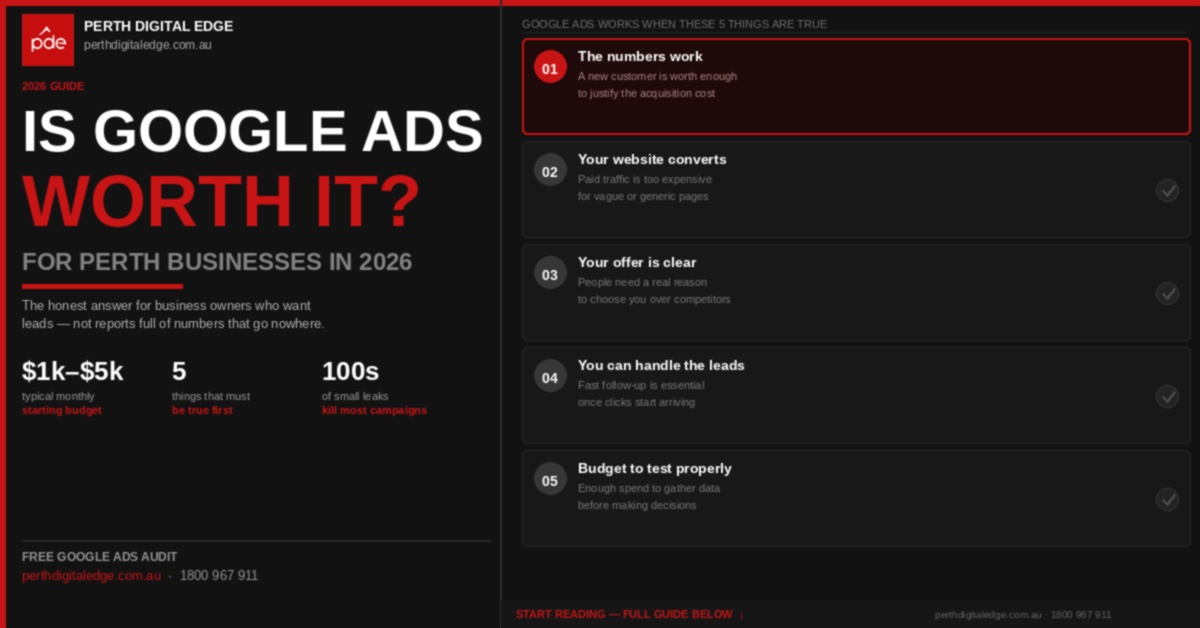
If you want the short version, Google Ads is usually worth it when five things are already true.
First, the numbers work. A new customer needs to be worth enough to justify acquisition costs.
Second, the website can carry its weight. Paid traffic is too expensive for vague pages.
Third, the offer is clear. People need a reason to pick you.
Fourth, the business can handle leads properly once they arrive.
Fifth, there is enough budget and patience to test properly rather than panic after a handful of clicks.
Why Some Perth Businesses Love Google Ads
When Google Ads works, it feels almost unfair.
Someone in your service area searches for exactly what you do. Your ad appears. They click. They call. Or they book. Or they fill in the form. That speed is hard to beat.
That is why local and service-based businesses often get so much out of paid search. A person searching for a tax accountant in Joondalup, a physio near Osborne Park, or a fencing contractor in Wanneroo is not drifting around the internet for fun. They are looking for a solution. The search already exists. You are not manufacturing interest from scratch. You are stepping into demand that is already there.
And for local businesses, the geographic control is a big deal. You do not have to pay for every suburb in Perth if you only service the northern corridor. You can tighten the campaign around the areas that matter, shape the ad copy around the service, and send people to a page that actually reflects what they searched for. Perth Digital Edge explicitly frames Google Ads this way for local businesses, including suburb and radius targeting to avoid wasting budget on areas the business does not serve.
That is where the platform earns its keep. Not because Google is magical, but because intent plus relevance is powerful.
Where It Goes Sideways
Now for the painful bit.
Google Ads has a nasty habit of looking easy right up until it gets expensive.
A business owner launches a campaign, picks some broad keywords, leaves the defaults mostly untouched, sends traffic to the homepage, and waits. For a few days it feels exciting. There are impressions, maybe some clicks, maybe even a few calls. Then the bill grows faster than the confidence.
Usually, the problem is not dramatic. It is ordinary. The wrong search terms. Weak exclusions. A landing page that says too little. Ad copy that sounds fine but not compelling. No real sense of which clicks are actually turning into revenue.
That is why Perth Digital Edge’s public positioning is useful here. Instead of talking like Google Ads success is about hacks or tricks, it talks about campaign setup, keyword research, ad group structure, extensions, conversion tracking, landing page guidance, and ongoing optimisation. That is the real work.
You do not usually lose money in Google Ads because of one catastrophic error. You lose it through a hundred little leaks.
The Perth Factor Most Generic Articles Miss
A lot of “is Google Ads worth it” content could be written for anywhere. That is exactly the problem.
Perth is not one homogenous market. A campaign aimed at Wanneroo and Joondalup behaves differently from one aimed at Subiaco and the inner west. A suburban trade business, a clinic, a law firm, and an eCommerce brand may all be buying clicks in Western Australia, but the level of urgency, competition, and buyer value is not the same.
That local nuance matters because paid search is not just about reaching a target audience. It is about reaching the right person in the right place with the right level of buying intent.
Perth Digital Edge anchors itself publicly in Wanneroo and repeatedly talks about Perth businesses in Western Australia wanting predictable lead flow rather than reports full of numbers that never turn into work. That local framing helps because it is closer to how buyers actually think. They are not searching for abstract marketing theory. They are trying to solve a business problem in a market they know.
So, Is It Worth It For Small Businesses?
For many small businesses, yes.
In fact, Google Ads can be one of the most practical channels available when the business is selling something people already search for and when speed matters. That is often the case for local services, urgent repairs, appointment-driven businesses, specialist professional services, and high-intent product categories.
But not every small business should be using it yet.
If your website struggles to convert, if your sales process is messy, if you do not know which services are actually profitable, or if every new customer leaves very little margin, Google Ads can feel brutally honest. It will not hide those problems behind vanity metrics for long.
Perth Digital Edge publicly states that Google Ads is worth the money when it can generate leads or sales at a cost that fits your margins and growth plans, and that part of the agency’s role is to be honest about whether Google Ads is likely to work before a business commits to long-term management. That is the sort of answer more agencies should give.
Not every business needs encouragement. Some need a reality check.
What About Budget?
This is where fantasy dies quickly.
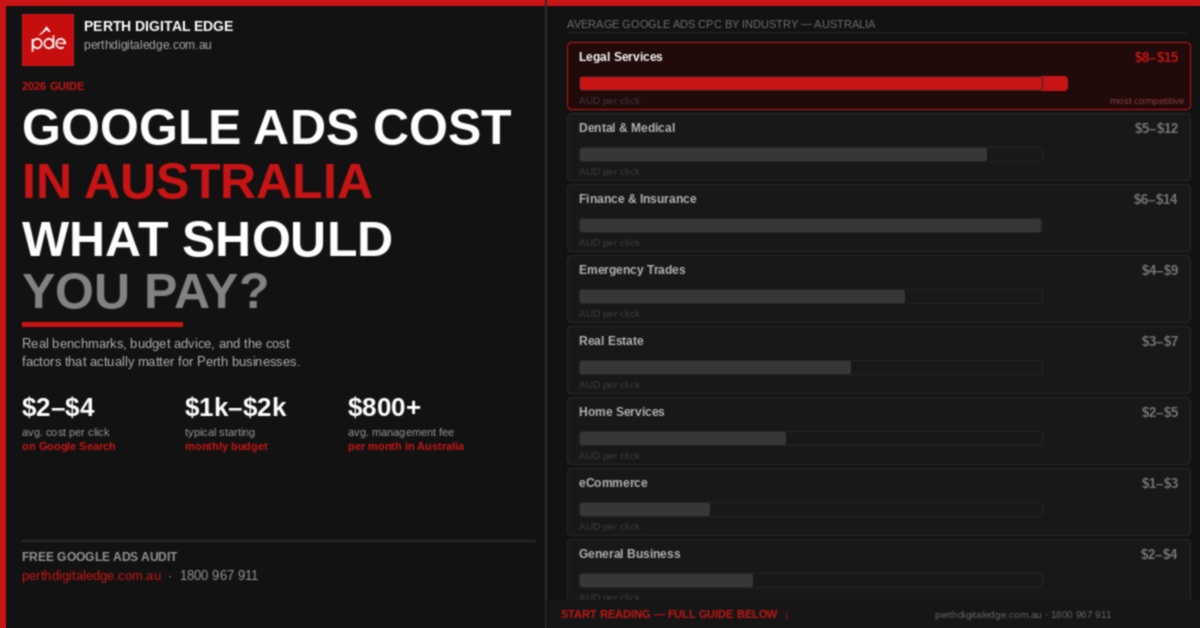
A lot of businesses come in hoping they can dominate search with a tiny monthly budget. Sometimes a very small test can tell you something useful, but most real campaigns need enough spend to gather data, learn what search terms are producing qualified traffic, and make meaningful adjustments.
Perth Digital Edge says most small to medium businesses start with a monthly Google Ads budget between $1,000 and $5,000, with the correct level depending on industry, competition, average CPC, and the value of each lead.
That range makes sense because it is realistic without pretending every business is the same. A fencing business is not buying the same click as a lawyer. A local service page is not competing like a statewide eCommerce campaign. The right budget comes from working backwards from the economics, not from picking a round number and hoping for the best.
If a lead is valuable and the close rate is healthy, a higher click cost can still be perfectly sensible.
If a lead is worth very little and the website converts badly, even a cheap click can be too expensive.
The Kind Of Proof That Actually Matters
You asked for cleaner evidence, not generic claims, so here is the honest version.
Perth Digital Edge’s public site does not currently show a detailed Google Ads case study with hard before-and-after PPC numbers that I can verify. I am not going to invent one.
What it does show is still meaningful. The Google Ads service page states clearly how the agency works, what it optimises for, and how it thinks about performance. It also says the business has over 40 Google reviews, and those reviews include named businesses and clients such as Timothy Utting’s fencing business, Guitar Lessons Perth, and City Beach Basketball Club praising Ben and the team. Franklyn Jardine from City Beach Basketball Club appears in multiple testimonial sections on the site recommending Ben and the team.
That is not the same thing as a PPC case study, and it should not be dressed up as one. But it does tell a reader this is not faceless content from nowhere. There is a real Perth business, with a real address in Wanneroo, a public Google Ads offer, and public client feedback attached to named people and organisations.
That matters more than fluffy certainty.
Google Ads Vs SEO, Without The Silly Rivalry
This does not need to be a cage fight.
Google Ads is faster. SEO is slower but compounds. Paid search gets you into the market quickly. Organic search builds a stronger long-term footprint. One captures demand now. The other keeps lowering your dependency on paid traffic over time.
For a lot of businesses, especially in Perth’s more competitive service categories, the smart play is not picking one forever. It is using both properly.
Perth Digital Edge already presents itself as a broader digital marketing partner across SEO, Google Ads, content, web design, and social, which is the right frame. Search visibility is not one channel in isolation. It is a system.
What A Good Decision Looks Like
A good Google Ads decision is usually not emotional. It is commercial.
You look at search demand. You look at your service areas. You look at what a lead is worth. You look at your conversion path. You decide whether your website and offer are good enough to justify the traffic. Then you set a budget that gives the campaign a fair chance.
If those pieces line up, Google Ads can be a very smart move.
If they do not, there is no shame in waiting and fixing the business fundamentals first.
That is not pessimism. That is how you avoid paying to learn obvious lessons the hard way.
The Bottom Line
Google Ads is worth it when the business is ready for it.
Not when the account is built on hope. Not when the website is vague. Not when the service area is too broad. Not when nobody knows what a lead is worth.
For Perth businesses with real search demand, decent margins, and a clean conversion path, it can be one of the most practical growth channels available. Especially when the campaign is structured around local reality, whether that means Wanneroo, Joondalup, Osborne Park, Subiaco, or a wider Perth metro footprint.
If you want a straight answer about whether Google Ads makes sense for your business, Perth Digital Edge already frames that conversation the right way: audit first, fix the leaks, then scale what is working. That is a much healthier starting point than blindly trying to “get more clicks.”
If you want help with that, visit our Google Ads Management Perth page.
Frequently Asked Questions
Is Google Ads Worth It For Small Businesses?
Yes, often. Especially when the business offers something people are already searching for and can turn those clicks into calls, forms, bookings, or sales at a sensible cost. Perth Digital Edge explicitly says Google Ads is worth the money when it can generate leads or sales at a cost that fits your margins and growth plans.
How Much Should A Small Business Spend On Google Ads?
Perth Digital Edge says most small to medium businesses start between $1,000 and $5,000 per month, depending on competition, average CPC, and the value of each lead.
Why Do Some Google Ads Campaigns Waste So Much Money?
Usually because of broad targeting, poor negative keyword control, weak landing pages, missing conversion tracking, and not enough ongoing management. Perth Digital Edge’s own service copy points to structure, intent, exclusions, and tracking as the places where accounts usually leak.
Is Google Ads Better Than SEO?
It is faster, not universally better. Google Ads gives immediate visibility in paid results. SEO builds longer-term visibility in organic search. Many businesses are better off using both.
Do I Need Google Analytics For Google Ads?
You can run campaigns without it, but proper tracking and analytics make it much easier to understand what happens after the click and whether the spend is actually producing commercial value. Perth Digital Edge’s approach to Google Ads explicitly includes conversion tracking and reporting as part of management.
What Makes Google Ads Work Better?
Stronger keyword targeting, smarter exclusions, tighter local targeting, better landing pages, sharper offers, and regular account review. In other words, the boring stuff that actually moves the numbers.