

A plumbing company in Balcatta called us on a Thursday afternoon in a state of controlled panic. They had launched a redesigned website the previous Monday. By Wednesday their organic traffic had dropped 61 percent. The phone, which normally rang twelve to fifteen times a day from Google, had rung twice. Their web designer, a nephew who “does websites,” had built the new site on a completely different URL structure, deleted the old pages without redirects, stripped every meta description, and published it live without telling anyone who understood SEO that it was happening. Four years of accumulated search engine rankings, gone in a deploy.
Ben drove to their office that Friday morning. He sat in the car park for a few minutes before going in because he needed to figure out how to explain the situation honestly without making the owner feel stupid for trusting a family member with something this consequential. The existing site had been ranking on page one for “emergency plumber Perth”, “blocked drains Balcatta”, and eleven other terms that were generating roughly $22,000 per month in attributable revenue. The new website looked better. Genuinely. Cleaner layout, better photography, mobile responsiveness that actually worked. But none of that matters if Google cannot find you.
We spent the following two weeks rebuilding their search presence. Mapped every old URL to its new equivalent. Implemented 301 redirects for 147 pages. Rewrote title tags and meta descriptions that the redesign had wiped. Resubmitted the XML sitemap through google search console. Recovered about 80 percent of their rankings within six weeks. The other 20 percent took four months. That gap between six weeks and four months cost them somewhere around $35,000 in lost leads. All of it avoidable.
That experience is why we approach every website redesign project with paranoia about search rankings before we think about design elements, colour palettes, or typography. A redesigned website that looks stunning and ranks nowhere is not a successful website redesign. It is an expensive vanity project.
When Your Website Actually Needs A Redesign
Not every underperforming site needs a full redesign. Sometimes what looks like a design problem is actually a content strategy problem, or a site speed problem, or a conversion rate problem that minor layout tweaks would fix. A website audit will tell you which situation you are in. We run these before quoting any redesign project because the answer genuinely changes what we recommend.
Here are the situations where a full site redesign is the right call rather than iterative improvements.
Your Site Was Built On Technology That Cannot Be Updated. A roofing company in Wanneroo was running a site built on a content management system that had not received a security update since 2019. Plugins were failing. The contact form broke every time PHP updated on the server. Patching it was like replacing planks on a boat that needed a new hull. When the underlying technology is obsolete, redesign involves starting fresh because the cost of maintaining legacy code exceeds the cost of rebuilding.
Your Current Website Delivers A Poor User Experience On Mobile. Check your google analytics data. If more than 60 percent of your visitors are on mobile devices, which is the case for nearly every service business in Perth, and your mobile site loads slowly, renders badly, or forces mobile users to pinch-zoom to read text, you are losing leads every day. Mobile responsiveness is not a feature anymore. It is the baseline. If your current site was built before responsive design was standard, a strategic website redesign is the only practical fix because retrofitting mobile responsiveness onto a desktop-first architecture usually creates more problems than it solves. We audited a landscaping business in Duncraig last year where 73 percent of traffic came from mobile devices but the site had been designed for desktop in 2017. Their bounce rate on mobile was 81 percent. Four out of five people arrived and left without clicking a single thing. The owner kept blaming his Google Ads for poor performance when the real problem was that mobile users could not physically use his website.
Your Brand Has Evolved Beyond What Your Site Communicates. Westside Auto Wholesale on Ewing Street in Bentley went through this. Their existing website still showed the branding and messaging from when they first opened, which did not reflect the reputation they had built in the used car market across Perth’s southeast. The outdated design was actively working against them because visitors interact with a site and form trust judgments within seconds. When your brand identity and your website tell different stories, potential customers notice the disconnect even if they cannot articulate it.
Your Site Architecture Is Fundamentally Broken. If your existing site has grown organically over years with pages added haphazardly, no logical hierarchy, broken internal links, duplicate content, and a site structure that confuses both users and search engines, a strategic redesign that rethinks the information architecture from scratch is more efficient than trying to reorganise the mess incrementally.
Your Website Redesign Goals Include Fundamentally Changing How Users Engage. Sometimes the issue is not aesthetics or technology but the way the site functions. If your business goals have shifted from informational to transactional, or from lead generation to ecommerce, or from a single service to multiple service lines, the existing site’s structure may not support the new direction. A dental practice in Victoria Park came to us wanting to add online booking, patient intake forms, and a resource library to a site that was essentially a five-page brochure. Bolting those features onto the existing architecture would have created a confusing user experience. A strategic redesign that rethought the entire user journey was the right call.
If none of these apply and your site is structurally sound but just looks dated, a website refresh targeting visual design elements while preserving the existing URL structure and content may be the smarter and cheaper option.
Planning Your Website Redesign Strategy
The redesign process fails most often not during design or development but during planning. Specifically, it fails when people skip planning and jump straight into choosing templates and colours.
Start With A Website Audit. Before you redesign anything, understand what your current website is actually doing. Pull your google analytics data for the past twelve months. Identify your key pages, the ones generating the most organic traffic, the most conversions, and the most engagement. These pages are sacred. Whatever happens in the redesign, these pages need to maintain their URL structure, their content substance, and their internal links. Any page currently ranking in google search results for your target keywords needs to be treated with surgical care during the transition.
Run a technical audit. Check site speed, core web vitals, crawl errors in google search console, and current seo performance across your key metrics. Document everything. This becomes your baseline for measuring whether the redesigned site performs better or worse after launch. Without this baseline you have no way to know if the redesign helped or hurt. Ben keeps a redesign checklist that we run through with every client before a single wireframe gets drawn, and the first twelve items on that list are all about documenting the current site’s performance. The design phase does not start until that checklist is complete.
Define Your Redesign Goals. “Make it look better” is not a redesign goal. It is a wish. A proper website redesign strategy starts with specific, measurable objectives. Increase mobile conversion rate from 1.2 percent to 2.5 percent. Reduce bounce rate on service pages by 15 percent. Improve site speed score from 45 to 85. Increase organic traffic by 30 percent within six months post-launch. These redesign goals give you something to measure against so you know whether the redesign project actually succeeded.
Conduct A Competitor Analysis. Look at what your top three competitors are doing with their sites. Not to copy them, but to understand the baseline expectations in your industry. If every competitor has a quote request form on every service page and you do not, that is a gap worth noting. If their sites load in 1.8 seconds and yours loads in 4.2, that tells you where the performance bar sits. We ran a competitor analysis for an electrical contractor in Osborne Park before their redesign and found that all three of their top competitors had added online booking in the previous eighteen months. His site still required a phone call for every enquiry. That insight alone justified the redesign budget because the feature gap was costing him jobs he never knew about. People who wanted to book online simply chose someone else.
Gather User Feedback Before You Design. This is the step almost everyone skips, and it is the one that produces the most valuable insights. Ask your existing customers what they find frustrating about your current site. Watch session recordings if you have them. Check where people abandon forms. Collect user feedback through surveys, phone conversations, or even just asking your receptionist what website complaints come up most. We did this for a physiotherapy clinic in Applecross before their redesign and discovered that 40 percent of callers mentioned they could not find the online booking page. The owner had no idea. That single insight reshaped the entire site architecture of the new site. You cannot gather user feedback after the redesign and expect it to be useful. By then you have already committed to decisions that may be wrong.
What A Website Redesign Actually Costs In Australia
Pricing varies enormously and the range confuses people, so let me be specific about what drives the numbers.
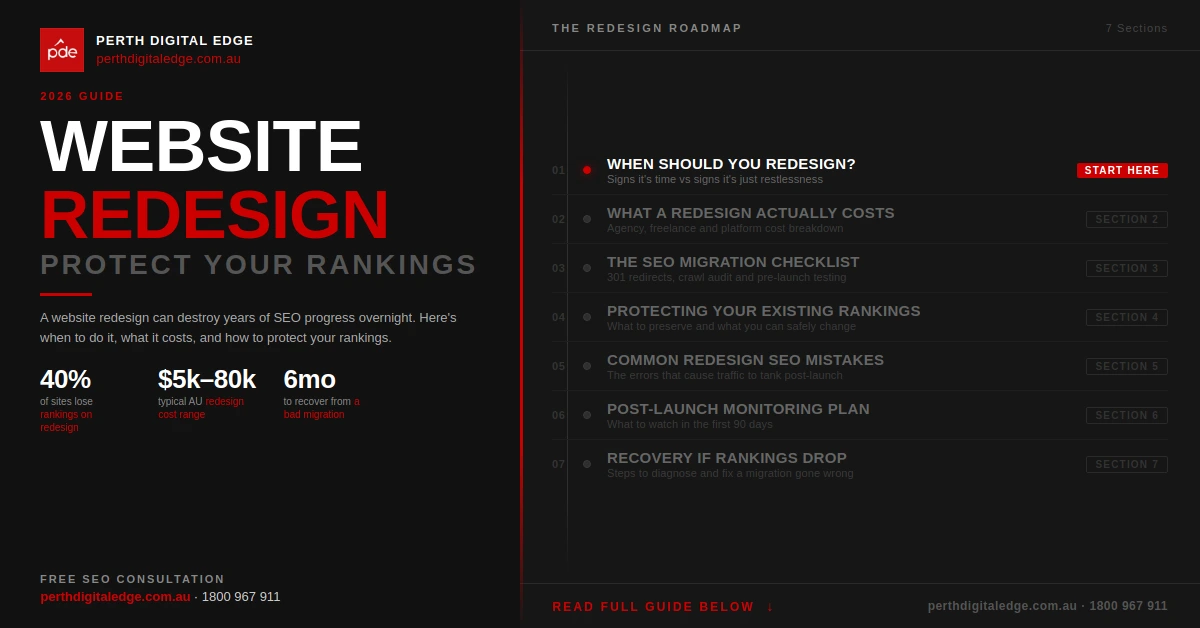
A small business website redesign using a pre-built theme on WordPress or Shopify, with five to fifteen pages, basic contact forms, and standard design elements, typically costs $3,000 to $8,000 in Australia. This covers theme customisation, content migration, mobile optimisation, basic SEO setup, and launch.
A custom development project for a medium business with unique functionality requirements, a content management system tailored to their workflow, integration with booking systems or CRMs, and twenty to fifty pages of custom content creation costs $10,000 to $35,000. The variation depends on complexity. A site with an ecommerce component, client portals, or complex forms sits at the upper end.
Large-scale projects involving enterprise content management systems, extensive custom development, multi-language support, or deep integration with business systems run $35,000 to $100,000 and beyond. Most of our clients do not need this, but occasionally a mid-sized company operating across multiple locations with complex service offerings requires it. The honest conversation we have with every client starts the same way: what does your website need to do, who is your target audience, and what is the simplest build that achieves both? Starting from simplest and adding complexity only where justified keeps budgets grounded in reality rather than aspiration.
What people do not factor in, and what catches them later, is the ongoing cost. A redesigned website is not a finished product on launch day. It needs content updates, security patches, performance monitoring, and continued SEO work. Budget for ongoing maintenance or you will be back in the same position three years from now with an outdated design running on neglected infrastructure.
Ben has a line he uses in proposals that some clients find blunt but nobody has disagreed with: “The redesign is 40 percent of the project. The other 60 percent is what happens after launch.” He started saying that after the Balcatta plumber situation, because that project would have been painless if someone with SEO knowledge had been involved from the beginning rather than called in for emergency surgery afterward.
How To Protect Your Search Rankings During A Redesign
This is the section that justifies the existence of this entire article. Everything above is important. This part is critical. A website redesign that damages your search engine rankings can take months to recover from, and some businesses never fully recover because they cannot survive the revenue gap.
Map Every Existing URL To Its New Equivalent. Before the new site goes live, create a complete spreadsheet mapping every URL on your existing site to where it will live on the redesigned site. Every page. Every blog post. Every PDF. If a page is being removed, decide where its traffic should redirect. If a page is being merged with another, redirect the old URL to the merged page. This is tedious, detail-oriented work that most web designers consider outside their scope. It is the single most important task in the entire redesign process for protecting seo rankings.
Implement 301 Redirects For Every Changed URL. A 301 redirect tells search engines that a page has permanently moved to a new location. It transfers the majority of the old page’s ranking authority to the new URL. If you change your URL structure during the redesign, which happens frequently, and do not implement redirects, Google treats every changed URL as a brand new page with zero authority. Years of accumulated search rankings disappear.
Preserve Your On-Page SEO Elements. Title tags, meta descriptions, header structure, image alt text, internal links, and structured data all need to transfer to the new site. A fresh design does not mean fresh content unless the content was bad. If a page was ranking well with its current title tag and page content, keep them on the same page in the new structure. Do not let a designer rewrite your headings for aesthetic reasons without understanding the SEO implications. This happens more than you would think. We had a web design agency hand us a redesigned site where the designer had rewritten every H1 on every service page to be “creative” rather than descriptive. Every single heading that previously helped search engines understand what the page offered had been replaced with something clever and meaningless. “We Make Water Behave” for a plumber’s blocked drains page. That kind of thing.
Build And Test On A Staging Environment. Never redesign on a live site. Build the new site on a staging environment that search engines cannot access. Test everything there. Check that redirects work. Verify that your google analytics tracking code is installed. Confirm that your google search console verification remains valid. Test site performance on mobile devices. Check that all forms submit correctly. Only when everything is verified should you push to production.
Monitor Performance Aggressively After Launch. The first four weeks after launch are critical. Check google search console daily for crawl errors, indexing issues, and drops in search performance. Watch your google analytics for changes in organic traffic, bounce rate, and conversion rate on key pages. Compare current website performance metrics against the baseline you documented before the redesign. If something drops, identify and fix it immediately rather than waiting to see if it recovers on its own. It usually does not.
We have managed redesign projects where organic traffic increased within two weeks of launch because the new site was faster, better structured, and properly optimised. We have also inherited disaster recoveries where traffic fell 70 percent because nobody followed these steps. The difference is not luck. It is process.
Something Ben started doing after the Balcatta disaster that has become standard practice for us: we create a pre-launch and post-launch monitoring document for every redesign client. It includes a complete URL map, redirect verification steps, a list of every page’s current search rankings and organic traffic, google analytics and google search console benchmarks, and a week-by-week monitoring schedule for the first 90 days. We call it the insurance policy. It adds two to three days to the timeline and saves weeks of emergency recovery. No client has ever complained about the extra time once they understood what it prevents. User engagement metrics like time on page, pages per session, and form completion rates all get tracked against the pre-redesign baseline so we can prove the new site performs better, not just looks better.
Content Strategy During A Redesign
A redesign is the best opportunity you will get to fix your content, because you are already touching every page anyway.
Audit your existing content. Identify pages that rank well and should be preserved exactly. Identify pages with thin, outdated, or duplicate content that should be rewritten. Identify content gaps where you should create content for target keywords you are not currently covering. This content strategy work happens during the redesign process, not after.
Rewrite your product or service descriptions. Update your about page. Refine your brand voice so it is consistent across the new site. Ensure every key page has sufficient, unique content for search engines to understand what the page offers and how it differs from competitors. A redesigned site with the same weak content in a prettier wrapper will rank no better than the old version. The redesign is your chance to optimize user experience and content simultaneously rather than treating them as separate projects.
The Applecross physio clinic used their redesign as an opportunity to publish twelve new condition-specific pages targeting long-tail search queries they had never ranked for. Within five months, those pages were generating 340 organic visits per month and contributing to 28 percent of their online bookings. That content did not exist before the redesign. The redesign created the structure and motivation to build it.
Choosing The Right Approach For Your Redesign Project
Not every website project requires the same approach. Understanding the spectrum helps you spend appropriately.
A website refresh updates visual design elements, photography, and branding while preserving the underlying site structure, URLs, and content. Lower cost, lower risk to search rankings, faster to execute. Suitable when your current site functions well but looks dated.
A strategic website redesign rethinks site architecture, content hierarchy, user flows, and design simultaneously. The entire website’s structure gets rebuilt to better serve your target audience and business goals. Higher cost, higher risk if mismanaged, but higher potential upside. Suitable when your current site has fundamental structural or strategic problems.
A platform migration with redesign adds the complexity of moving between content management systems, such as from Wix to WordPress or from an old custom build to Shopify. This is the highest risk scenario for search rankings because everything changes simultaneously: URLs, site structure, templates, and often content. Requires meticulous redirect planning and post-launch monitoring.
For most small business website projects in Perth, a strategic redesign on the same platform produces the best balance of improvement and risk management. Platform migrations should only happen when the current platform genuinely cannot support your business goals.
There is a fourth category that nobody talks about because it is embarrassing: the redesign that should not have happened at all. A mortgage broker in South Perth paid $14,000 for a full website redesign last year before coming to us. His old site was ugly. No argument there. But it ranked on page one for four competitive keywords and generated eight to ten leads per week. The redesigned site looked professional but the developer changed every URL, added no redirects, and rewrote the page content with generic copy that removed the specific suburb references and case studies that had been driving his search rankings. His leads dropped to two per week. He came to us to fix it and Ben had to tell him that the fastest path back to where he was would still take three to four months. The look on his face when he realised he had paid $14,000 to damage something that was working is not something you forget. Sometimes the right answer is to leave the website’s structure alone and only update the visual layer.
How Long Does A Website Redesign Take?
A small business website redesign typically takes six to twelve weeks from planning through launch. Medium complexity projects run twelve to twenty weeks. Large or custom development projects can extend beyond six months. The planning and content creation phases almost always take longer than clients expect. Rushing the planning to start designing sooner consistently produces worse outcomes and more expensive post-launch fixes.
Will A Website Redesign Hurt My SEO?
It can, significantly, if handled poorly. The Balcatta plumber lost 61 percent of their organic traffic overnight from a redesign that ignored SEO entirely. With proper URL mapping, 301 redirects, preserved on-page elements, and post-launch monitoring, a redesign should maintain or improve your seo performance. The redesign itself is not the risk. Careless execution is.
How Often Should I Redesign My Website?
Most businesses benefit from a full redesign every three to five years, with ongoing minor updates and content additions in between. Technology, web design standards, and user expectations evolve continuously. A site that was current in 2021 may feel outdated by 2025. However, redesigning purely because time has passed is wasteful. Let your performance metrics, user feedback, and business goals determine timing rather than an arbitrary schedule. Monitor your key metrics quarterly. If organic traffic, user engagement, and conversion rates are stable or improving, your current site is doing its job regardless of how old it looks to you.
Should I Redesign My Own Website Or Hire A Professional?
If your own website is a brochure site with five pages and no significant search rankings to protect, a DIY approach using modern templates can work. If your site generates meaningful organic traffic, handles bookings or enquiries, or represents a business with real revenue attached, hire a professional. The risk of a botched redesign is not that the site looks bad. It is that you lose the search visibility that was generating revenue, and rebuilding that visibility costs more than hiring someone to do the redesign correctly in the first place.
Ready To Redesign Without Losing What You Have Built
A successful redesign is not measured by how the new site looks on launch day. It is measured by whether, three months later, your organic traffic is higher, your conversion rate has improved, your site performance is faster, and your search engine rankings are intact or stronger. Everything else is decoration.
At Perth Digital Edge, Ben Tippett and our team manage website redesign projects for businesses across Perth that cannot afford to lose their search visibility during a rebuild. We handle the web design process from initial audit and redesign strategy through to development, content migration, redirect implementation, and aggressive post-launch monitoring of every metric that matters. If you are considering redesigning your website and want it done by people who understand that a beautiful site means nothing if Google cannot find it, talk to us. We will audit your current site, identify what needs protecting, what needs improving, and what it will cost to do both properly.