A Joondalup plumber told me last year that he was getting fewer calls despite ranking on page one for “plumber Perth.” When I pulled up his Google Business Profile, the problem was obvious. His listing showed the wrong phone number, had no reviews from the past eight months, and his business hours still reflected a COVID-era schedule from 2021. Meanwhile, a competitor three suburbs away with a fraction of his experience had a fully optimised profile, 47 recent reviews, and was appearing in Google’s map pack for every “near me” search in the northern corridor. That competitor was getting the calls. It was genuinely frustrating to see, because my client was the better tradesperson by a mile. But Google does not rank businesses on skill alone. It ranks them on signals. And his competitor understood those signals better. That is local SEO in a nutshell.
I am Ben Tippett, founder of Perth Digital Edge, operating from 17 Bonnievale Tce in Wanneroo. Over the past decade, I have built and managed local search engine optimisation campaigns for trades, professional services, hospitality, and retail businesses across Western Australia and nationally. This complete guide to local SEO covers everything a business owner needs to understand about how local searches work, what Google actually rewards, and the specific steps that move your business from invisible to dominant in local search results. What follows is built from years of campaign data, client wins, and the occasional hard lesson learned when Google shifted the goalposts overnight. I have written it for business owners who are tired of generic advice and want to understand what actually moves the needle in local search.
What Is Local SEO And Why Does It Matter?
Local SEO is the process of optimising your online presence so your business appears in search results when people search for products or services in a specific geographic area. When someone types “dentist near me” or “best electrician Subiaco” into Google, the search engine uses a combination of relevance, proximity, and prominence to decide which local businesses to display. That decision determines whether your phone rings or your competitor’s does.
The numbers explain why local SEO important is not an exaggeration. According to Google’s own data, 46% of all Google searches have local intent. Seventy-six percent of people who search for something nearby on their phone visit a related business within 24 hours, and 28% of those local searches result in a purchase. For local businesses, this is the highest-intent traffic available. These are not people casually browsing. They are sitting in a car park in Midland searching for a mechanic, standing in a kitchen in Scarborough with a burst pipe, or scrolling through their phone at a Leederville cafe looking for a physio appointment this afternoon. The intent is immediate and the proximity is everything.
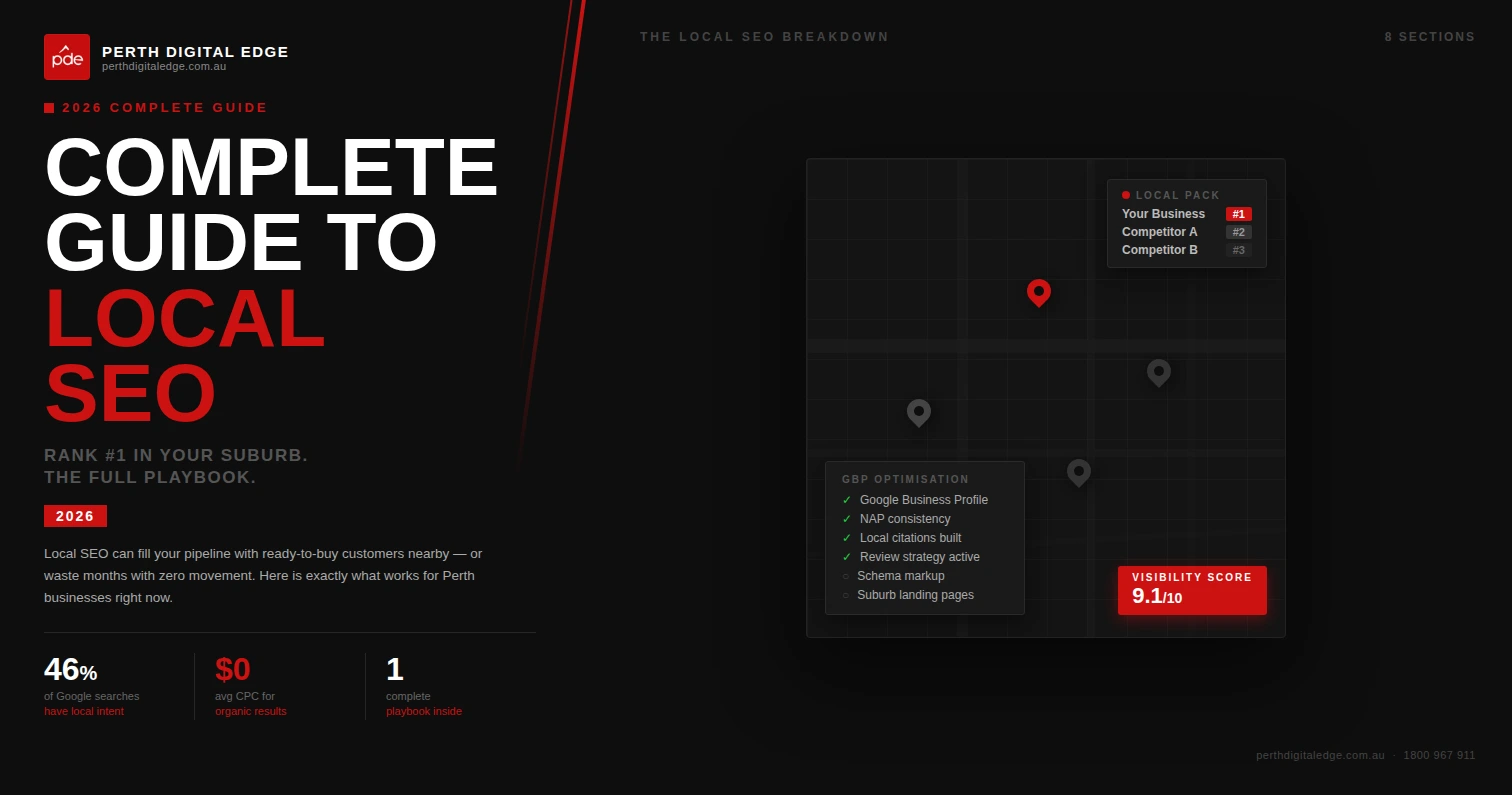
Local SEO works differently from traditional search engine optimisation in several important ways. Traditional SEO focuses on ranking in organic search results nationally or globally. Local SEO focuses on ranking in three specific places: the local pack (the map listing with three businesses that appears at the top of google’s search results for local queries), Google Maps itself, and the local organic results below the map. Each of these has different ranking factors, and a strong local SEO strategy addresses all three.
How Local Search Actually Works
When someone performs a local search, Google evaluates three primary factors to determine which businesses appear in local results. Understanding these factors is the foundation of every effective local SEO strategy we build at Perth Digital Edge.
Relevance measures how well your business listing matches what the searcher is looking for. If someone searches “emergency plumber Joondalup” and your Google Business Profile category is set to “plumber” with service descriptions mentioning emergency work in Joondalup, Google considers you relevant. If your profile says “general contractor” with no mention of plumbing, you are invisible to that search regardless of proximity.
Proximity is how close your physical location is to the searcher or the location specified in their query. You cannot fake proximity, and in a city as spread out as Perth, where a customer in Two Rocks is 90 kilometres from a customer in Mandurah, this matters enormously. But you can ensure Google accurately understands where you operate by maintaining consistent name, address and phone number information across every platform and by specifying your service areas correctly in your profile.
Prominence reflects how well-known and trusted your business is. Google measures this through online reviews (quantity, quality, and recency), local citations across business directories, backlinks from other websites, your overall web presence, and how much engagement your listing receives. A business with 200 genuine reviews, consistent local business listings across 40 directories, and mentions on local resource pages will outrank a competitor with five reviews and no citations, even if the competitor is physically closer.
Optimising Your Google Business Profile
Your Google Business Profile (formerly Google My Business) is the single most important element of local search engine optimisation. It controls what appears in the local pack, in google maps results, and in the knowledge panel when someone searches your business name. If you do nothing else from this guide, optimise this profile thoroughly.
Start with accuracy. Your business name must match your real-world signage exactly. Do not stuff keywords into it. Your address and phone number must be identical everywhere they appear online. Google cross-references your details against local business directories, your website, social profiles, and data aggregators. Any inconsistency creates doubt about your legitimacy in Google’s systems. This concept, often called NAP consistency (name address and phone), is foundational to local search rankings.
Select your primary business category carefully. Google offers hundreds of categories, and the one you choose directly affects which local searches you appear in. A business listed as “electrician” will appear for different queries than one listed as “electrical contractor.” Research which category your top-ranking competitors use and choose the most specific option that accurately describes your primary service. You can add secondary categories for additional services, but the primary category carries the most weight.
Complete every section of the profile. Business hours, service areas, attributes (wheelchair accessible, women-owned, veteran-owned), products and services with descriptions and prices where applicable. Upload genuine photos of your premises, your team, and your work. Businesses with more than 100 photos receive 520% more calls than the average listing according to Google’s own research. Post regular updates through Google Posts to signal that your business is active. We update our clients’ profiles weekly at Perth Digital Edge, and the correlation between posting frequency and local pack visibility is consistent.
Local Keyword Research That Drives Real Traffic
Effective local keyword research goes beyond plugging your service into Google Keyword Planner and hoping for the best. The goal is to identify the specific search terms your local customers actually type when they need what you offer, then build content and optimisation around those terms.
Start with your core services and combine them with geographic modifiers. “Plumber Perth” is obvious. But “blocked drain Joondalup,” “hot water system replacement Wanneroo,” and “emergency plumber near me” represent different stages of local search intent and different opportunities. Use google keyword planner as your baseline for search volume data, then supplement with Google Search Console to see what queries already send impressions to your site. Google’s autocomplete suggestions and the “People also ask” section reveal how real people phrase their local queries, which often differs from what business owners assume.
A free keyword research tool like Google’s Keyword Planner or Ubersuggest can surface relevant local keywords you are missing entirely. When we took over SEO for a Balcatta physiotherapy practice, their site targeted “physiotherapy Perth.” Keyword research revealed that “sports physio near me,” “neck pain treatment Stirling,” and “bulk billing physio Balcatta” collectively had three times the search volume of their primary keyword. They were optimising for the wrong terms. We restructured their content around the keywords their actual local audience was using, and organic traffic increased 118% within four months.
Target local keywords across different intent levels. Informational queries like “how much does a roof restoration cost in Perth” attract people early in the customer journey. Commercial queries like “best roofer Joondalup” capture people comparing options. Transactional queries like “roof repair Wanneroo quote” capture people ready to buy. A robust local SEO strategy creates content for each intent level, building a path that guides potential customers from research to contact.
On-Page Optimisation For Local Search
Your website is the foundation that supports every other local SEO effort. Without proper on-page optimisation, your Google Business Profile improvements and citation building will underperform because Google uses your website to verify and reinforce the signals from your profile.
Title tags and meta descriptions should include your target local keywords naturally. “Emergency Plumber Joondalup | 24/7 Service | Perth Digital Edge” tells both Google and the searcher exactly what the page offers and where. Every service page should target a specific service-plus-location combination. If you serve multiple suburbs, create dedicated pages for each area with unique content that references local landmarks, service area specifics, and customer needs particular to that community. Thin, duplicated location pages with only the suburb name swapped out will be ignored or penalised by search engines. I see this constantly with Perth businesses that serve suburbs from Yanchep to Rockingham. They create 30 pages that are carbon copies with the suburb name changed. Google sees through it immediately.
Implement LocalBusiness schema markup on your website. This structured data tells search engines your business name, address, phone number, opening hours, service area, and business type in a format they can parse directly. Schema does not guarantee a ranking improvement, but it removes ambiguity and helps Google connect your website to your Google Business Profile with confidence. At Perth Digital Edge, every client site includes schema markup as standard. It is one of those local SEO tactics that takes 30 minutes to implement and pays dividends indefinitely.
Embed a Google Map on your contact page and ensure your full address and phone number appear in the footer of every page. Internal linking between your service pages, location pages, and blog content creates a network that helps Google understand the geographic and topical scope of your business. These are not glamorous changes. They are the structural fundamentals that every winning local SEO strategy is built on.
Building Local Citations And Business Listings
Local citations are mentions of your business name, address, and phone number on other websites, typically in local business directories, industry-specific listings, and data aggregators. Citations serve as third-party confirmation that your business exists, operates at the listed address, and provides the services you claim. They are a significant ranking factor for the local pack.
Start with the top local business listings that carry the most authority in Australia. These include Google Business Profile, Apple Maps, Bing Places, Yellow Pages, True Local, Hotfrog, StartLocal, and industry-specific directories relevant to your trade. A plumber should be listed on HiPages and ServiceSeeking. A restaurant should be on TripAdvisor, Zomato, and Dimmi. A medical practice should be on HealthEngine and HotDoc. The common thread is that every listing must show the same business name, same address, and same phone number. Even minor variations, like “St” versus “Street” or a different mobile number, create inconsistency that weakens your local SEO performance.
Data aggregators distribute your business information to hundreds of smaller directories simultaneously. In Australia, services like Localeze and Data Axle feed information to platforms that would take months to update individually. Getting your NAP correct in these aggregators cascades accuracy across the broader directory ecosystem. At Perth Digital Edge, citation cleanup is often the first task we perform for new clients because the downstream impact on local search rankings is immediate and measurable.
Online Reviews And Reputation Management
Online reviews are not optional in local SEO. They are a direct ranking factor for the local pack and the single most influential element in a potential customer’s decision to click your listing over a competitor’s. Google has confirmed that review quantity, review quality (star rating), and review recency all influence local rankings. A business with 150 reviews averaging 4.7 stars will consistently outrank a business with 12 reviews averaging 5 stars.
Build a systematic process for requesting reviews. After every completed job or appointment, send a direct link to your Google review page. Make it easy. A text message with a one-tap link converts at significantly higher rates than an email asking someone to “find us on Google and leave a review.” Respond to every review, positive and negative. Google tracks response rates, and potential customers read your responses to gauge how you handle feedback. A thoughtful response to a negative review often builds more trust than a dozen five-star ratings.
We helped Castle Security in Landsdale implement a post-installation review request process. Within six months, their Google reviews grew from 23 to 89, their average rating improved from 4.2 to 4.7, and their visibility in the local pack for security-related searches across Perth’s northern suburbs increased measurably. Reviews compound. There is something deeply satisfying about watching a client’s listing climb from the middle of page two into the map pack, knowing that each of those reviews represents a real customer who took 60 seconds to share a genuine experience. That is the kind of organic growth no amount of ad spend can replicate.
Link Building For Local SEO
Link building in a local context is different from traditional SEO link building. The goal is not to accumulate high-authority backlinks from international publications. It is to earn relevant links from websites that signal your geographic and industry relevance to search engines.
Local link opportunities exist everywhere once you know where to look. Sponsoring local community events like the Wanneroo Agricultural Show, a junior football team at Kingsway Reserve, or a charity fundraiser at the Joondalup Resort typically earns a link from the organisation’s website. Joining your local chamber of commerce or business association earns a directory link from a trusted local domain. Contributing expert commentary to a local news outlet or writing a guest article for a local resource page earns editorial links that carry significant weight. Every link from a locally relevant source reinforces Google’s understanding that your business is an established part of the local community.
At Perth Digital Edge, we build local links for clients through a combination of community involvement, local PR, supplier and partner cross-linking, and industry directory submissions. For a Joondalup building company, we secured links from three local sporting organisations, the Wanneroo Business Association, and two local news features. The combined impact moved them from position 8 to position 2 in the local pack for their primary keyword within 90 days. Local link building is slower than buying links from a broker, but the results are durable and the risk of penalty is zero.
Google Search Console And Performance Tracking
You cannot improve what you do not measure. Google Search Console is a free tool that shows you exactly which queries bring your site impressions and clicks, which pages rank for local queries, and where technical issues might be suppressing your visibility. Every local SEO audit we perform at Perth Digital Edge starts here.
A google search console audit reveals which local keywords you already rank for, often in positions you did not expect. You might discover your site appears on page two for “accountant Subiaco” despite never specifically targeting that term. That is an optimisation opportunity: strengthen that page with additional local content and internal links, and you may move from page two to the local pack with minimal effort.
Track your local SEO performance across three dimensions: local pack visibility (how often you appear in the map results), organic local rankings (where you rank in the standard organic results for local queries), and conversion metrics (calls, direction requests, website visits, and messages from your Google Business Profile). Google Business Profile Insights provides the last set of data directly. At Perth Digital Edge, we combine Search Console data, GBP Insights, and google analytics into a unified monthly report so clients see the complete picture of their local search visibility and can connect ranking improvements to actual business outcomes.
Local SEO For Businesses With Multiple Locations
If your business operates from more than one physical location, each location needs its own Google Business Profile, its own set of local citations, and its own location page on your website. A chain of three dental practices across Perth cannot rely on a single profile and expect to rank in the local pack for searches near each clinic.
Each location page on your website should contain unique content specific to that location: the street address, local phone number, embedded Google Map, specific team members who work there, photos of that specific premises, and content that references the surrounding local area. Avoid templated location pages where only the suburb name changes. Google recognises thin duplicate content and will suppress those pages in search results. At Perth Digital Edge, we have seen multi-location businesses double their aggregate local traffic by replacing five identical template pages with five genuinely unique location pages, each with local testimonials, area-specific service descriptions, and original photography.
Common Local SEO Mistakes That Cost You Rankings
After auditing hundreds of local business profiles and websites over the past decade, the same mistakes surface repeatedly. Avoiding these is often more impactful than adding new tactics, and honestly, some of them will make you wince because they are so preventable.
Inconsistent NAP information across the web is the most common and most damaging issue. If your website says “17 Bonnievale Terrace” but Yellow Pages says “17 Bonnievale Tce” and your Facebook page lists a mobile number instead of your landline, Google loses confidence in your listing accuracy. Audit every instance of your business information online and standardise it.
Ignoring reviews or, worse, faking them. Google’s systems are sophisticated enough to detect review patterns that suggest manipulation. A sudden influx of 20 five-star reviews from accounts with no review history triggers filters that can suppress your listing entirely. Build reviews organically and steadily. Respond to criticism professionally. I know it stings when someone leaves a one-star review that feels unfair, especially when you have poured years into building your reputation. But how you respond publicly says more about your business than the review itself ever could.
Neglecting your website while focusing exclusively on your Google Business Profile. The two work together. A strong GBP listing that links to a slow, outdated website with no service pages and no local content will underperform because Google uses your website to verify the claims made in your profile. Your website is the evidence that backs up your listing.
Choosing the wrong primary category. This single selection has an outsized impact on which searches you appear in. If you are an air conditioning installer listed as “HVAC contractor,” you may be invisible to searchers typing “aircon installation near me.” Research the categories your top-ranking competitors use and choose accordingly.
Local SEO Tools We Use And Recommend
The right local SEO tools make the difference between guessing and knowing. Here are the platforms we rely on at Perth Digital Edge for managing local SEO campaigns.
Google Business Profile Manager is the command centre for your listing. Google Search Console is essential for understanding which queries drive impressions and clicks. Google Analytics tracks what visitors do after they land on your site. Google Keyword Planner provides baseline search volume data for local keyword research. Ahrefs or SEMrush handles competitive analysis, backlink monitoring, and keyword tracking at scale. BrightLocal is a specialist local SEO platform that automates citation audits, review monitoring, and local rank tracking. For businesses managing their own local SEO efforts, the combination of Google’s free tools (GBP, Search Console, Analytics, Keyword Planner) covers the fundamentals without any software cost.
How Local SEO Connects To Google Ads
Local SEO and google ads are not competitors. They are complementary channels that reinforce each other when managed together. At Perth Digital Edge, we run both for the majority of our local business clients because the combined impact exceeds what either channel achieves alone.
Research consistently shows that having both a paid ad and an organic listing visible for the same local search increases total click-through rate by 25% to 35% compared to organic alone. Your Google Ads data also reveals which local keywords convert at the highest rates, which directly informs your local SEO strategy. If your paid campaigns show that “emergency electrician Joondalup” converts at 12% while “electrician Perth” converts at 3%, that data tells you exactly where to focus your organic local SEO efforts for maximum return. The two channels share intelligence that makes both more effective.
Frequently Asked Questions
The questions Australian business owners ask most often about local search engine optimisation.
How Long Does Local SEO Take To Show Results?
Google Business Profile optimisations can impact local pack visibility within days. Citation building and cleanup typically takes four to six weeks to propagate across directories and data aggregators. Content and on-page changes usually take two to three months to influence local rankings significantly. A comprehensive local SEO strategy that combines all elements generally shows measurable improvement within 90 days, with results compounding over the following six to twelve months.
Can I Do Local SEO Myself?
Absolutely. Claiming and optimising your Google Business Profile, requesting reviews, and ensuring NAP consistency across directories are tasks any business owner can handle. The local SEO tips in this guide are designed to be actionable without agency support. Where professional SEO services add value is in keyword research at scale, technical website optimisation, competitive analysis, link building strategy, and the ongoing monitoring and refinement that turns initial improvements into sustained local search visibility.
What Is The Difference Between The Local Pack And Organic Results?
The local pack (also called the map pack or google’s map pack) is the box showing a map and three business listings that appears near the top of search engine results page for searches with local intent. It is driven primarily by your Google Business Profile, reviews, and citations. Organic search results appear below the local pack and are driven by your website’s content, backlinks, and technical SEO. A strong local SEO strategy targets both because they have different ranking factors and capture different types of clicks.
Do I Need A Physical Location To Rank In Local SEO?
You need a legitimate business address to create a Google Business Profile. Service-area businesses like plumbers, electricians, and cleaners who travel to customers can hide their physical address and specify service areas instead. This is perfectly acceptable and these businesses regularly appear in the local pack for searches within their service radius. What you cannot do is create listings with fake addresses. Google verifies physical locations and will suspend profiles that fail verification.
How Do Other Search Engines Handle Local SEO?
While Google dominates search in Australia with over 93% market share, Bing, Apple Maps, and other search engines also serve local results. Bing Places for Business works similarly to Google Business Profile. Apple Maps draws from Apple Business Connect. Optimising for these platforms follows the same principles: accurate NAP information, complete profiles, and consistent local citations. The effort is minimal because the data is largely the same, and appearing in Bing and Apple Maps captures the segment of local searches that happen outside Google.
Start Building Your Local Search Visibility Today
Leveraging local SEO is not a one-off project. It is an ongoing discipline that compounds over time. Every review, every citation, every piece of locally relevant content strengthens your presence in local search results and makes it progressively harder for competitors to displace you. The businesses that commit to a strong local SEO strategy today are the ones that dominate their local area for years. If you are a business owner who wants more local customers finding you through Google, the steps in this guide give you a clear starting point. If you want professional support to accelerate the process, Perth Digital Edge builds and manages local search engine optimisation campaigns for businesses across Australia. We handle Google Business Profile optimisation, citation building, local keyword research, on-page SEO, link building, and performance tracking so you can focus on running your business while your local SEO rankings improve month over month. Contact Perth Digital Edge for a free local SEO audit.