If you are reading this, you’re probably in one of two moods.
Mood one is hopeful. You’re investing in SEO services, you’re building pages, and you can feel there is demand in Perth. You just want your site to show up when people search online.
Mood two is fed up. You have published content, paid invoices, received reports, and still cannot point to the web pages that reliably produce calls, quote requests, or bookings. That frustration is fair. This part of search engine optimisation looks easy from the outside, and quietly burns months when it’s mis-aimed.
Perth Digital Edge works from Wanneroo, and the pattern is consistent across Perth businesses. When things stall, it is rarely “we didn’t write enough”. It is usually one of these: the page does not match the search query, the site structure is confusing for web crawlers, the page speed is poor on mobile devices, or the conversion path is unclear.
If you are still deciding whether your industry really needs SEO, read Businesses That Need SEO. If you are pressure-testing providers, use Best SEO Companies In Perth (2026). If budget is the sticking point, SEO Pricing In Perth WA (2026) breaks down what is usually included at each tier.
The Perth Reality Check Before We Define Anything
Before we talk definitions, do this two-minute test.
Open Google on your phone. Search for your main service plus a suburb you actually want. Try “electrician Joondalup”, “roof repairs Canning Vale”, “accountant Osborne Park”, “jeweller Perth”, or the closest version for your business. Now look at the first page of search engine results pages.
Ask two blunt questions.
Do you have a relevant page that deserves to rank for that search term, or are you hoping Google will stitch together meaning from unrelated pages?
If you were a customer in a hurry, would you click your site and know what to do next within 10 seconds?
If either answer is “not really”, you do not have a content problem in the “we need more blog posts” sense. You have a content for SEO services system problem: the wrong page types, weak page SEO, unclear internal linking, and pages that do not match user intent.
What SEO Content Is
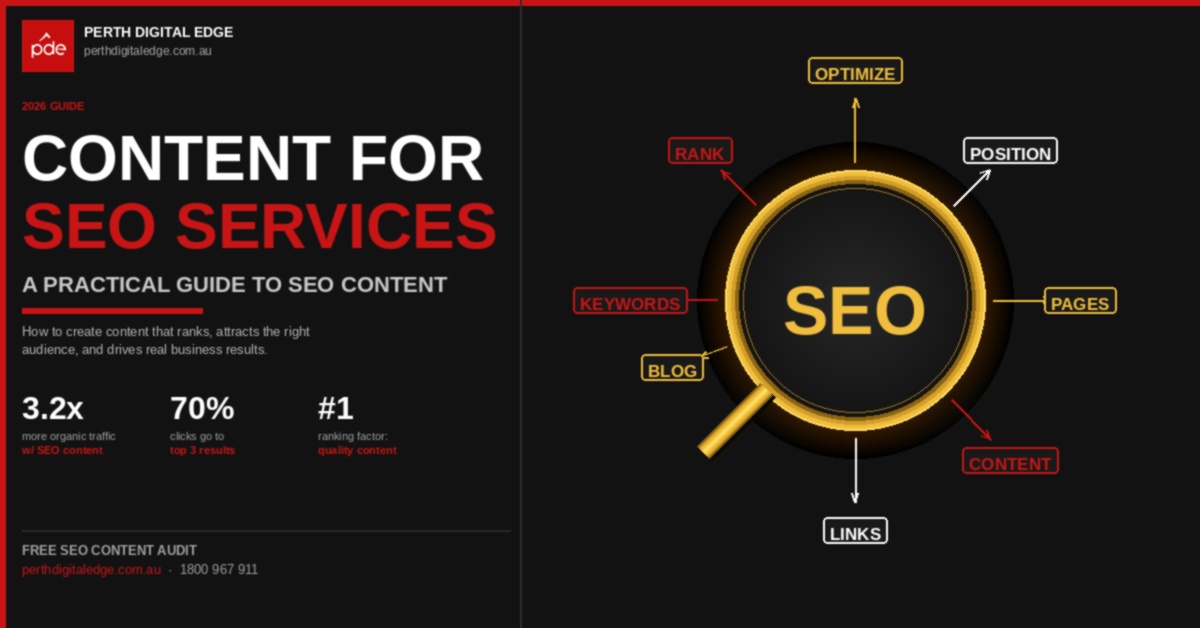
SEO content is content created with a clear purpose in search engine optimization: help a given page appear in search results for user queries, then help the visitor complete a specific action.
That includes the words on the page, but it also includes the parts that help search engines understand the page: page title, title tags, meta titles, the meta description tag, headings, internal linking, and supporting elements like alt tags and logical page structure.
It is also not just blog posts. Content for SEO services includes service pages, landing pages, category pages, product pages for ecommerce websites, guides, lists, FAQs, and the site structure that connects them. When those pieces work together, search engines understand the site faster, and visitors take action sooner.
Why Content Is Important For SEO
Content matters because search engines do not rank businesses, they rank pages. A brand can be excellent offline and still be invisible online if its web pages do not match search terms and user intent.
Good SEO content usually does three practical jobs.
It gives search engines enough context to return your page for relevant search results.
It reduces friction for the visitor so they do not bounce back to Google’s search results.
It gives you more entry points into the site, which means more search queries can land on the right page, not just your home page.
In Perth, this has a local SEO layer. People rely on local searches, Google Business Profile signals, online reviews, and quick shortlists. They are not reading a dissertation. They are scanning, comparing, and deciding.
The Different Types Of SEO Content And When They Win
Different page types win different kinds of search intent. Mix them up and you can publish a lot, then still stall on search engine rankings.
Blog Posts
Blog posts work best for informational user intent and early-stage research. They capture questions, concerns, comparisons, and “how does this work” searches.
The make-or-break detail is what happens next. A blog post should point, via internal links, to a relevant service page or a landing page that converts. Without that, you might earn website traffic, but you will not earn paying customers.
A Perth example: a plumbing article that explains why hot water systems can fail faster near coastal suburbs, and what to check before calling, often holds user engagement better than a generic explainer. It matches real user queries and it sounds like it was written by someone who has seen the jobs.
Service Pages
Service pages are where commercial intent lives. They should target relevant keywords tied to “do the thing” searches, not broad education.
A good service page answers, quickly: what you do, who it’s for, where you operate, what influences cost of the job, and how to book. If your opening and closing paragraphs are vague, or the call to action is buried, you can rank and still lose the lead.
Category Pages And Content Hubs
Category pages and hubs are the glue that holds site structure together. They are not filler pages. They organise relevant pages into silos that help search engines understand relationships and help visitors navigate.
A hub also prevents cannibalisation, where multiple relevant pages fight each other for the same search query and Google cannot tell which one should win.
Product Pages For Ecommerce Websites
Product pages and category pages serve transactional intent. Ecommerce SEO content needs more than features. It needs context above the fold, clean product descriptions, and a structure that avoids duplication from filters, sorting, and parameter URLs.
If your ecommerce website creates the same content across multiple URLs, web crawlers waste crawl budget, keyword rankings fragment, and your best products do not get the visibility they deserve.
Landing Pages
Landing pages are built to convert. They can support paid ads and they can rank organically when the page matches search intent.
The common Perth mistake is creating dozens of suburb landing pages with the same content, swapping place names. That creates duplicate content, thin relevance, and low trust. A location page should exist only when it adds relevant information the target audience actually cares about.
Guides, Lists, And Articles
Guides win when the query expects depth and clarity. Lists win when the query expects options and comparisons. Articles win when the tone needs to be formal and structured.
These formats can also earn a featured snippet when the answer is clear, structured, and placed early, which can lift click-through even when the SERP is busy.
FAQs
FAQs are not decoration. They are an efficient way to capture secondary search terms, address objections, and support snippet-style search engine results.
A good FAQ section mirrors what your customers ask on calls and in quotes, not what an SEO tool guesses people might ask.
Keyword Research: The Filter That Stops You Writing The Wrong Page
Keyword research is not just “find keywords”. It is deciding which search term belongs on which page type, based on user intent and what Google is already ranking.
A practical keyword strategy for content for SEO services looks like this.
Use Google Keyword Planner to sense search volume and variant keyword phrases.
Use Search Console to find pages sitting in positions 4 to 12 where small changes can shift search rankings.
Review the search engine results page manually for your target keyword, because the SERP tells you what content type Google prefers.
Group relevant keywords by intent, not by a vague topic label.
Map one primary keyword to one page, then support it with internal linking from relevant pages in the same silo.
This is how you avoid the most common “Perth business” error: trying to rank one “Services” page for everything.
Search Intent: The Difference Between A Page That Ranks And A Page That Converts
Search intent is the reason someone typed the query. Search engines are trying to satisfy intent, not reward keyword density.
You will see four recurring intent patterns in Google search.
- Informational: looking for answers.
- Navigational: looking for a specific business or brand.
- Commercial: comparing options.
- Transactional: ready to buy, call, book, or request.
Here’s the field note that makes this feel less like a textbook. The SERP is a free brief. Google’s search results show you what it believes the user wants. If the first page is dominated by service pages and map listings, a guide will usually struggle. If the first page is dominated by guides and definitions, a service page will usually struggle.
That is why SEO writing should begin with the SERP, not a blank document.
Site Structure: How Pages Become A System Instead Of A Pile
A clean site structure is not “nice to have”. It determines whether search engines understand your site and whether internal linking actually does its job.
A simple structure that works for most Perth businesses looks like this: home page, service hubs or category pages, service pages and supporting pages, then blog posts and guides that support the commercial pages.
This matters because internal linking spreads relevance and authority. If your best pages are buried behind five clicks, or your navigation makes no sense, search engines struggle to interpret what is important.
Perth adds another layer. Suburb intent is real, but suburb pages should be created selectively. If you scale local optimisation with thin copy, you create same content footprints across the site and invite duplicate content issues.
Page Structure And On Page SEO: What A Strong Page Looks Like
On page SEO is not “add keywords”. It is shaping a web page so search engines understand it and a human can act.
A page that performs tends to have one clear page title and H1 aligned to the main keyword and user intent, a logical heading structure using H2 and H3, title tags written for relevance and clicks, a good meta description tag that earns the click, and internal linking that connects to relevant pages.
It also needs basic hygiene. Broken links, redirect chains, messy canonicals, and accidental duplicates slow down indexing and weaken SEO rankings. This is where SEO tools like Screaming Frog and Search Console earn their keep, because they reveal problems you cannot “feel” by browsing the site.
Website speed is another reality check. A page can feel fine on office Wi-Fi and feel awful on a phone in outer suburbs with variable NBN performance or mobile connections. If your hero loads late, your visitor leaves before your message appears, and you never get the chance to convert.
If you want to make page speed actionable, focus on the common culprits: oversized images not served as WebP, render-blocking scripts, too many plugins, fonts causing layout shift, slow hosting response, weak caching, and third-party widgets that delay interaction.
Copywriting For SEO Content: How To Write Like A Human And Still Win Google
SEO copywriting is writing content that matches user intent and still persuades a person. It is not writing an “SEO article”. It is writing a page that does the job the searcher came for.
Answer early, then expand. If the query is “how long does roof restoration take”, give a clear range early, then explain the variables.
Use the customer’s language. Keyword research exists because the words businesses use are often not the words people search.
Make the next step obvious. Even informational pages should connect to a logical action through internal links.
Avoid keyword stuffing. It rarely improves search engine rankings and it almost always makes writing content worse for real people.
If you want a practical way to keep this sharp, watch the Google Search Central Blog for guidance on what search engines reward, then apply it through clarity, not jargon. Your target audience can smell a fake a mile away, and Google’s systems are increasingly good at spotting thin pages that say a lot but explain nothing.
Off Page SEO: Why Content And Link Building Still Work Together
Off page SEO includes link building, mentions, and authority signals from other websites. In many competitive Perth categories, you will not win on page SEO alone.
Content supports off page SEO because links follow value. If you publish authoritative content, it is easier to earn quality backlinks. If your site is thin, outreach becomes awkward and often drifts into low-quality patterns that hurt domain authority instead of building it.
Before you chase new links, make sure internal linking and site structure are clean. Otherwise you earn authority and then waste it.
Measuring SEO Content With Search Console And Google Analytics
If content is not measured, it becomes a publishing habit.
Use Search Console to track which search terms trigger impressions, clicks and CTR by page, indexing problems and duplicates, and keyword performance movement after updates.
Use Google Analytics to track organic traffic to key landing pages, user engagement, conversion paths, and which pages produce forms, calls, bookings, or sales.
Here’s the emotional reality behind the data. Most businesses are not annoyed by hard work. They’re annoyed by “reporting” that never answers the obvious question: which pages are producing enquiries, and which pages are just taking up space.
First Party Proof From Perth Digital Edge Case Studies
This is where theory meets the real world.
Project Concrete is a good example of what happens when the basics are fixed early and the plan is intent-led, not random. The case study reports a 312% increase in website traffic in three months, 62 conversions in the first month, and 14 first page keywords in the first month. Results move that early when technical SEO barriers are removed, the right landing pages exist, internal linking is deliberate, and tracking in Search Console and Google Analytics is set up from day one.
Westside Auto Wholesale shows what “system” really means at scale. The case study reports 4,900% ROI, 1.4M visitors in 2023, 120,000+ leads in 2023, plus 81 keywords in the top 3 and 124 of 130 niche terms on the front page. That is not one clever blog post. It is disciplined structure, pages built to match search queries, ongoing measurement, and decisions that compound.
Fremantle Roofing Services is the trade pattern Perth businesses recognise immediately. The case study reports a 300% increase in qualified leads. Trade SEO tends to be brutally honest. Local searches are high intent, and the combination of Google Business Profile, credible service pages, and clear conversion paths usually decides who gets called.
Stelios Jewellers is the reminder that retail intent is mixed. People research online, compare, then buy. That pushes the content approach toward strong category architecture, clean product and service pages, and supporting content that answers commercial questions without bloating the page.
Those numbers are not magic. They are the outcome of structure, relevance, and measurement working together.
Frequently Asked Questions
These are the questions we hear most often when businesses start creating content for SEO services and want to know what actually matters.
What Is SEO Content?
SEO content is any content created to help pages appear in search engine results for relevant user queries. It includes SEO content writing for blogs, service pages, landing pages, and ecommerce websites, plus the site structure and internal links that help search engines understand your site.
What Should I Create First For SEO?
Start with the pages tied to revenue: service pages, key landing pages, and essential category pages. Then build supporting pages based on keyword research, user intent, and Search Console opportunities.
Do Blog Posts Still Help Local SEO?
Yes, when they support local searches and feed internal links into the service pages that convert. Random blog posts without internal linking are usually busy work.
How Do I Avoid Duplicate Content With Suburb Pages?
Only build location pages when they add relevant information. Copy-paste suburb pages create duplicate content risk and often fail to hold user engagement. Use a stronger hub structure and selective pages where justified.
How Do I Know If SEO Content Is Working?
In Search Console, you should see improved impressions and clicks for relevant search terms and stable indexing. In Google Analytics, you should see more organic traffic landing on the right pages and completing tracked actions.
Build Content That Perth Searchers Trust
If you want the simplest summary, here it is. The goal is not to publish “more”. The goal is to publish the right page for the right search term, with a site structure that helps search engines understand it, and a conversion path that makes sense to a human.
If you want a Perth-specific content plan, book a free SEO consultation with Perth Digital Edge. We will review your site structure, Search Console data, key landing pages, internal linking, and the pages currently losing clicks on the search engine results pages, then map what to fix first and what to create next.
Book Your Free Consultation And Get A Perth Specific SEO Content Plan.