

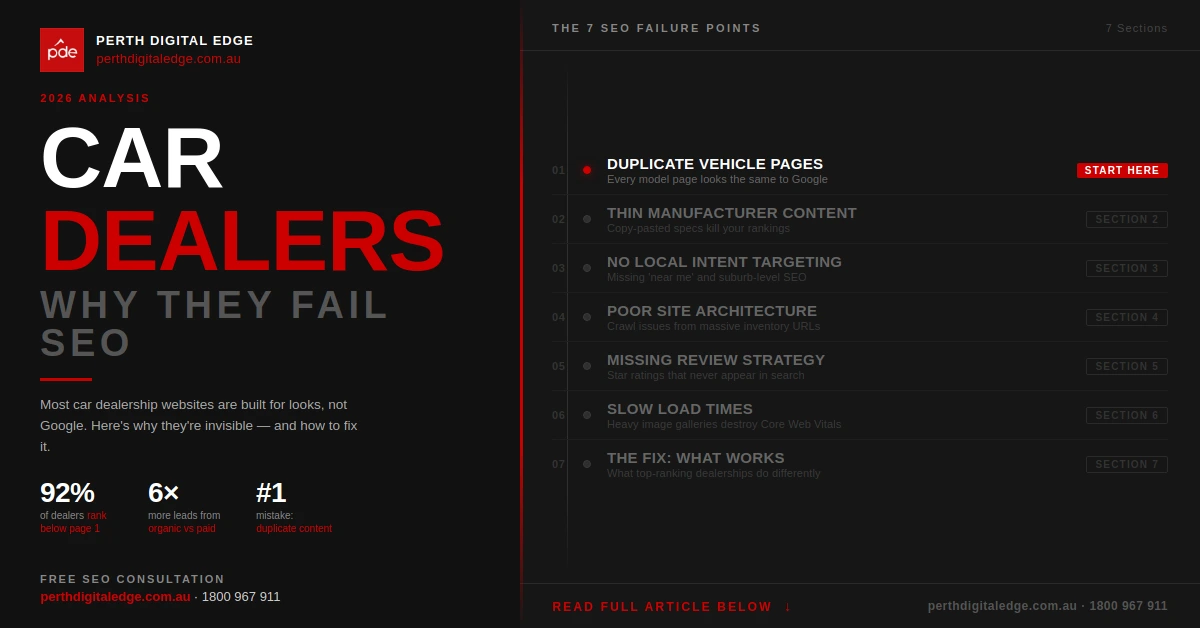
Most dealers do not have a traffic problem because people stopped researching vehicles online. The opposite is true. Car buyers in Perth are comparing pricing, checking stock listings, reading Google reviews, and searching for a test drive before they ever visit a yard. The massive opportunity is right there. The issue is that most dealership websites are still built like digital brochures rather than search-ready sales tools.
My name is Ben Tippett. I run Perth Digital Edge from Wanneroo, and the automotive vertical is where some of our sharpest results have come from. When Westside Auto Wholesale came to us, they were one of Perth’s largest used car dealers but barely visible on Google. Competitors with weaker stock were outranking them. Within a year, we had 124 of 130 target keywords on page one, 81 in the top 3, 1.4 million visitors, and over 120,000 leads. That gap is exactly why most car dealership websites fail at SEO. The demand exists. The site just was not built to capture it.
The Search Behaviour Has Changed Faster Than Dealer Websites
The way customers shop for a car has changed, especially in Perth where buyers cover ground from Rockingham to Joondalup comparing stock before deciding. The online shopping experience customers expect is faster and more detailed than what many car dealer websites provide. They want vehicle detail pages that load quickly, make key features obvious, show trust signals, and give them a clear path to book a test drive.
Many dealership websites are tied to rigid website providers, thin inventory management systems, outdated websites, and templates that make every vehicle page identical. The data reaffirms this: most dealers assume the platform handles the hard part. It does not. It may load stock, but it does not create local SEO strength, strong search rankings, or a structure that helps search engines understand the difference between one car, one service, and one page.
Most Inventory Pages Are Too Thin To Compete
Inventory pages should be one of the strongest parts of a dealership site. Instead, they are often the weakest.
Many stock listings are generated automatically with very little original information. The vehicle detail page may include make, model, year, and a short equipment list, but that is rarely enough to stand out in search results. Thin vehicle detail pages with repeated wording and no local context struggle to compete.
This is what we found at Westside Auto. Every listing looked the same. No suburb-level targeting, no buyer-intent copy, no differentiation between a Mazda CX-5 and a Toyota HiLux beyond the specs. We restructured those pages so each targeted specific long-tail search terms by make, model, and category, and added schema markup so Google could interpret pricing and vehicle detail properly. That restructuring pushed 124 niche keywords to page one. Same stock, presented in a way search engines could actually rank.
Poor Website Performance Kills Trust Before SEO Can Help
A lot of dealer websites fail before the buyer even reads the page. Poor website performance does that.
If a site is slow on mobile devices, jumps around as images load, or takes too long to show stock, people leave. That is not just a customer experience issue. It is an SEO issue. Page speed, visual stability, and broader Core Web Vitals all influence how usable the site feels. Search engines care about that because bad experience produces bad outcomes. A low performance score in PageSpeed Insights signals to Google that the page is not ready to serve real buyers. Broken links, missing images, and layout shifts compound the damage across search results pages.
This matters because researching vehicles online now happens heavily on phones. If your site is not mobile friendly, if it loads poorly on both mobile and desktop, or if a vehicle page becomes frustrating before the customer reaches the price, then SEO is sending traffic into a broken experience. We tested just seven websites from the same dealer platform provider in Perth and found that none passed the Core Web Vitals pass rate threshold on mobile. That is not a dealer problem. It is a platform problem.
Local SEO Is Often Treated As An Afterthought
Car buyers are not always searching in broad national terms. A lot of searches carry local intent. In Perth, that means “used car dealer Rockingham,” “SUV for sale Midland,” or “test drive Joondalup.” People want reassurance the business is established locally and trusted by other customers.
Most dealers underuse local SEO. They may have a Google Business Profile, but it is not connected to the site properly. They may have positive Google reviews, but those reviews are not supported by location specific pages. Happy customers are leaving signals across the web, but the site does nothing to bring those trust signals inward. At least one platform provider we have reviewed in the Perth market offers no built-in support for suburb-level landing pages at all.
Westside Auto’s local SEO was almost non-existent when we started. We built geo-targeted landing pages for their catchment areas across Perth’s southern suburbs, aligned the Google Business Profile, and made sure local events and community presence were reflected on the site. That local layer helped turn “used cars Perth” from a page-3 position into a number-one ranking.
Many Dealer Sites Are Built For Feeds, Not For Search Engines
A lot of dealership websites are built to ingest stock feeds and keep inventory management simple. That solves one problem but creates another. The site becomes good at storing data points and weak at turning those data points into pages search engines understand.
This is where structured data and schema markup matter. Without that layer, many dealer websites remain technically visible but strategically weak. AI tools and AI platforms are making it easier for competitors to generate content at scale, which means the bar for useful pages is rising. Dealers who rely on auto-generated feed pages are falling further behind each consecutive year.
Over-Reliance On Paid Ads Hides SEO Weakness
A lot of dealers can still generate traffic because they spend heavily on paid ads. That can mask deeper problems.
Paid ads are useful for fast visibility and promotions. But when a car dealership relies solely on paid ads while organic search stays weak, the business is more exposed than it realises. Every click has a cost. Every campaign pause hurts.
Organic search results support a steady flow of local buyers and used car visibility without forcing the dealership to pay for every visit. Westside Auto ran paid ads alongside their SEO campaign, but we restructured the paid side too, separating inventory into dedicated ad groups with call tracking. Paid ads effectiveness improved 13%. But the organic channel grew to deliver the majority of 120,000 leads. That is the shift: from paid dependency to organic strength.
Trust Signals Are Often Weak Or Buried
People want reassurance before buying a car. They look for positive reviews, visible contact details, strong Google Business Profile signals, and social proof. A dealership page that feels anonymous will struggle to build stronger engagement, even if the vehicles are competitive.
Jay Wolfe Honda in the US became a well-known case study for this: transparent pricing, visible reviews, and a customer experience that extended from showroom to website. The principle applies just as strongly in Perth. If your dealership has strong Google reviews or community involvement, that should be part of the site. Trust is not optional in automotive SEO. It is part of the path from search to sale.
Why Website Providers Often Hold Dealers Back
Not every problem sits with the dealership itself. Sometimes the biggest issue is the platform.
Many website providers in the automotive space prioritise standardisation over performance. Templates are locked down. Technical fixes are slow. Schema markup is limited. Core Web Vitals are poor. The SEO team can only optimise what the platform allows.
If the platform cannot support better technical SEO, cleaner local SEO, or stronger vehicle detail pages, the dealership is working against itself. Platform choice is not just a web decision. It is a visibility decision. For potential customers who never see the site because it cannot rank, it is a sales decision too.
What Better Dealer SEO Actually Looks Like
Good automotive SEO starts with a site that is fast, clear, and mobile friendly enough to support real search performance. It needs strong local SEO, cleaner inventory pages, useful vehicle detail pages, structured data, schema markup, and content that reflects how local buyers search.
It also needs commercial thinking. Some pages should support service searches. Some should support used cars by make or category. A stronger site architecture helps search engines connect those sections instead of treating the whole site as one stock feed. That is when SEO starts generating leads and driving more sales.
Why Some Dealers Keep Pulling Ahead
The reason some dealers keep pulling ahead is not luck. They have cleaner systems. They understand that dealership websites are not just inventory shelves. They are sales platforms that support local searches, help customers compare vehicles online, make trust visible, and turn organic traffic into action.
Westside Auto is proof of what happens when a car dealership treats its website as a commercial asset instead of a feed display. Whether you are a single-site independent in Osborne Park or a multi-franchise group across the metro area, the dealers who invest in the site and the SEO are the ones who stop leaving money and leads on the table.
Frequently Asked Questions
These are the questions Perth car dealers ask most often when their site is underperforming.
Why Do Most Car Dealership Websites Fail At SEO?
Most dealers underinvest in technical SEO, local SEO, structured data, and page quality. Their inventory pages are thin, their platform is restrictive, or the site experience is poor on mobile devices.
Are Inventory Pages Enough To Rank?
Not usually. Inventory pages need stronger context, cleaner vehicle detail, trust signals, schema markup, and better internal support to compete in organic search results.
Does Local SEO Matter For A Car Dealership?
Yes. Many car buyers search with local intent, especially for dealerships, servicing, and used vehicle availability. Local SEO, Google Business Profile, and location specific pages all play a key role in capturing that demand.
Do Paid Ads Solve The Problem?
Paid ads can drive traffic, but they do not fix weak SEO foundations. If the site is underperforming organically, the dealership often ends up spending more on ads than it should to compensate.
Put Your Dealership Website Under A Harder Spotlight
If your dealership website is getting traffic but not enough real leads, or if competitors keep outranking you in search results that should be yours, Perth Digital Edge can help. Book a strategy review and we will assess your site, your Perth SEO setup, your inventory pages, and the technical issues most likely costing you visibility and sales.
Ready To Turn Your Dealership Website Into A Sales Tool?
Book a strategy review with Perth Digital Edge and find out what your site is actually costing you in missed leads and lost rankings.