How does international SEO work once you get past the surface-level explanations? The mechanics are more interesting than the textbook version usually suggests. After more than a decade running campaigns out of Perth Digital Edge for WA clients expanding into global markets, our team has developed a clear picture of how international SEO actually functions under the hood. This international SEO guide walks through the technical aspects of how search engines interpret international websites, how they decide which language version to serve, and how a robust international seo strategy ties everything together into one coherent signal. If you have ever wondered why some international sites rank effortlessly and others never escape obscurity, the answer sits in these mechanics.
The short version is that international SEO works by giving search engines enough clear signals about which page is intended for which country and language that they can confidently serve the right version to the right user. Everything else, from keyword research to content strategy to link building, supports that fundamental task. Get the signals aligned and search engines do the work for you. Get them contradictory and search engines hesitate, confuse themselves, and under rank every version of the site.
What Search Engines Actually See
When search engines crawl an international site, they look at a bundle of signals to decide how to handle it. These include hreflang tags, url structure, server location, the HTML lang attribute, the language of the content itself, the backlinks pointing to the page, and the Google Search Console international targeting settings. Each signal reinforces or contradicts the others. Search engines weigh them together to decide which language version belongs to which country and which audience should see it in local search results. Search engines interpret consistent signals as a legitimate international site and inconsistent signals as either duplicate content or a misconfiguration.
This is where international SEO revolve around signal quality rather than signal quantity. Ten signals all saying the same thing beats fifty signals arguing with each other. Our job when implementing international SEO strategies is to make sure every signal on every page tells the same story about which country and language it belongs to. That discipline is what turns a confused international website into one search engines trust.
How Hreflang Tags Work
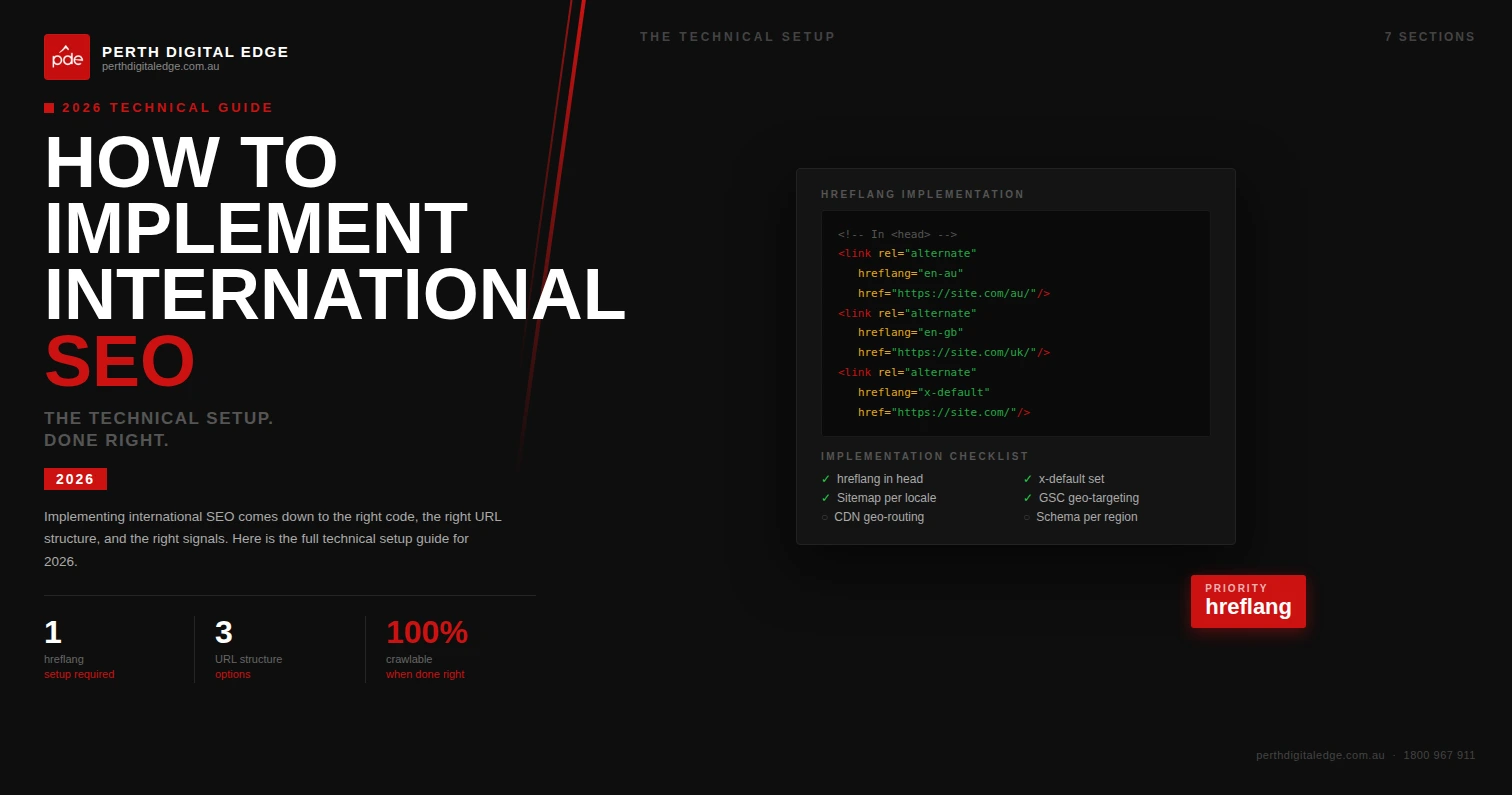
Hreflang tags are the single most important technical signal in international SEO. They tell search engines explicitly which page is intended for which language and region combination. A page with hreflang tags for en-au, en-gb, and en-us tells search engines that three English language versions exist for three different countries, and that each should be served to users in the matching region. Without hreflang, search engines guess, and their guesses are often wrong enough to tank rankings across every target country.
Hreflang also prevents duplicate content problems when the same language targets different countries. An English page targeted at Australia and an English page targeted at the UK would otherwise look like duplicate content to search engines. Hreflang tells them that the duplication is intentional and tied to geographic targeting, and that each page deserves to rank for its own target country.
How URL Structure Reinforces Geographic Signals
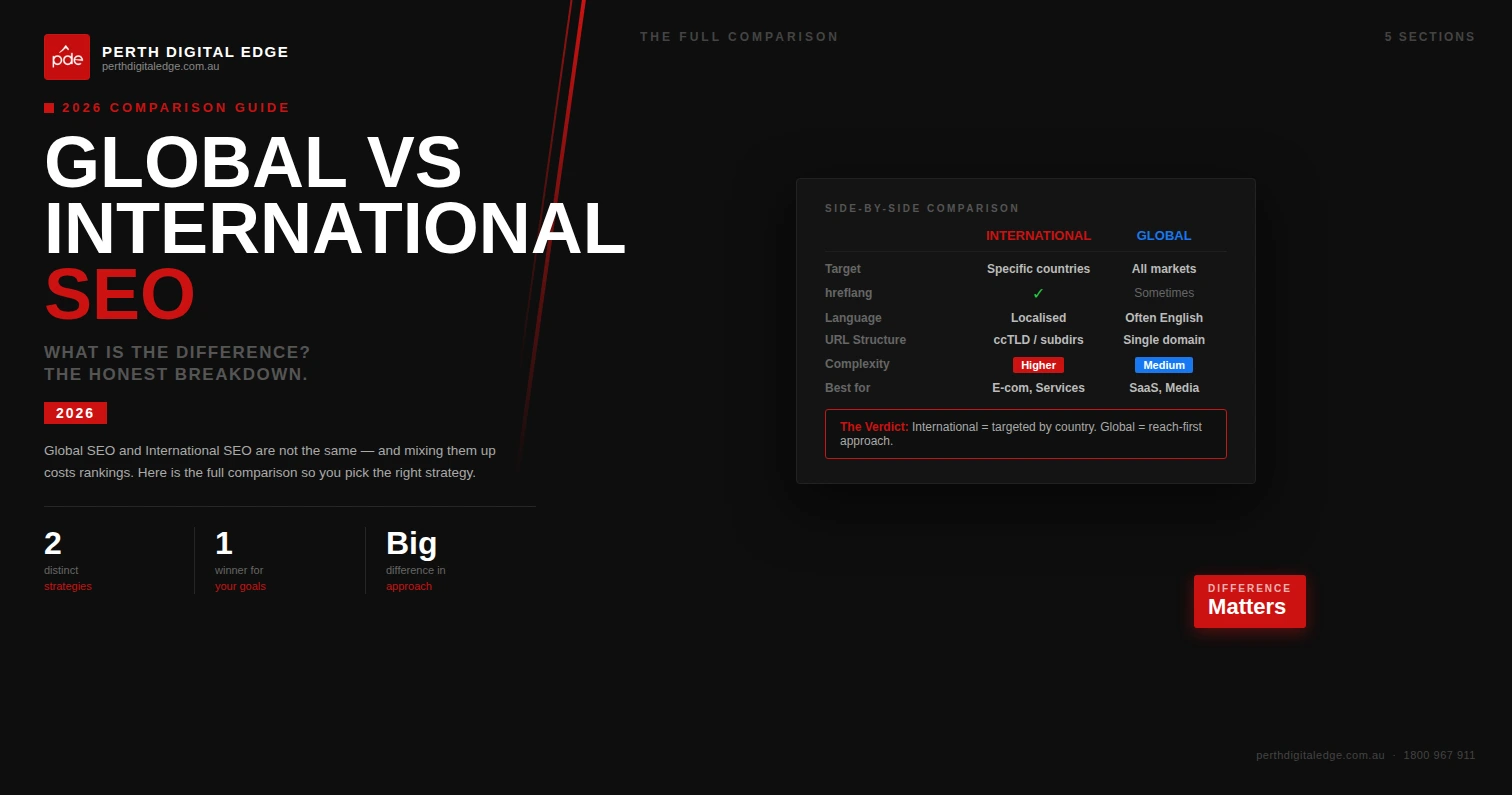
URL structure is the second-largest signal after hreflang. Country code top level domains like example.de give the strongest geographic signal. Subdirectories like example.com/de/ give a weaker but still valid signal. Subdomains like de.example.com sit between the two. Each url structure choice affects how search engines understand geographic intent and how local search engines in each target country weigh the site. Server location adds a small additional signal, though in practice CDNs have made this less important than it used to be.
URL structure also affects how users perceive the site. A .de domain feels local to German users in a way that an /de/ subdirectory does not, which can affect click-through rate from search engine results. Building a global online presence that also wins trust in each target country often comes down to which url structure is used.
How Keyword Research Feeds Into The System
Keyword research in each target market is what tells search engines which queries your content is meant to answer. We run keyword research tools in each target country using native language sources to find relevant keywords with real local search volume. This produces a keyword list grounded in actual local usage rather than translated guesses. The content we then create matches that keyword list precisely, which gives search engines a clear signal about which queries each page is targeting in its own language. Conducting keyword research properly is the difference between content that ranks and content that sits invisible.
Comprehensive keyword research also surfaces the kind of long-tail opportunities that domestic keyword research misses. Local search terms, slang, and idiomatic phrasing only show up in native language keyword research, and they often carry lower competition and higher conversion intent than the obvious high-volume terms. Finding those terms is one of the quiet advantages of running international SEO properly.
How Content Signals Local Relevance
Content signals local relevance through language, tone, references, and structure. Search engines read the language of the content itself and use it as a confirmation signal against hreflang. If a page has hreflang fr-fr but the content is written in English, search engines will distrust the hreflang. The content needs to match the language tags for the signal to be credible. Beyond language, cultural differences in tone and reference also affect how search engines and local users perceive the page. Content that reads as translated or outsider-written tends to underperform content written by someone embedded in the local culture.
Writing for international audiences is closer to writing in a foreign language from scratch than to translating existing content. We brief writers on the cultural context, the expected tone, and the local search patterns before they start. The result is content that feels native rather than imported, which search engines and users both reward.
How Search Engines Handle Multiple Countries
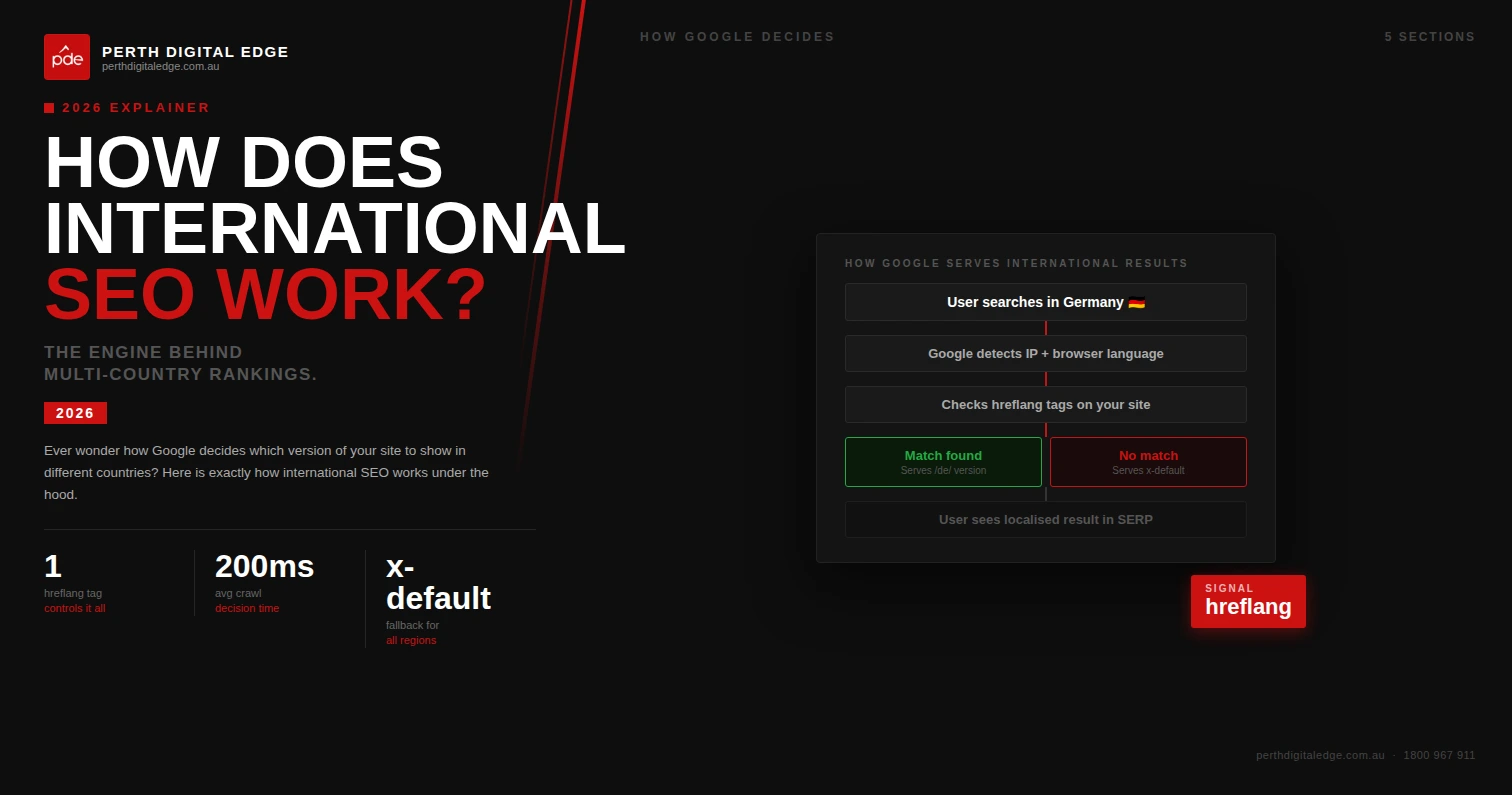
Search engines handling multiple countries use the full bundle of signals to decide which version to serve to each user. Google in particular uses hreflang, geographic targeting, content language, user location, and user search history together. The result is that a user in Germany searching in German will see the German version of your site, while a user in France searching in French will see the French version. Without the signals aligned, both users might see the English version, neither might rank at all, or search engines might serve them contradictory results on different queries.
Other search engines handle this differently. Baidu, Yandex, and Naver each have their own approach to multilingual content and their own expectations for local signals. Targeting China, Russia, or South Korea means understanding how each local search engine interprets international sites, which can differ meaningfully from Google’s approach. For most Australian businesses, Google covers the overwhelming majority of target markets, but the exceptions matter when they matter.
How International SEO Works With Technical SEO
Technical SEO aspects underpin everything international SEO does. Page speed, mobile friendliness, clean canonical tags, XML sitemaps that include every language version, and proper internal linking all factor into how search engines crawl and evaluate international sites. A site with strong content but broken technical foundations will underperform a site with average content and clean technical execution. Implementing international SEO without first nailing the technical SEO foundations is one of the most common reasons campaigns fail to produce results.
For a practical walkthrough of the implementation sequence, read our guide on how to implement international SEO. And if you want the foundational definitions and context, our article on what is international SEO covers the core concepts in more depth.
How Local Backlinks Reinforce The Signal
Local backlinks from publications and industry sites in each target country tell search engines that the site has genuine credibility in that market. Authority from Australian backlinks does not automatically transfer to a .de or .co.uk domain. Earning local backlinks in each target country is slower than domestic link building, but the payoff is stronger because each local link adds real weight to the geographic signal. Local influencers, industry bloggers, trade associations, and local news sites are all sources we target when running international link building campaigns.
Local backlinks also support how search engines understand authority within a specific region. A site with hundreds of Australian backlinks and no German backlinks will still struggle to rank in Germany. The search engines need to see local proof before they trust a site as a legitimate option in a target country.
How Measurement And Key Metrics Work
Measurement is how we verify that international SEO is actually working. Google Search Console and Google Analytics both segment data by country and language, which gives us the key metrics we need to track international SEO performance properly. We monitor organic traffic per target country, search engine visibility per language version, search rankings for priority keywords in each market, and conversion rate per country. These numbers show which target markets are delivering and which need more work. Without segmenting data this way, a traffic drop in one country can hide inside a global average and go unnoticed for months.
We review key metrics monthly and rebuild priorities quarterly based on the data. This discipline catches problems early and surfaces opportunities before competitors find them. Flying blind on international SEO performance is one of the easiest ways to waste a budget, and setting up proper measurement from day one is one of the cheapest insurance policies available.
Common Things That Break The System
A handful of issues break international SEO more often than others. Broken hreflang is the single biggest culprit. Missing tags, circular references, and mismatched country codes confuse search engines and crater rankings in the affected target country. Canonical tags pointing across language versions is another common breakage, since it tells search engines that one version supersedes the other. Content gaps where some language versions have significantly less content than others also drag down rankings for the weaker versions. We audit for these issues at least quarterly on every international site we manage.
Other breakages include accidental noindex tags, misconfigured XML sitemaps that miss language versions, and blocked crawling through robots.txt rules left over from staging. Each of these looks harmless individually but together they can confuse search engines enough to suppress rankings across multiple markets at once.
Why International SEO Feels Slower Than Domestic SEO
International SEO feels slower because search engines take time to trust new language versions. A brand new German domain has no history, no authority, and no local backlinks. Search engines watch for a few months before deciding how to rank it. During that window, even excellent content ranks modestly. Clients who expect domestic-speed results from international campaigns often feel discouraged in the first quarter. Sticking with a robust international SEO strategy through the slow early phase is what separates successful international campaigns from ones that get abandoned.
The payoff when patience holds is that international SEO compounds over years in a way paid advertising never does. Organic traffic from well-optimised international sites keeps producing leads long after the initial work is done, and every additional quarter of sustained effort adds to the foundation built in earlier quarters.
How International SEO Works With Local SEO
International SEO and local SEO aim at different objectives but use many of the same fundamentals. Local SEO aim is to dominate a single city or region, while international SEO targets multiple countries at once. Both disciplines rely on clean technical SEO , content that matches local search patterns, and link building from locally credible sources. Strong domestic local SEO is often the best preparation for international expansion because the same patterns apply on a larger scale. Clients who master local seo in their home market tend to handle international SEO better because the core disciplines are already familiar.
How International SEO Best Practices Fit Together
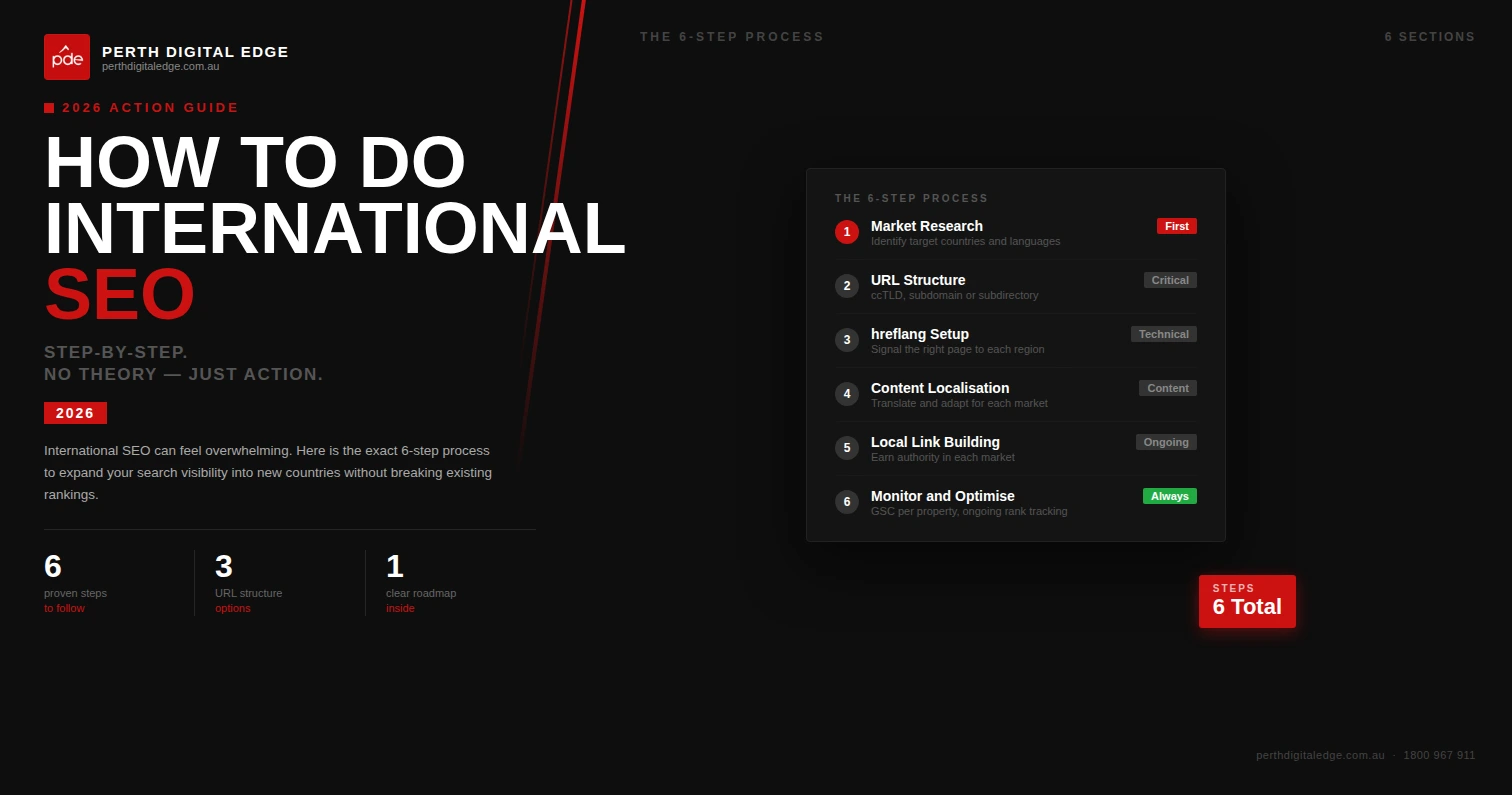
International SEO best practices are less about clever tricks and more about running the fundamentals consistently. A successful international SEO strategy rests on market research in each target market, an effective international SEO strategy built around a global SEO strategy that serves audiences across different regions, and a willingness to create content in multiple languages for a diverse audience. Countries and languages matter, so do cultural nuances, and so does the discipline to conduct keyword research in each local language rather than rely on translation. Every international seo effort we run starts by setting international SEO best practices as the baseline and then adapting them to the target audience in each international market.
International SEO efforts spread across international markets in different languages only pay off when these fundamentals are treated as non-negotiable. Expanding internationally at a global scale without following SEO best practices wastes budget faster than almost any other digital marketing decision. Global reach comes from executing the basics well across a broader audience rather than chasing shortcuts. Language targeting through hreflang, country targeting through url structure, and careful planning across different countries and languages all reinforce each other. Local language content for each target market helps search engine rankings lift in the local market, while the overall global audience builds incrementally as each new target country starts producing organic traffic.
Case Studies From Our Work
Ben Tippett founded Perth Digital Edge more than a decade ago, and our team has run the mechanics described here for clients across ecommerce, professional services, tourism, and resources. For Westside Auto Wholesale, broader SEO work delivered a 4,900% return on investment, 1.4 million visitors, and 120,000 leads. For Castle Security, technical and content work lifted organic traffic 364% and placed 109 keywords on page one within six months. For Wholistically Healthy, the work lifted traffic 118% and conversion rate 51%. For Eco Style Pool Renovations, PageSpeed improvements took the site from 27 to 86.
These results illustrate what becomes possible when the mechanics of international SEO are executed consistently. The signals get aligned, the content matches local usage, the links come from credible local sources, and search engines reward the whole configuration with meaningful rankings.
Frequently Asked Questions
The questions we hear most from clients trying to understand how international SEO actually works.
How Do Search Engines Know Which Version To Serve?
Search engines use hreflang tags, url structure, content language, and user location together to decide which version to serve. Hreflang is the single most important signal, but the others reinforce it. When they are consistent, search engines confidently serve the right version. When they conflict, search engines often fall back to the default language version and rankings suffer across every target country.
Does Server Location Still Matter?
Server location matters less than it used to because content delivery networks mask geographic latency. Hreflang and url structure do more work than server location for most modern international sites. That said, for target markets where page speed differences are large, hosting or CDN configuration can still move the needle.
How Long Before Rankings Start Improving?
Most clients see early indicators within three to six months, with meaningful rankings arriving between six and twelve months. The exact timeline depends on existing domain authority, competitive intensity in the target market, and how aggressively the link building and content work proceeds.
Can We Use The Same Content Across Multiple Countries?
Only if the same language genuinely serves both countries with minor changes. Even between english-speaking countries, local search behaviour and cultural expectations differ enough that pure reuse often underperforms lightly adapted versions. For non-english markets, direct reuse almost never works because translation alone misses the local nuance search engines and users both reward.
Final Thoughts And Next Step
How does international SEO work? It works by aligning every signal on every page so search engines can confidently match the right version of your site to the right user in the right country. Hreflang, url structure, content language, local backlinks, and technical SEO all pull in the same direction when the strategy is executed properly. If you want a Perth team with a decade of experience to handle the mechanics for your business, our international SEO services in Perth are built around exactly this discipline. Book a free strategy call with our team and we will walk through where your international SEO is strong, where it is leaking, and what to fix first.