The first Google Ads account I ever managed lost money. Not a little. The client, a Balcatta carpet cleaning business, burned through $2,400 in three weeks with exactly zero trackable leads. I was new, the campaign setup was sloppy, and I had not yet learned the difference between spending money on ads and investing it in a system that produces returns. That failure shaped everything I have built since. I’m Ben Tippett, founder of Perth Digital Edge, and I have spent the past seven years managing Google Ads accounts for tradies, allied health clinics, ecommerce retailers, and professional services firms across Western Australia. The question I hear before any other: how much do google ads cost australia businesses in 2026?
The honest answer is that no two accounts pay the same rate. But there are clear benchmarks. This guide breaks down real cost per click data by industry, monthly budget ranges by business size, pricing across every campaign type, and the specific levers Perth Digital Edge uses to reduce google ads spend for our clients. Every figure reflects what we see inside live accounts and verified Australian market data for 2026.
What Determines How Much Google Ads Cost In Australia
Google Ads runs on an auction system. Every time someone types a query into Google Search, advertisers bid for placement in those search engine results pages. But the highest bidder does not always win. Google weighs your bid against your quality score, a composite rating built from three components: ad relevance (how closely your ad matches the search intent), landing page experience (how useful and fast your destination page is), and expected click through rate (how likely users are to click based on historical data). The product of your bid and quality score determines your ad rank, which controls both your ad positions and your actual cost per click.
This is not abstract. Project Concrete, a concreting company in Rockingham that Perth Digital Edge took on in 2024, pays $3.80 per click for “concrete driveway Perth”. A competitor in the same suburb was paying $7.60 for the identical keyword because their landing page loaded in five seconds, their ad copy had not changed in over a year, and their quality score sat at 4 out of 10. Same keyword, same suburb, double the cost. Understanding how google ads calculates your cost is not academic. It is the foundation of every budget decision you will make.
Two businesses bidding on the same term can pay wildly different amounts. The one with higher ad quality, tighter targeting, and a faster page occupies a better position and often pays less. That gap is where money is either made or quietly wasted.
Average Cost Per Click In Australia By Industry
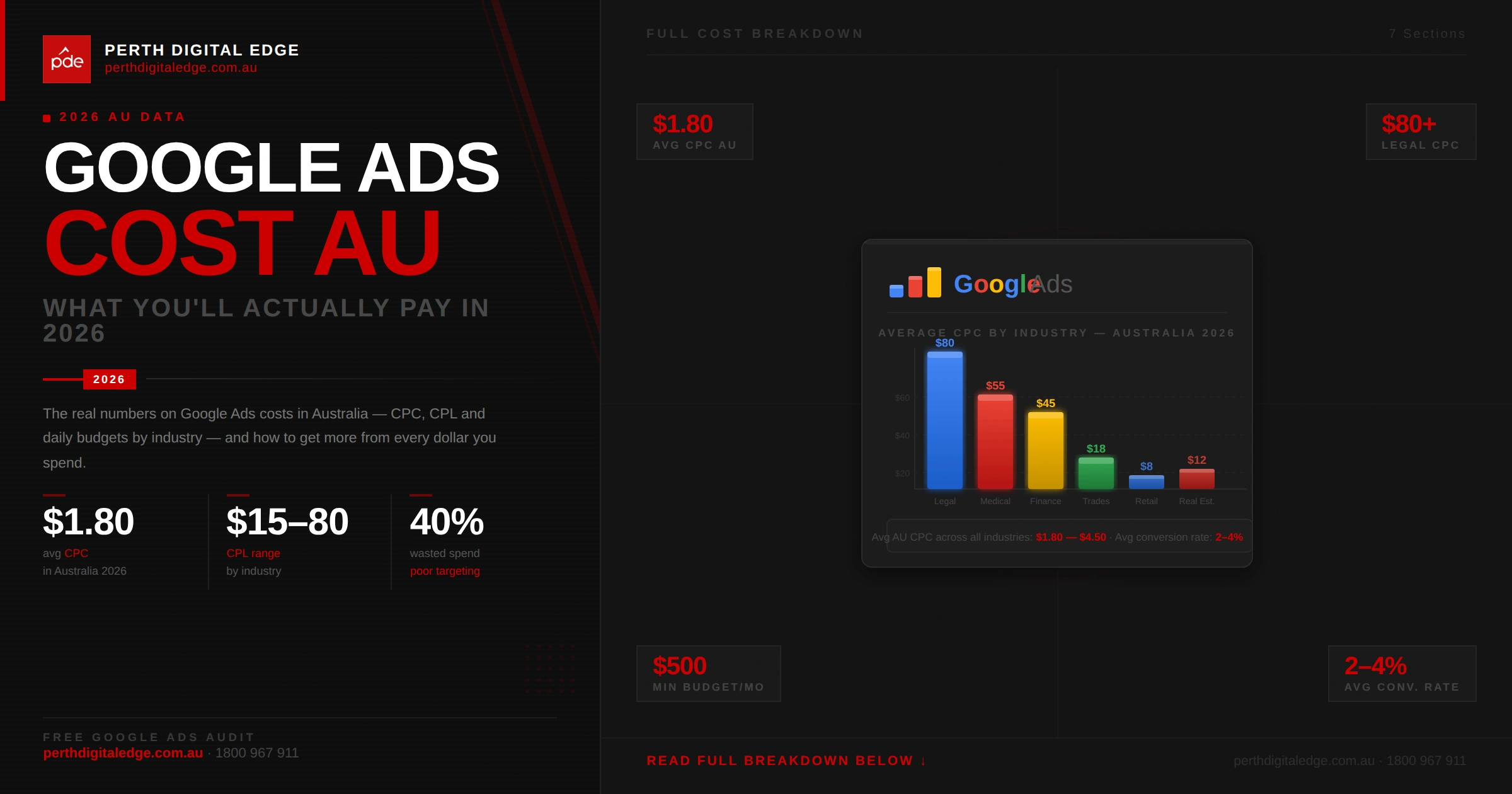
The average cost per click in Australia varies enormously by vertical. The figures below reflect 2026 averages across the google search network, drawn from Perth Digital Edge account data and industry benchmarks.
| Industry | Average CPC (AUD) | Typical Range | Competition Level |
| Legal Services | $6.40 | $3.50 – $12.00 | Very High |
| Finance & Insurance | $5.80 | $3.00 – $11.50 | Very High |
| Home Services (Plumbing, Electrical, HVAC) | $4.10 | $2.20 – $8.50 | High |
| Medical & Allied Health | $3.60 | $1.80 – $7.20 | High |
| Real Estate | $3.20 | $1.50 – $6.80 | High |
| Ecommerce & Retail | $1.40 | $0.50 – $3.80 | Medium |
| Hospitality & Tourism | $1.10 | $0.40 – $2.60 | Medium |
| Education & Training | $2.80 | $1.20 – $5.50 | Medium-High |
Legal services and finance sit at the top because the lifetime value of a single client justifies aggressive bidding. A personal injury firm in Perth can generate $30,000 or more from one case, so paying $8 to $12 per click is rational when even a modest conversion rate covers the investment. Competitive industries like these require careful structure and disciplined bid management.
Here is something that surprises most business owners: the cheapest clicks are not always the best value, and the most expensive clicks are not always a bad deal. A Joondalup family law firm we manage pays $9.40 per click, which sounds painful, but each converted lead generates $8,000 to $15,000 in billings. Meanwhile, a hospitality client paying $0.80 per click was converting at under 1% because the traffic was mostly tourists browsing, not locals booking. The average cost per click only tells you the price of admission. What matters is what happens after the click.
Monthly Google Ads Budgets: What Australian Businesses Actually Spend
Knowing the average CPC is only half the equation. The other half is working out a monthly google ads budget that gives your campaigns enough data to optimise without haemorrhaging money while you learn. At Perth Digital Edge, I structure monthly google ads budgets based on three tiers.
| Business Size | Recommended Monthly Ad Spend | Average Daily Budget | Best Suited For |
| Startup / Testing | $1,000 – $2,500 | $33 – $82 | Validating demand, initial keyword research |
| Established SME | $2,500 – $7,500 | $82 – $247 | Consistent lead generation, refining winners |
| Growth / Multi-Location | $7,500 – $25,000+ | $247 – $822+ | Multi-campaign, complete pipeline coverage |
These figures cover ad spend only, not management fees. Your average daily budget is calculated by dividing your monthly spending limit by 30.4. Google may spend up to twice your average daily budget on high-traffic days, but it will never exceed your monthly spending limit over the billing cycle.
I talk to small businesses every week who have tried Google Ads, spent $500 or $800 over a month, seen nothing come back, and concluded the platform does not work for them. That conclusion is almost always wrong. If your average cost per click is $4.50 and your daily budget is $10, you are buying two clicks per day. That is not enough volume to learn anything. You would not judge a fishing spot after casting twice. I advise a minimum of 15 to 20 clicks per day during the first 60 days of a new google ads campaign so there is sufficient data for smart bidding strategies to find their footing.
Google Ads Pricing Breakdown By Campaign Type
The ads cost in Australia varies not just by industry but by the campaign format you choose. Each type has its own pricing dynamics, audience behaviour, and role within a broader digital marketing strategy.
Search Ads
Search ads, including responsive search ads, appear at the top and bottom of search engine results when someone types a relevant query. They are intent-driven: the user is actively looking for something specific. That makes them the highest-converting format for most businesses. The average CPC for search ads in Australia sits between $1.00 and $8.00 depending on keyword competition, with highly competitive keywords in legal, finance, and medical verticals exceeding that range. Perth Digital Edge builds every search campaign around tightly grouped target keywords matched to dedicated landing pages, keeping the quality score high and cost per click CPC under control.
Shopping Ads
Shopping ads display product images, prices, and store names directly in search results. For Australian ecommerce businesses pursuing online sales, they are non-negotiable. CPCs tend to run lower than search, typically $0.30 to $2.50, because the visual format pre-qualifies the click. If someone sees your price and still clicks, they are further along the buying decision. I manage shopping campaigns for several WA-based retailers and consistently see stronger return on ad spend from shopping than from broad search terms, provided the product feed is well maintained.
Google Display Network Ads
The google display network reaches over 90% of internet users worldwide through banner placements on partner websites, apps, and Gmail. Display ads are awareness-driven rather than intent-driven, so CPCs sit lowest of any format: typically $0.20 to $1.50 in Australia. The trade-off is conversion rate. Display clicks convert at a fraction of search. But they serve a purpose in building familiarity, especially for brands entering a new market. Ad placement on the display network matters enormously. Without proper exclusions, your ads can appear on children’s gaming sites or content farms, burning budget on clicks that will never convert.
YouTube Ads And Video Ads
YouTube ads, including skippable video ads and bumper formats, operate on a cost-per-view model rather than cost-per-click. You typically pay when a viewer watches 30 seconds or more, or interacts with the ad. Video ads in Australia average $0.05 to $0.30 per view, making them one of the most cost-efficient ways to build brand recognition. Perth Digital Edge has used youtube ads to support awareness campaigns for Osborne Park and Joondalup based businesses where the brief was visibility, not direct lead generation.
Re Marketing Ads
Re marketing ads target users who visited your website but did not convert. Because these people already showed interest, re marketing ads deliver the lowest cost per acquisition of any format. CPCs range from $0.25 to $2.00, and conversion rates run two to three times higher than cold traffic. For any business running google ads seriously, a remarketing layer should be active from day one. We configure remarketing audiences on every Perth Digital Edge account at launch.
The Factors That Push Your Ads Cost Higher (And How To Control Them)
Several interconnected factors determine whether your ads cost lands at the low or high end of the range. Understanding each one hands you direct control over efficiency.
Quality score is the single most influential variable. It is a 1 to 10 rating Google assigns to each keyword in your google ads account, based on ad relevance, landing page experience, and expected click through rate. A keyword scoring 8 can cost 30% to 50% less per click than the same keyword scoring 5. Perth Digital Edge monitors quality scores weekly and rebuilds underperforming ad groups rather than simply raising bids.
Keyword competition directly affects what you pay. Competitive keywords attract more advertisers, which inflates the auction price. In verticals like legal services and financial planning, head terms carry a premium. This is where long tail keywords become critical. A Wanneroo-based pest control client of ours targets “termite inspection Wanneroo” instead of “pest control Perth.” The long tail variant has lower search volumes but converts at nearly four times the rate and costs 60% less per click. City Beach Basketball Club, another Perth Digital Edge client, saw a similar pattern: niche sporting terms at $1.20 per click outperformed generic fitness keywords at $3.80 because the search intent was specific enough to attract people ready to sign up.
Your bidding strategies also shape cost. Manual bidding gives you granular control but requires constant attention. Automated bidding, particularly smart bidding strategies like Target CPA and Maximise Conversions, uses machine learning to adjust bids in real time. At Perth Digital Edge, we start new campaigns on manual bidding for the first four to six weeks to collect baseline data, then transition to automated bidding once there are at least 30 conversions in the account.
Ad scheduling is another lever most advertisers overlook. If your data shows that leads from clicks between 10pm and 6am never convert, why fund those hours? We apply ad scheduling to every campaign, concentrating spend during the windows that produce returns. Similarly, mobile ads often perform differently to desktop. For some industries, mobile converts at half the rate, meaning you are paying full price for weaker traffic unless you adjust bids by device.
How To Reduce Your Google Ads Spend Without Cutting Results
Reducing ads cost is not about shrinking the budget. It is about amputating the portion that produces nothing. Here is how Perth Digital Edge approaches it across every google ads campaign we manage.
Build and maintain a negative keywords list from day one. Negative keywords prevent your ads from appearing on irrelevant searches. Without them, a Rockingham concreting company bidding on “concrete services” could pay for clicks from people searching “concrete poetry” or “concrete jungle meaning.” We review search term reports weekly and add irrelevant keywords to the exclusion list. Over time, this compounds. Project Concrete, after six months of disciplined negative keyword work, saw their monthly ad spend drop 22% with zero drop in enquiry volume. That saving went straight back into their pocket.
Invest in keyword research beyond the obvious. Google keyword planner is a starting point, not a strategy. We layer in competitor analysis, search intent mapping, and seasonal trend data to identify relevant keywords the competition has missed. Targeting these gaps often delivers clicks at 40% to 60% below the category average because fewer advertisers are competing for them.
Improve your landing page. This is the change I get most excited about because the results are immediate and the client did not have to spend an extra dollar on ads. A Subiaco physio client saw their average CPC drop from $4.80 to $3.10 after we rebuilt their landing page with faster load times and a simplified booking form. That is a 35% cost reduction from a single change that had nothing to do with bidding. Their 4.9-star Google review average was already doing the trust-building work. The page just needed to stop getting in the way.
Write high quality ads that earn clicks from the right people. Vague, generic ad copy attracts low-intent traffic that bleeds budget. Specific, benefit-driven responsive search ads matched to tight keyword groups attract the target audience ready to take action. Perth Digital Edge writes and tests a minimum of three ad variations per ad group, rotating weekly to surface the best performers.
Google Ads Cost By Australian City
Ads cost in Australia is not uniform across the country. Capital cities carry different competitive dynamics, population densities, and industry concentrations that directly influence what you pay per click.
| City | Avg CPC (Services) | Avg CPC (Retail) | Competition Intensity |
| Sydney | $4.80 – $7.50 | $1.20 – $3.40 | Very High |
| Melbourne | $4.50 – $7.00 | $1.10 – $3.20 | Very High |
| Brisbane | $3.80 – $6.20 | $0.90 – $2.80 | High |
| Perth | $3.50 – $5.80 | $0.80 – $2.60 | High |
| Adelaide | $3.00 – $5.20 | $0.70 – $2.30 | Medium-High |
| Hobart | $2.40 – $4.50 | $0.50 – $1.80 | Medium |
| Darwin | $2.20 – $4.20 | $0.50 – $1.70 | Medium |
| Canberra | $3.40 – $5.60 | $0.80 – $2.50 | Medium-High |
Sydney and Melbourne dominate on volume and competition, which inflates CPCs across nearly every vertical. Perth occupies an interesting position: competition is lower than the eastern capitals but has been climbing year on year as more local businesses shift marketing budgets into paid search. For Perth businesses specifically, the relatively lower cost per click compared to Sydney creates a genuine window. Perth Digital Edge clients routinely achieve cost per lead figures 25% to 35% below what equivalent businesses pay in Sydney and Melbourne. That gap will narrow as more Perth advertisers enter the auction, which is exactly why acting now matters.
Google Ads Management Cost And Fees In Australia
Beyond your ad spend, you need to account for google ads management cost if you are working with a provider. Google ads management fees in Australia typically follow one of three structures.
| Fee Structure | Typical Range | Best For |
| Flat Monthly Fee | $800 – $3,000/month | SMEs with stable ad spend |
| Percentage of Ad Spend | 10% – 20% of monthly spend | Larger budgets, scales with investment |
| Hybrid (Flat + Percentage) | $500 base + 10% of spend | Mid-range budgets seeking alignment |
At Perth Digital Edge, we use a flat monthly fee. I chose that model deliberately because the incentive structure has to align with campaign performance. A percentage-based model creates a quiet conflict: the more you spend, the more the agency earns, regardless of whether that extra spend produces proportional returns. I have turned down clients who wanted to double their budget when the data did not support it. That is not noble. It is just how you build relationships that last longer than one contract cycle.
When evaluating google ads pricing from any provider, ask what is included. Some agencies quote a low management fee but charge separately for campaign setup, keyword research, ad copy writing, landing page recommendations, and monthly reporting. Perth Digital Edge includes all of that in a single fee. No add-ons. No surprises.
Is Google Ads Worth The Investment For Australian Businesses
The question of whether google ads worth the spend reduces to one metric: google ads roi. What are you getting back for every dollar you put in? Across Perth Digital Edge clients, the average return on ad spend sits between 4:1 and 8:1 for service businesses and 3:1 to 6:1 for ecommerce. Every dollar of ad spend generating between three and eight dollars in revenue.
Those returns are not automatic. They are the result of disciplined management: tight ad campaign structure, continuous optimisation, proper conversion tracking, and landing pages that convert. Businesses that hand over a budget and disappear will not see those numbers. The ones who review monthly reports and collaborate on adjustments consistently outperform.
Compared to traditional advertising, the advantage of running google ads is surgical precision. A billboard on the Mitchell Freeway reaches 100,000 drivers, most of whom will never need what you sell. A search ad for “commercial electrician Joondalup” reaches the person who needs that service today, at the moment they pick up their phone. That specificity is what makes the google ads cost justifiable even in competitive industries where the cost per click feels steep. You are not paying for eyeballs. You are paying for intent.
Frequently Asked Questions
The questions Australian business owners ask most often about Google Ads pricing and budgets.
How Much Does Google Ads Cost Per Month In Australia?
Most small businesses spend between $1,000 and $5,000 per month on google ads spend, with mid-sized companies allocating $5,000 to $15,000. There is no fixed price. Your monthly cost depends on your industry, target keywords, geographic targeting, and competitive intensity. The much does google ads cost you specifically depends on keyword difficulty and how well your account is built.
What Is A Good Google Ads Budget For A Small Business?
I recommend a minimum of $1,500 per month for a new google ads budget in most industries. That provides enough click volume, roughly 10 to 15 clicks per day at average Australian CPCs, to gather conversion data within 30 days. Starting below $1,000 in anything other than a low-competition niche typically means the campaign takes too long to optimise and the business loses patience before results appear.
How Does Google Ads Calculate What You Pay Per Click?
Google ads calculates your actual CPC using the formula: (ad rank of the advertiser below you / your quality score) + $0.01. You rarely pay your maximum bid. You pay just enough to beat the next advertiser in line. This is why quality score matters: a higher score means you occupy strong ad positions while paying less than competitors with weaker ads and landing pages.
Should I Use Manual Or Automated Bidding?
Both have a place. I start most new accounts on manual bidding for four to six weeks to establish which keywords, locations, and times of day convert. Once the account has at least 30 conversions, we transition to automated bidding strategies that use machine learning to optimise in real time. Starting automated bidding on a new ad campaign with no data is a gamble because the algorithm has nothing to learn from.
What Industries Have The Highest Google Ads Cost In Australia?
Legal services, finance, insurance, and medical specialists consistently carry the highest average cost per click in Australia, often exceeding $6 to $12 per click. These are competitive industries where the revenue from a single converted lead justifies aggressive google ads spend. If you operate in one of these verticals, disciplined account management and strong landing page experience are not optional. They are the only way to keep acquisition costs sustainable.
Planning Your Google Ads Budget Starts With Knowing What You Are Paying For
The question of how much do google ads cost Australian businesses does not have a single answer, but it has a clear framework. Your industry sets the baseline. Your quality score, keyword strategy, landing page, and campaign structure determine where you land within that range. The gap between a well-managed account and a neglected one can be tens of thousands of dollars per year in wasted spend, and I have sat across the table from business owners who did not realise how wide that gap was until we pulled their search term reports.
At Perth Digital Edge, every dollar of your google ads spend is tracked, justified, and optimised. I have spent seven years refining how we build and manage campaigns across Perth and Western Australia, learning as much from accounts that struggled as from accounts that thrived. The results show in the numbers our clients see in their accounts, not in a pitch deck.
If you want a clear picture of what your business should be spending and where the gaps sit, I am happy to walk you through it.
Get A Free Google Ads Cost Analysis From Perth Digital Edge
I’m Ben Tippett. From our office in Wanneroo, Perth Digital Edge builds and manages Google Ads campaigns for small and mid-sized businesses across Western Australia. Whether you are launching your first ad campaign or looking to cut waste from an existing account, let me show you exactly where your budget should go. Contact Perth Digital Edge today for a free, no-obligation cost analysis and audit.