How to implement international SEO is the practical question that usually follows once a business decides international expansion is worth chasing. Strategy documents are one thing, but implementing international SEO strategies in the real world requires a different kind of discipline. After more than a decade running campaigns out of Perth Digital Edge for clients expanding into global markets, our team has built a repeatable implementation playbook that turns a well-written strategy into a live website producing organic traffic from multiple countries. This guide walks through how we implement international seo from planning through to post-launch monitoring.
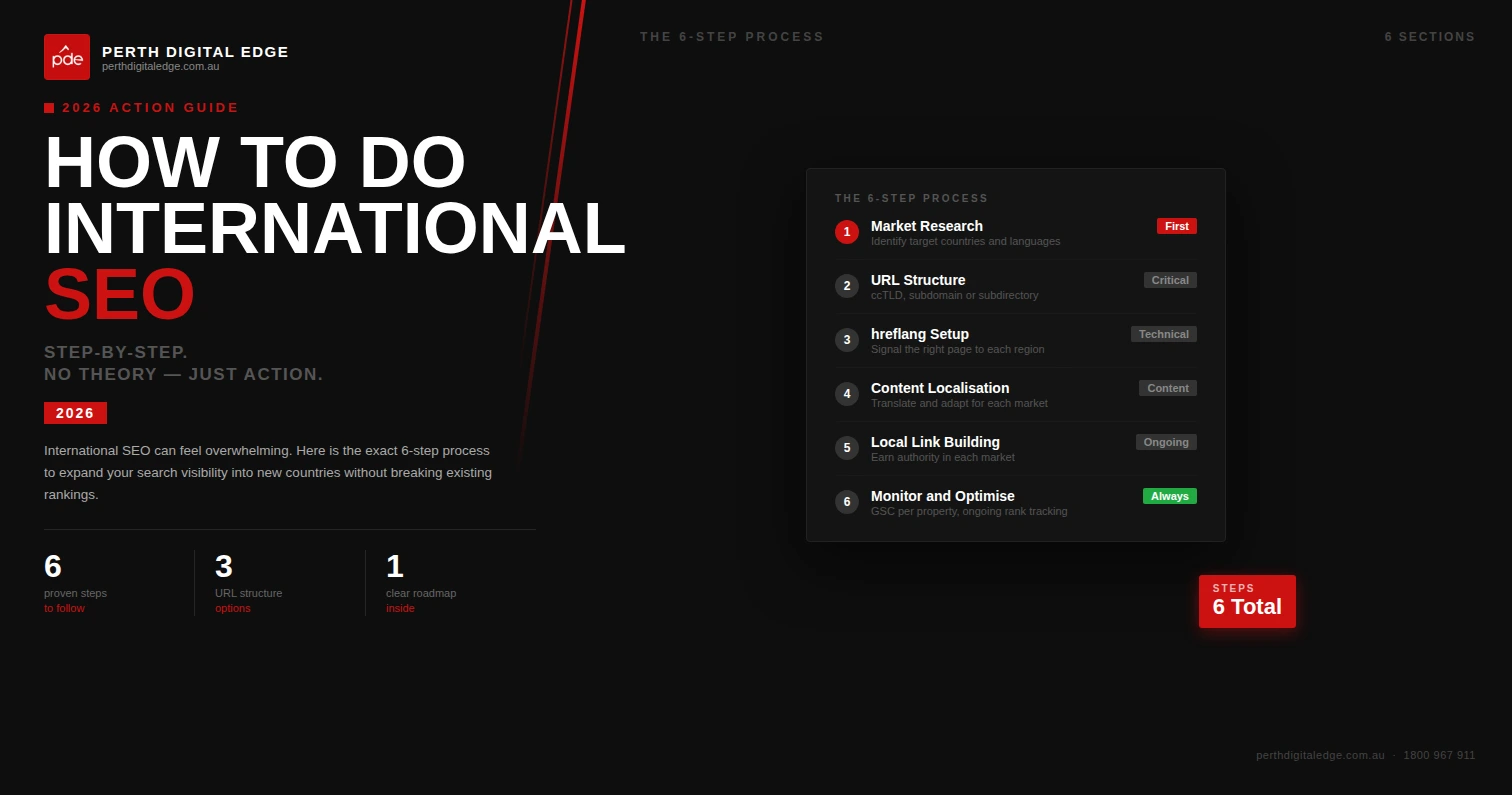
The summary is this. Every successful international SEO strategy we have deployed has followed the same implementation order. Begin with clear business objectives, run thorough market research, lock in the url structure early, implement hreflang tags correctly the first time, build a content plan that matches the target audience in each target country, earn local backlinks deliberately, and measure international SEO performance against clear key metrics. Implementing international SEO is less about secret techniques and more about executing fundamentals consistently across every target market.
Start With The Commercial Reality
Before any implementation work begins, we sit down with clients and work through the commercial reality of expanding internationally. Which target markets deliver the fastest payback? What does global online success look like in twelve, twenty-four, and thirty-six months? How much budget is actually available, and how does it compare to the scope of work required for each target country? Without these answers, implementing international SEO becomes an expensive exercise in guesswork. With them, every subsequent decision has a clear test to measure it against.
The business case also drives how aggressively we pursue country targeting. A business with firm revenue targets in two target markets gets a narrower international SEO strategy than a business testing the waters across five. Both approaches can work, but the execution looks different. Clarity at the business case stage keeps the rest of the engagement focused on outcomes rather than activity.
Run Thorough Market Research
Thorough market research is the foundation of any international SEO checklist. We look at search volume in each candidate target country, the competitive landscape, existing organic traffic from Google Analytics, and the cultural context our client needs to understand before writing content. Market research also surfaces local search behaviour, local competitors already ranking in each market, and the gaps where demand exists without strong coverage. This is where the international SEO strategy genuinely shapes itself around reality rather than assumptions.
Different markets behave differently. Search volume in the UK and the US for the same product can vary by a factor of ten. Competition density in Germany for B2B software looks nothing like competition density in Italy. Market research is what tells us where to spend our client’s budget first, and where to leave for phase two. Getting this wrong leaves the whole implementation chasing the wrong audience.
Choose The Right URL Structure
Choosing the url structure early is one of the most important implementation decisions. The three main options are country specific domains like example.de or example.co.uk, subdirectories like example.com/de/, and subdomains like de.example.com. Country specific domains send the strongest geographic signal but split authority across separate properties. Subdirectories consolidate authority but send a weaker geographic signal. Subdomains sit in between. We walk each client through the trade-offs and pick based on their existing domain authority, their budget, and their long-term plans.
Once the url structure is chosen, it shapes every other implementation decision. Server configuration, hreflang implementation, analytics tracking, and internal linking all follow from that first choice. Changing it later is expensive and disruptive, so we prefer to get it right at the start even if the discussion takes longer than the client expects.
Implement Hreflang Tags Correctly
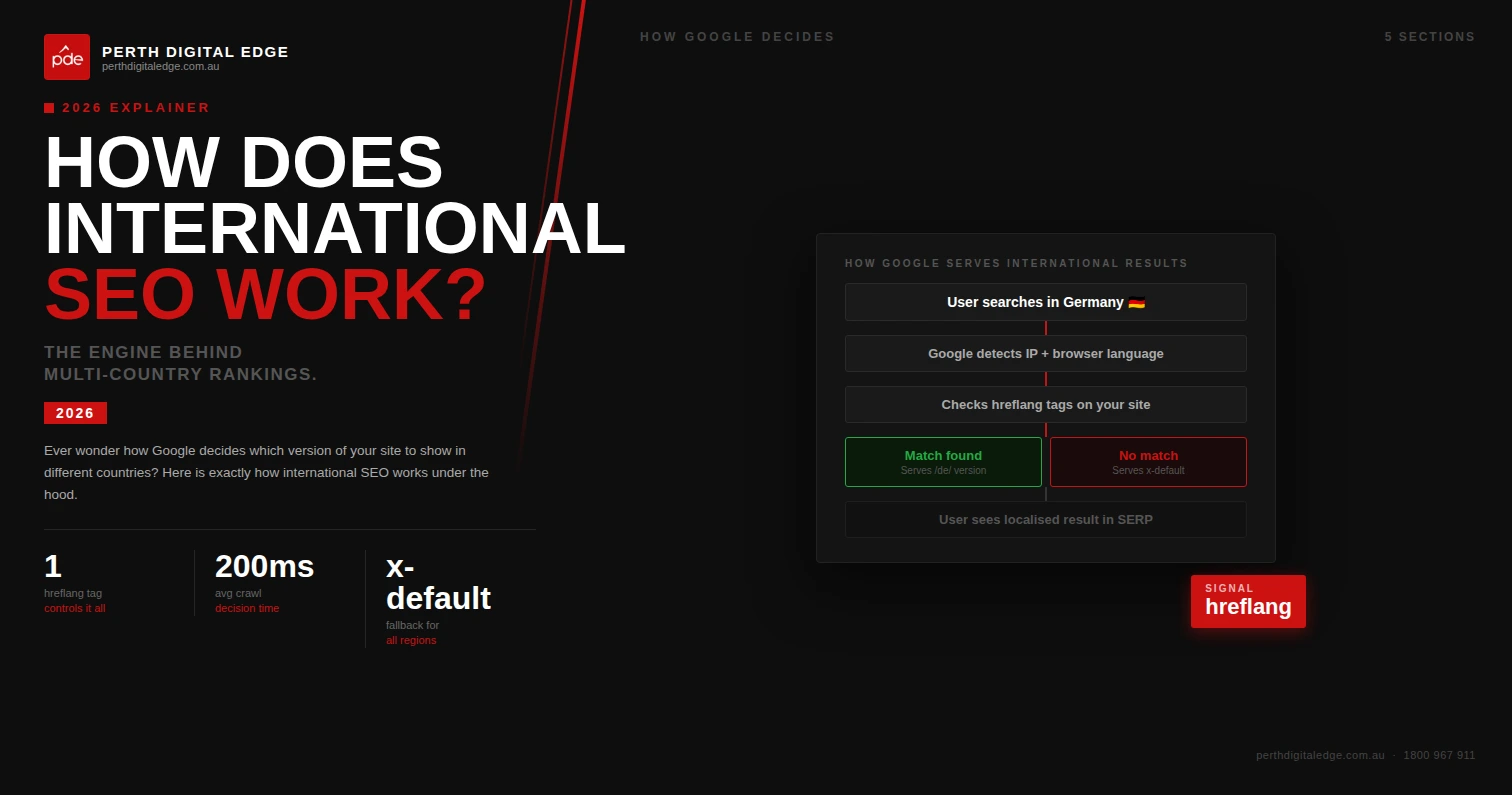
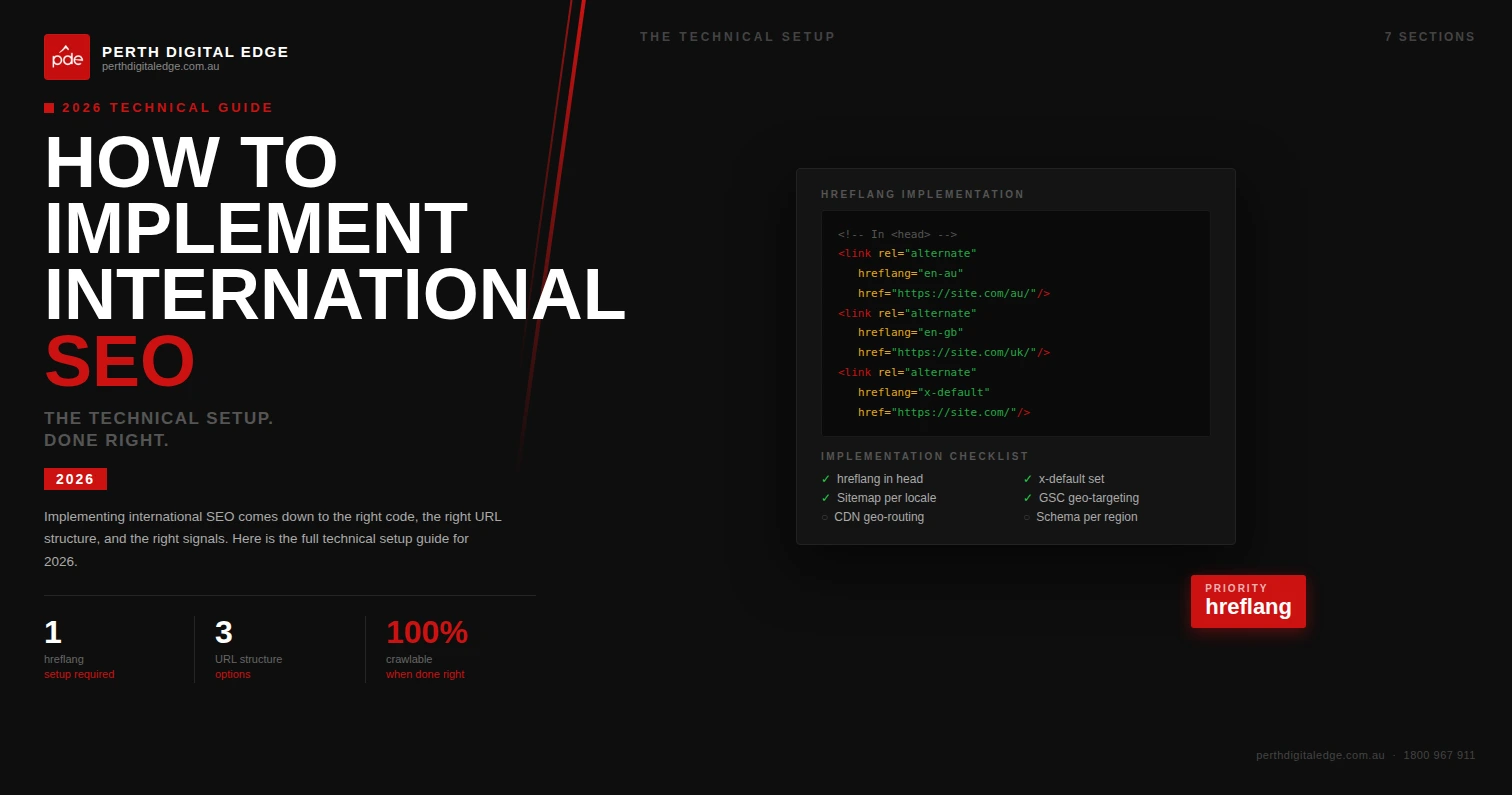
Hreflang tags are the single most important piece of technical SEO in any international SEO implementation. They tell search engines which language version of a page is intended for which country and language, and they are easy to get wrong. Every page needs to reference every other language version including itself. Country codes and language tags need to follow ISO standards. Self-referencing tags need to be present. We implement hreflang through an XML sitemap for larger sites because that centralises the logic and simplifies maintenance. For smaller sites we add hreflang in the HTML head of each page directly.
Broken hreflang is one of the most common reasons international SEO efforts underperform. Missing tags, circular references, and mismatched language codes all confuse search engines and can cannibalise rankings across multiple countries. We test hreflang implementation with tools like Merkle’s hreflang tag testing tool and Screaming Frog’s hreflang audit before considering implementation complete. Getting this right the first time saves months of remedial work later.
Build A Solid Technical Foundation
International websites need the same technical SEO fundamentals as single-country sites, but everything is amplified because there are more pages, more templates, and more ways for things to break. We audit page speed, mobile friendliness, canonical tags, XML sitemaps, internal linking, schema markup, and core web vitals across every language version. We also check that every language version is being crawled properly through Google Search Console. International sites accumulate technical debt faster than single-country sites, so the initial audit is more comprehensive and the ongoing monitoring happens more frequently.
The website’s domain authority also factors into how quickly each language version can start earning search visibility. Existing authority on a primary domain flows through to subdirectory versions, giving them a head start. Brand new country code top level domains need to build authority from scratch, which takes longer. We factor these realities into the implementation timeline so clients have accurate expectations from day one.
Plan Content Before Writing It
Content is where most international SEO implementations struggle. Direct translation rarely works. Cultural context matters more than keyword density. Local culture drives how users respond to tone, structure, and examples. We plan content around priority search queries in each target market first, then brief writers who understand the target audience in the local language. Every piece goes through native speaker review before publication. Relevant keywords are integrated naturally rather than stuffed into copy that reads as translated.
We also map content to intent. Commercial keywords get product and service pages. Informational keywords get blog content and guides. Transactional keywords get landing pages with clear calls to action. This mapping is identical to domestic SEO planning, but the execution has to respect local language, local search behaviour, and local expectations about how content should feel. Writing the same article for German, Japanese, and Brazilian audiences requires three genuinely different pieces of content, not three translations of one.
Implement Country And Language Targeting
Country targeting tells search engines which audience each page is intended for. We set country targeting through hreflang, url structure, and, where appropriate, Google Search Console’s international targeting settings. Language targeting is handled primarily through hreflang, but it also shows up in the content itself, in the meta tags, in the HTML lang attribute, and in the language versions served for different regions. Implementing international SEO strategies without getting country targeting and language targeting properly aligned leaves search engines guessing, and guessing rarely ends in good rankings.
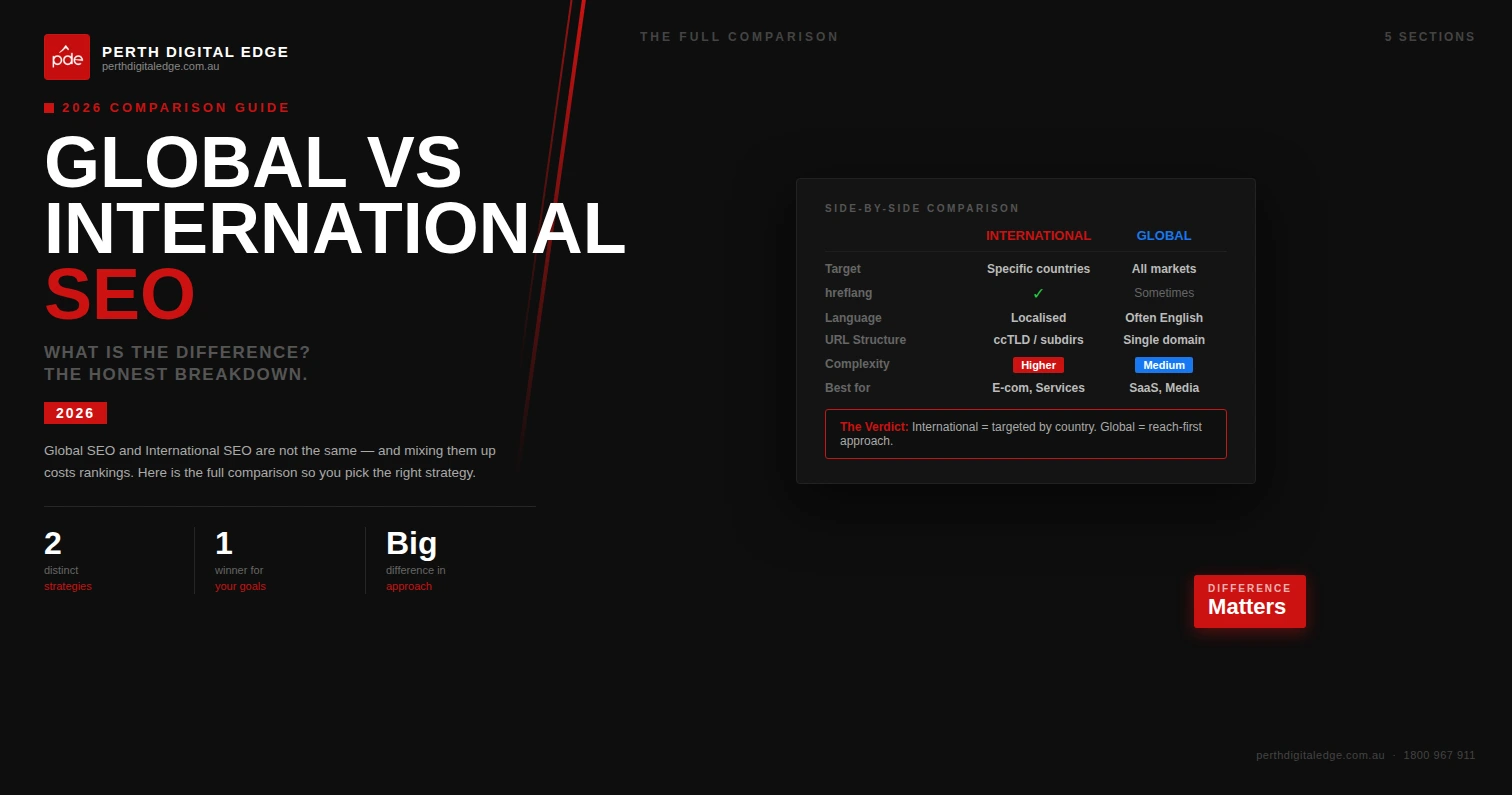
For a broader view of how international SEO fits against global strategy, read our guide on the difference between global and international SEO. And if you want to understand the day-to-day tactics of running international campaigns, our how to do international SEO article covers the tactical playbook in detail.
Earn Local Backlinks Deliberately
Local backlinks from publications, trade associations, and industry partners based in each target country are essential for building trust with local search engines. Authority built in Australia does not automatically transfer to a .de or .co.uk domain. We run deliberate outreach campaigns in each target market, building relationships with local publishers and industry contacts who can publish legitimate editorial links. Link building for international sites is slower than buying bulk links, but it is the only approach that produces durable rankings in competitive foreign markets.
Local backlinks also reinforce the other country targeting signals. Search engines interpret a site with strong local backlinks, correct hreflang, and a country specific domain as a legitimate option for users in that market. Missing any one of these signals weakens the whole configuration. Implementing international SEO properly means building all three signals in parallel rather than treating them as independent work streams.
Measure Everything From Day One
Measuring international SEO performance from day one is essential because international campaigns are slower to show results and easier to misread. We set up Google Analytics and Google Search Console to segment data by country and language from the start. Key metrics include organic traffic per target country, search rankings for priority keywords, search visibility per language version, and conversion rate per market. We review these numbers monthly and realign priorities every quarter based on what the data shows.
Measurement also catches problems early. A sudden drop in search rankings in a single target country might point to a hreflang breakage or a canonical tag issue specific to that language version. Without country-level measurement, these problems can run for weeks before anyone notices. With it, they surface within days and can be fixed before they damage long-term international SEO success.
Ongoing Maintenance And Optimisation
Implementing international SEO is not a one-off project. Search engines update their algorithms, competitors launch new content, cultural references shift, and plugins or templates change behaviour in ways that can silently break hreflang or canonical tags. We run quarterly audits on every international site we manage to catch these issues before they damage rankings. Content also needs refreshing as search behaviour shifts, and new opportunities emerge as the business expands into new markets.
Link building continues throughout the engagement. Every month we add new local backlinks, strengthen existing relationships, and identify new outreach opportunities. The site’s authority compounds over time, and each additional link lifts rankings incrementally. This is slow work, but the effect is cumulative in a way that paid advertising never is.
Common Pitfalls To Avoid
The most common implementation pitfall is launching an international site without testing hreflang before going live. Broken hreflang on launch day can cripple rankings for months while search engines figure out which version to trust. Another common pitfall is ignoring Google Search Console alerts during the first few weeks after launch, missing early warning signs that something has gone wrong. A third is cutting budget for content creation and trying to launch with machine-translated pages, which almost always fails to rank.
We also see clients try to implement international SEO across too many markets at once. Four or five target markets with half-baked content in each delivers nothing. Two or three target markets executed properly delivers real results. Picking the right scope is part of the implementation conversation, and we push back when clients want to spread their budget too thin.
Keyword Research During Implementation
Keyword research runs in parallel with the technical implementation rather than before or after it. We conduct keyword research in each target country using native language tools, local search volume data, and competitive analysis against local operators already ranking in those international markets. An effective international SEO strategy depends on finding the right keywords in different languages, because the same language across different countries still produces different search patterns. Countries and languages rarely map neatly onto each other, and treating them as the same is one of the surest ways to waste budget. A robust international SEO strategy builds keyword lists from scratch in each target market rather than translating an Australian list.
These keyword lists then shape how we create content for diverse audience segments across multiple languages. Search engines understand relevance partly through keyword match and partly through how well a page answers a specific query. A global SEO strategy that produces best practices at a global scale for local audiences needs keyword lists built around real local usage, not aspirational translations. The effort pays off in search engine rankings across different countries because pages actually answer the question being asked. Other search engines beyond Google, including Baidu, Yandex, and Naver, rely on the same principle even if their ranking algorithms differ in the details.
Global Reach Through Local Execution
A global online presence is built from the bottom up, one target market at a time. Global audiences are reached by earning local rankings in enough countries that together they form meaningful global reach. Local SEO foundations in your home market set the pattern for how each new market gets tackled. International SEO best practices are shared across markets but the execution adapts to local culture, local search results, local search patterns, and the same language being used differently across regions.
International SEO Is Different From Regular SEO
International SEO is different from regular SEO in several important ways. The content volume is larger because every target market needs its own content. The technical complexity is higher because hreflang, url structure, and multiple language versions all need to work together. The link building is harder because local backlinks in foreign markets are slower to earn than domestic ones. And the measurement framework needs to segment by country and language from day one rather than bolting segmentation on later. Expanding internationally is a different kind of discipline from scaling domestically, and treating it otherwise usually leads to disappointing results.
Implementing International SEO From A Perth Base
Running international SEO implementations out of Wanneroo gives the work a peculiar flavour that we have grown fond of. Perth sits over two thousand kilometres from the nearest capital, across the Nullarbor from Adelaide, and closer to Jakarta than Sydney. That isolation changes how our WA clients think about foreign markets. A FIFO worker flying between Karratha and Perth on a Sunday night is already used to moving between worlds. A Fremantle wine exporter shipping to Singapore already treats a twelve-hour time zone gap as a normal Tuesday. When we brief a Scarborough ecommerce brand on launching into the UK, there is none of the cultural resistance we sometimes see with clients in tighter domestic markets. Perth businesses already live globally in a quiet, practical way. The implementation work meets that mindset halfway.
There is also a particular kind of frustration that shows up in this work, and it is worth naming. We have sat in rooms in West Perth with resources consulting firms whose German clients could not find them on Google.de because a theme update broke hreflang eighteen months earlier and nobody caught it. We have watched a Cottesloe skincare founder go pale when we showed her that her French site had been effectively invisible since launch. These moments are raw. The relief a quarter later when the phone starts ringing from Lyon and Hamburg is just as raw in the other direction, and it is one of the reasons we still turn up to the office on grey winter mornings along the Swan River. This job has its sentimental patches, and international SEO is where most of ours live.
What The Local Market Teaches Us About Foreign Ones
A strange thing we have noticed is that clients who have wrestled with local SEO in the Perth metro area, especially suburbs like Joondalup, Subiaco, and Rockingham where the competitive set is unforgiving, tend to implement international SEO more calmly than clients from softer markets. They have already learned patience. They have already accepted that Google will not simply reward them for existing. They have fought for every ranking in Kingsway Reserve and Kings Park postcodes, and that battle trains the stubborn muscle you need to push through the slow first quarter of any international launch. The grit is already there, and the implementation plan just needs somewhere to point it.
Case Studies From Our Work
Ben Tippett founded Perth Digital Edge more than a decade ago, and our implementation playbook has been refined through years of client engagements. For Westside Auto Wholesale, broader SEO work delivered a 4,900% return on investment, 1.4 million visitors, and 120,000 leads. For Castle Security, technical and content work drove organic traffic up 364% and placed 109 keywords on page one within six months. For Wholistically Healthy, the work lifted traffic 118% and conversion rate 51%. For Eco Style Pool Renovations, PageSpeed improvements took the site from 27 to 86.
These results come from stubborn, unglamorous execution rather than clever tactics. The same stubbornness applies when we help a client implement international SEO across new foreign markets. Every successful international SEO strategy we have deployed has followed the same fundamentals, adapted to the specific target countries and business model involved.
One quieter lesson from a decade of this work is that implementation quality compounds. The first market is hardest because templates are built from scratch and every decision feels heavy. By the third or fourth target country, the patterns repeat and the internal team understands how to brief writers and review hreflang changes without guidance. Costs drop after the first phase, which is why we push clients to see the first launch through.
Frequently Asked Questions
The questions we hear most from clients preparing to implement international SEO for the first time.
How Long Does A Full Implementation Take?
A typical international SEO implementation takes between three and six months from kick off to launch for two or three target markets, plus ongoing optimisation thereafter. Larger implementations covering more markets or more complex technical environments can take longer. We sequence the work so early wins arrive within the first quarter even if the full scope takes longer to complete.
Do We Need Separate Hosting For Each Country?
Usually no. A single well-configured CDN serves international audiences fast enough that geographic hosting location is rarely the deciding factor. Hreflang tags, url structure, and local backlinks do more work than server location for most businesses.
Should We Implement Everything At Once Or Phase It?
We almost always recommend phasing. Phase one usually covers the technical foundation and the most important target market. Phase two adds additional target markets once the first one is producing. Trying to implement everything simultaneously stretches resources thin and slows down every part of the project.
Can We Reuse Our Existing Content In New Languages?
You can start from existing content as a reference, but every piece needs rewriting for the local market. Direct translation rarely ranks or converts. Native speaker rewriting catches cultural nuances, local search phrases, and tone expectations that machine translation misses. It costs more but the return is proportionally larger.
Final Thoughts And Next Step
How to implement international SEO comes down to working through a simple sequence without cutting corners. Strategy first, then technical foundation, then content, then links, then measurement, then optimisation. Every step matters and skipping any of them costs rankings. If you want an experienced Perth team to handle the implementation end to end, our international SEO services in Perth are built around this playbook. Book a free strategy session with our team and we will map out exactly what an international SEO implementation would look like for your business.