A lot of business owners ask this after they have already spent money somewhere else.
They have tried Google Ads. They have boosted posts. They have paid for social media advertising. They may even have hired an SEO agency once before and ended up with monthly reports, rising website traffic, and no real sense of whether any of it helped the business.
That is usually where the real question begins.
Not “what is search engine optimisation?”
Not “can you get me to number one?”
But: is SEO worth it?
For Perth Digital Edge, the answer is still yes, but not in the lazy, salesy way that many SEO agencies use it. SEO is worth it when the work matches the market, the customer journey, and the business goals. It is not worth it when it is reduced to vanity metrics, vague promises, or content churn that brings in the wrong people.
If you are a local business, a service brand, or one of the many small businesses trying to decide where to put your next marketing dollars, this page is built to answer the practical version of the question. What return can SEO actually deliver? How does it compare with other marketing channels? What has AI changed? And when is SEO a long term investment worth making, versus a channel you should avoid for now?
The Short Answer
Yes, SEO is worth it for small business owners in 2026, but only when the work is tied to commercial intent.
That distinction matters.
A lot of SEO industry noise still focuses on search rankings, keyword rankings, or raw organic traffic. Those things matter, but they are not the finish line. If your site attracts irrelevant visitors, ranks for the wrong search queries, or pulls in traffic from outside your service area, the campaign can look healthy inside Google Analytics while the sales funnel stays flat.
That is why the short answer needs context.
SEO remains one of the few digital marketing strategies that can keep delivering after the monthly spend slows down. Unlike paid ads, organic SEO can continue driving organic traffic, generating leads, and improving how your business appears in search results long after a page has been published or improved. The trade-off is time. It rarely behaves like a quick fix. It usually behaves like an asset. That difference is exactly why SEO is worth considering for businesses that want steadier customer acquisition costs rather than constant ad dependency.
Why This Question Keeps Coming Up
Part of the confusion comes from how SEO has been sold for years.
Many SEO agencies still frame the whole channel around very specific keyword phrases, ranking positions, or traffic graphs. It sounds impressive. Sometimes it even looks impressive. But more website traffic does not automatically mean more customers. More keyword rankings do not automatically mean better SEO results. A business can rank for dozens of specific keywords and still miss the searches that matter most.
That is why so many business owners end up asking whether SEO is worth it after they have already paid for it.
They were sold the wrong scoreboard.
The better question is not “did my SEO provider improve rankings?” The better question is “did the right pages start showing up for the right search intent, and did that create commercial movement?” If the answer is no, the issue may not be that SEO is dead. The issue may be that the campaign was aimed at the wrong target audience, the wrong specific keyword phrases, or the wrong stage of the customer journey.
This is also where a lot of confusion about SEO traffic begins. Relevant visitors and random visitors are not the same thing. If you are a Perth-based local business and the site is pulling traffic from broad informational search queries with no local or commercial value, the campaign may boost numbers while doing very little for the business itself.
What Actually Decides Whether SEO Pays Off
SEO worth is shaped by a few stubborn realities.
The first is competition. Search engines do not rank pages in a vacuum. A strong SEO strategy for a suburban electrician is a different job to one for a family law firm, an e-commerce category, or a health clinic. Some industries can gain traction with clear pages, local SEO, and a well-managed Google Business Profile. Others need technical SEO, stronger domain authority, better quality backlinks, sharper content marketing, and a much longer runway.
The second is execution. Most small business owners do not have twenty spare hours a week for keyword research, technical fixes, content optimisation, Google Search Console reviews, Google Analytics analysis, review site management, and link building. That is one reason small business SEO often stalls. The owner understands the theory, but the SEO work never gets the consistency it needs.
The third is fit. SEO helps when potential customers searching on Google can discover your business at a point where they are actually able to act. A local plumber, a skin clinic, a conveyancer, an orthodontist, or a used car dealer can all benefit because people use Google Search heavily in those buying journeys. A business that needs revenue in the next three weeks and has no pipeline might be better off leaning on Google Ads or other marketing channels first, then using SEO services as the slower compounding layer underneath.
The fourth is site quality. Sometimes the content is not the issue at all. Sometimes the site is just hard to crawl, hard to interpret, or weak from a technical optimisation perspective. In those cases, no amount of blog posts or SEO content will fix the deeper problem until the structure, internal links, Core Web Vitals, structured data, meta descriptions, and page architecture are cleaned up.
What The Data Suggests In 2026
Search engine optimisation still matters because Google still dominates Australian search behaviour. As of February 2026, Statcounter shows Google holding 88.83 percent of the Australian search market, with Bing at 8.32 percent and Yahoo at 1.51 percent. In practical terms, that means most businesses are still optimising mainly for Google Search, even while keeping an eye on Bing Chat, AI tools, and other discovery surfaces.
At the same time, the environment is not standing still. Google’s own Search Status Dashboard shows major ranking changes through 2025, including the March 2025 core update, June 2025 core update, August 2025 spam update, and December 2025 core update. That tells you two things. First, search engine algorithms continue to shift. Second, any SEO campaign that depends on shortcuts is fragile by design.
What about user behaviour? One of the clearest changes has come from AI Overviews. Seer Interactive’s 2025 study, which analysed 3,119 search terms across 42 client organisations and more than 25 million organic impressions, found that organic click-through rate dropped sharply on queries where AI Overviews appeared. That does not mean organic search has collapsed. It means the click environment is tougher, especially for broad informational searches that AI can summarise directly.
This is where the old “SEO dead” narrative gets things wrong. SEO remains commercially useful. What has changed is the kind of SEO that keeps working. Thin blog spam, generic how-to pages, and weak “write a well written article every week” strategies are getting squeezed. Search intent, originality, local authority, and answer-first page design matter more than they did before.
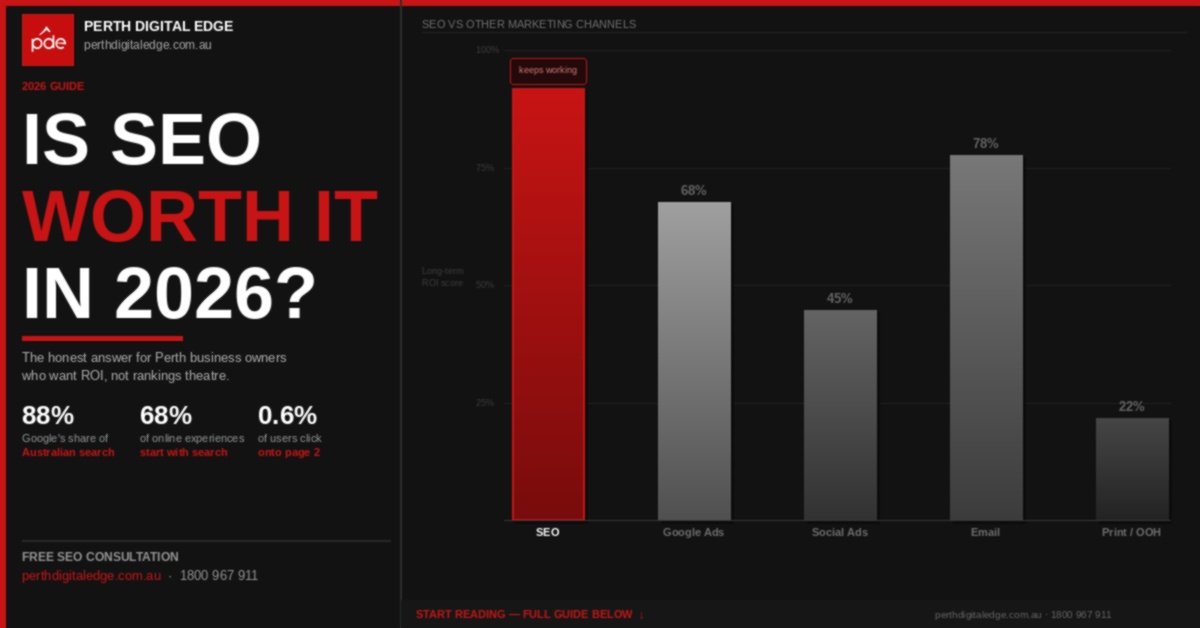
SEO Vs Other Marketing Channels
A lot of people ask whether SEO is still worth it once you compare it to Google Ads, paid ads on Meta, email, or other marketing channels.
The cleanest answer is that each channel solves a different problem.
Google Ads can bring fast visibility, especially when you need leads now and you know which search queries convert. It is one of the best digital marketing strategies for testing demand, validating specific keywords, and filling gaps while SEO efforts are still building. But unlike paid ads, the traffic stops as soon as the spend stops. There is no lasting asset in the same way.
Social media advertising is often useful higher up the funnel. It can build awareness, support remarketing, and help shape the target market before the person ever opens a search engine. It is strong when the offer is visual, impulse-driven, or needs interruption to get noticed. It is less reliable when the business relies on people actively comparing providers in Google.
Email remains one of the best channels for retention, referrals, and repeat sales, especially once a business has a list. But it does not usually solve the top-of-funnel discovery problem by itself.
SEO sits in a different lane. It is one of the few channels that can improve search rankings, support local searches, reduce customer acquisition costs, and keep driving organic search long after the original work is done. That is why SEO remains valuable in a mixed-channel strategy. It usually should not carry the whole burden alone, but it often becomes the most durable layer in the stack.
What AI Changed, And What It Did Not
The arrival of ChatGPT, Perplexity, AI Overviews, and other AI tools changed the tone of the whole conversation. Suddenly every second article was asking if SEO is dead, whether Bing Chat would replace Google, or whether websites would stop getting clicked altogether.
The reality is more nuanced.
AI has absolutely changed how some people discover information. It has also changed how search engines present answers. That matters. If your business relies heavily on broad informational queries, you may see fewer clicks than a few years ago because the answer is partly or fully visible in the search engine results.
But that is not the same as saying SEO is over.
It means the shape of SEO strategy has changed. The businesses doing well now are the ones building answer-first pages, stronger entity signals, clearer structure, better local search assets, and more authority across the web. They are not only optimising for blue links. They are also trying to become the source that AI systems cite, summarise, or recommend.
That is where search engine optimisation and modern content marketing now overlap. A page should be easy for a human to skim and easy for a machine to extract from. That means stronger headings, direct answers, clean page structure, original expertise, and useful schema. It also means not letting AI tools flatten the brand into generic copy. AI can speed up drafting. It still cannot replace actual market knowledge, local understanding, or sharp editorial judgement.
Why Local SEO Still Matters So Much In Perth
One reason local SEO still gives a strong competitive edge is that many businesses in Perth are not really competing state-wide. They are competing precinct by precinct.
Joondalup is a good example. The City of Joondalup positions the area as a major health and medical investment zone, with Joondalup Health Campus as the largest health care facility north of Perth CBD and a growing ecosystem around health, education, and innovation. That affects local searches. People looking for medical, allied health, and specialist services in that precinct often search in a more comparison-heavy way because the district itself signals credibility and choice.
Wangara works differently. Its wider industrial setting and transport access shape buyer behaviour. Searches there are often more direct. The person is less interested in reading five thought-leadership articles and more interested in whether the business appears credible, local, reachable, and clear about what it actually does. That changes what effective local SEO looks like.
This is one reason a local SEO agency with Perth context can often outperform a generic provider. Local business pages do not all need the same content pattern. A page aimed at Joondalup may need stronger reassurance, reviews, practitioner proof, and credibility cues. A page aimed at Wangara may need clearer service specificity, faster routes to action, and less fluff.
What Small Businesses Should Do Before Spending More
Before committing a larger marketing budget to an SEO campaign, there are a few things worth checking.
Start with a proper SEO audit. Not a toy scan that spits out red warnings, but a real review of technical SEO, internal links, search intent alignment, page quality, local SEO signals, Google Business Profile health, Core Web Vitals, and whether the current site even deserves to rank for the terms being targeted.
Then do real keyword research. Look beyond search volume. You need to know which search queries actually map to buyer intent, which specific keywords are worth a dedicated page, and which terms simply sound attractive but have little commercial value. Many small business owners have been sold campaigns around very specific keyword phrases that were never likely to generate leads in the first place.
Benchmark the current performance properly. Use Google Analytics and Google Search Console, not intuition. Review where website traffic is coming from, which search rankings matter, how many relevant visitors reach key pages, and whether the site is already getting impressions for terms it should not be wasting.
After that, decide where SEO fits among your broader marketing channels. If you need immediate lead flow, Google Ads may carry more of the short-term load. If you want compounding visibility and lower acquisition costs over time, SEO helps. Often the best answer is not SEO versus other marketing channels. It is sequencing them properly.
What Makes Small Business SEO Work Better In 2026
The campaigns that pay off now usually share a few traits.
They are built around search intent, not around broad traffic vanity.
They take local searches seriously. That means suburb pages where they are justified, review sites that actually matter in the category, a properly maintained Google Business Profile, and local business citations that are consistent enough to support trust.
They use content marketing selectively. Not every business needs endless blog posts. But most businesses benefit from a handful of pages that answer real objections, support the customer journey, and make the business appear credible when potential customers searching compare options.
They treat SEO content like a commercial asset. One strong page can outperform ten weak ones. A well written article that genuinely addresses the search can support both organic search and conversions. Thin pages, templated suburb content, and safe generic copy rarely do much now.
They build authority over time. That still means link building, domain authority development, and earning quality backlinks from relevant local or industry sources. Google has not stopped caring about trust. If anything, trust signals matter more when AI-generated pages are flooding the web.
And they measure the right things. Keyword rankings matter. Search rankings matter. But the most useful SEO results are usually seen in lead quality, organic traffic quality, and whether the business appears more often in the searches that actually matter.
What First-Party Work Looks Like At Perth Digital Edge
This is where a lot of SEO pages get lazy. They throw in a big metric and expect that to do the work. The better question is what changed underneath the number.
Take Project Concrete. The public Perth Digital Edge case study says the site improved visibility for terms like “Perth concreting services”, “residential concrete Perth”, and “commercial concrete solutions Perth”, with a 312 per cent increase in traffic in the first three months, 62 conversions in the first month, and 14 first-page keywords in the first month. The more useful practitioner insight is not just that rankings improved. It is that residential and commercial intent appear to have been separated more clearly. In trade SEO, one broad service page often tries to do too much. Once service segmentation, on page optimisation, and internal pathways are tightened, the campaign becomes easier for both search engines and users to interpret.
Westside Auto Wholesale shows a different pattern. The public case study reports a 4,900 per cent return on investment, 81 keywords in the top three, 124 out of 130 niche specific keywords on the front page, 1.4 million visitors in 2023, and more than 120,000 leads in 2023. More interestingly, the page also notes that the geo-targeted paid campaign split inventory categories into dedicated ad groups, aligned ad copy to buyer intent, and routed traffic to landing pages that displayed relevant vehicles while simplifying booking. That is the sort of detail many agencies skip, but it is often what separates strong automotive campaigns from noisy ones. The structure was built around inventory type, suburb-level buying behaviour, and conversion quality, not just broad traffic volume.
That is what useful SEO case studies look like. Not just better numbers, but a clearer explanation of what changed in the system.
Frequently Asked Questions
A lot of the same questions come up once business owners start weighing SEO against other digital marketing strategies. These are the ones we hear most often.
Is SEO Worth It For Small Businesses?
Yes, SEO is worth it for small businesses when people use Google Search to find and compare what you offer. It tends to work best when the business can commit to a long term investment, has a site worth improving, and does not expect overnight SEO results.
Is SEO Better Than Google Ads?
Not always. Google Ads is often better for immediate demand capture, testing offers, and generating leads fast. SEO helps when you want stronger organic search visibility, lower long-term dependency on paid ads, and a channel that can keep working after the spend eases. The two usually work best together.
How Long Does SEO Take To Show Results?
It depends on the market, the current site, and the starting point. Some local SEO improvements can move quickly, especially around Google Business Profile, page clarity, and technical issues. Broader SEO strategy gains usually take longer because competition, link building, and trust signals compound over time.
Is SEO Dead Because Of AI?
No. SEO is not dead, but lazy SEO is under more pressure. AI tools, AI Overviews, and platforms like Bing Chat have changed how search results behave, especially for informational queries. The businesses still winning are the ones creating original, clear, useful pages that can support both human readers and AI-driven search environments.
What Should I Check Before Hiring An SEO Agency?
Look at their case studies, reporting approach, understanding of search intent, and whether they talk about business goals rather than only traffic. A good SEO agency should be able to explain what work matters, what success looks like, and how they would sequence technical SEO, local SEO, keyword research, content marketing, and measurement.
The Final Verdict
So, is SEO worth it?
Yes, SEO is worth it when it is treated as a customer acquisition asset rather than a ranking hobby.
It is worth it when the work is tied to the way your target market actually searches. It is worth it when pages are built around search intent, not generic filler. It is worth it when local SEO, Google Business Profile management, quality content, technical structure, and authority signals all work in the same direction. And it is worth it when business owners understand that search engine optimisation is not a quick patch, but one of the strongest long term investments available in modern digital marketing.
It is not worth it when the campaign chases irrelevant visitors, broad vanity traffic, or specific keywords that never had commercial intent in the first place.
If you want a Perth-specific answer for your business, book a consultation with Perth Digital Edge. We can review your current setup, look at the pages that should already be doing more work, benchmark your SEO efforts in Google Analytics and Google Search Console, and map out whether SEO is the right next move for your market, your site, and your growth goals.