
If you run a small business in Perth, you know the moment I mean.
A new enquiry lands. The person says, “Found you on Google search.” You feel that tiny exhale in your shoulders because it means the phone can ring without paid advertising doing all the heavy lifting. Then the next week is quiet again, and you start wondering if your website SEO is actually working, or if you just got lucky.
From our office in Wanneroo, Perth Digital Edge sees this pattern constantly across local businesses. Not “bad businesses” either. Solid operators. Great work. A business website that looks professional. But underneath, the SEO journey is held together with duct tape: technical SEO issues blocking search engine crawlers, page titles duplicated across the site, broken links from old web design changes, or three pages chasing the same keyword and cancelling each other out.
This guide is for the owner who wants traction, not theatre. We’ll walk through what actually improves search engine rankings, how local SEO in Perth works, and what to fix first if you want organic traffic that turns into paying customers.
What SEO Is And How It Works For A Small Business
Search engine optimisation (SEO) is the work that helps a web page appear in search results when people search online for what you do. That sounds obvious, but it matters because search engines do not rank “your business” as a single thing. They rank pages.
So small business SEO usually comes down to three questions:
- Can search engines crawl and index your pages without friction?
- Do those pages match the search terms and user intent you want?
- When potential customers land, is the next step easy?
If the answer to any of those is “sort of,” your website ranks inconsistently. One month you see movement. Next month it stalls. Reports look busy. The bank account does not.
A good SEO strategy is the opposite of busy. It’s deliberate. It’s repeatable. It’s the same way you’d run any part of the business that affects cashflow.
The Perth Layer That Makes Local SEO Hit Harder
Perth is not one tidy market. It’s a string of hubs and corridors, and the way people search reflects that.
In the industrial pockets like Osborne Park, Malaga, Welshpool, and Wangara, searches are often urgent, mobile-first, and practical. Visitors want an answer fast: service area, turnaround, compliance, and a clear way to call.
Up the coast and through the suburbs, local search results and Google Maps take over. People check a Google Business Profile, scan online reviews, then shortlist quickly. They do not read your entire website content like a novel. They skim. They compare. They pick.
And here’s a detail that catches small business owners out: what feels “local” to you might not be local to Google. If your profile is incomplete, categories are off, or your address and service areas are inconsistent across other websites, you can have a great service page and still miss local search visibility.
So yes, the fundamentals are global. The execution is local.
Five Moves That Improve Search Rankings Without Turning Your Week Into Admin
You will see endless SEO tips online. Most are technically true and practically useless.
What matters for a small business is what you can actually do, and what will actually show up in search engine results.
1) Fix Technical SEO Issues So Google Can Read The Site Properly
Before you write a new paragraph, check whether Google can crawl what you already have.
This is where Google Search Console earns its keep. It tells you about indexing problems, errors, and pages that are being ignored. Pair it with a crawl using SEO tools like Screaming Frog, Semrush, or Ahrefs, and you get the full picture.
The most common technical SEO issues we find in Perth:
- broken links and redirect chains
- duplicate content from old URLs, filters, or “copy-paste suburb” pages
- repeated page titles and meta descriptions across dozens of pages
- pages blocked by noindex tags or robots rules
- slow templates and bloated plugins hurting website speed
This step is unglamorous. It is also the fastest way to stop your SEO efforts leaking.
A quick real-world example, without naming names. We audited a small trades site that “had SEO done” for years. The homepage was fine. The service pages were decent. But 40 percent of internal links were pointing to redirected URLs, and the same keyword was being targeted across multiple pages with near-identical headings. Google could not confidently choose a relevant page, so rankings drifted. Fixing the plumbing of the site moved the needle faster than publishing another blog post ever could.
2) Do Keyword Research That Matches How Customers Actually Talk
Keyword research is not a spreadsheet competition. It’s a matching exercise.
You are trying to match the way customers find and describe problems, to the pages you want search engines to rank.
A practical workflow:
- Start in Google Search Console. Find queries where you already appear, but not high enough to get clicks.
- Use Google Keyword Planner to sense search volume and variants, then sanity-check those phrases against calls, emails, and quotes.
- Open the search engine results page for the main term and look at what is ranking. That tells you what Google thinks the intent is.
This last step is the part many people skip. It’s also where most bad SEO begins. If Google is ranking service pages and you publish a guide, you are swimming against the current. If the SERP is full of guides and your page is a thin service pitch, you will often stall.
3) Rebuild The Pages That Convert, Not The Pages That Are “Nice To Have”
Small business SEO is not about having lots of pages. It’s about having the right pages do their job.
The pages that tend to matter most:
- core service pages
- a small set of location pages where local optimisation is justified
- landing pages for key offers
- supporting content that answers common questions and links back to revenue pages
If your service page starts with a vague mission statement, you are asking a rushed visitor to do work. They will not. They will hit back and click the next result.
A strong page does the basics quickly:
- what you do
- who it’s for
- where you operate
- how to take the next step
Then it earns trust: proof, process, and FAQs that reflect what customers ask. This is where you optimise on page elements in a way that feels natural, not robotic. Headings that answer questions. Internal links that help people move deeper into the site. Meta descriptions that win clicks without sounding like keyword stuffing.
4) Treat Google Business Profile As A Sales Asset, Not A Listing
Local businesses often get the biggest early lift from Google Maps and the local search results. That means your Google Business Profile is not optional admin. It’s a front door.
The profile details that matter more than most owners think:
- categories that match what you actually sell
- accurate service areas
- photos that show real work
- review velocity and replies that feel human
- consistent NAP details across reputable sites and directories
Reviews matter twice. They influence click behaviour and they influence trust. Even when rankings improve, a profile with weak reviews or stale details often converts poorly.
5) Build Authority With A Link Building Strategy You Can Explain
For competitive categories, relevance and technical SEO get you into the game. Authority often decides who stays there.
A link building strategy should not be “we’ll get you links.” It should be “we’ll earn inbound links from reputable websites that make sense for your niche.”
Examples that are usually safe and effective:
- real local partnerships and sponsorships
- supplier and association profiles
- industry publications and relevant mentions
- digital PR built around something worth linking to
If you are offered bulk links quickly, be cautious. You can end up with “progress” in a report and a mess to clean up later. High quality backlinks cost time and judgement. That’s why good SEO is not the cheapest line item in your digital marketing plan.
How To Get Started Without Wasting Six Months
If you want the cleanest start, follow this order:
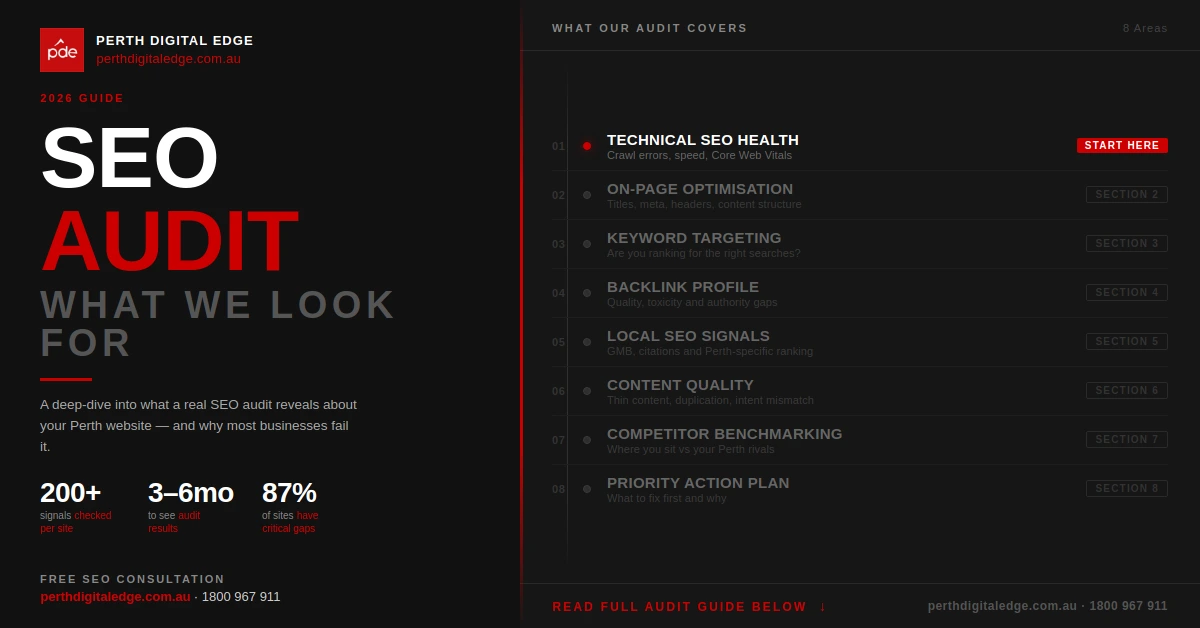
- Technical SEO audit and fixes
- Content audit and consolidation
- A 90-day plan tied to outcomes
- Consistent execution and reporting
A content audit is not just “what do we have.” It’s what is working, what is cannibalising, and what is being ignored. Combine it with data from Google Search Console and Google Analytics and you stop guessing.
This is also where SEO ROI becomes real. If you cannot track calls, forms, bookings, or sales, you can’t measure an SEO campaign properly. You can only measure activity.
How To Choose Small Business SEO Services In Perth
Whether you hire an SEO agency, an hourly SEO consultant, or work with an internal SEO team, the questions should force clarity.
Ask:
- Who is doing the SEO work day-to-day, and can I speak to the SEO specialists doing it?
- What will you change month-to-month, and what does success look like beyond keyword rankings?
- How do you handle technical SEO, not just content updates?
- What is your link building strategy and how do you vet reputable websites?
- How do you report using Google Search Console and Google Analytics?
If the answers are vague, you are not buying a robust SEO strategy. You are buying a feeling.
And one more thing, from experience. If the relationship starts with lock in contracts and mystery, it rarely improves later. Good operators can explain what they’re doing, and they’re happy to show you.
First Party Proof From Perth Digital Edge Case Studies
It’s easier to understand the work when you can picture what it looks like in the wild.
- Project Concrete reported a 312% increase in website traffic in three months, 62 conversions in the first month, and 14 first page keywords in the first month. That kind of early movement usually happens when technical SEO issues are removed quickly, pages are mapped to intent, and tracking is clean from day one.
- Westside Auto Wholesale reported 4,900% ROI, 1.4M visitors in 2023, 120,000+ leads in 2023, plus 81 keywords in the top 3 and 124 of 130 niche terms on the front page. Results like that are rarely one tweak. They come from consistent site structure work, relevant content, internal linking, and authority building over time.
- Fremantle Roofing Services reported a 300% increase in qualified leads after improving local search visibility and trust signals across the site and profile ecosystem.
Those numbers are not a shortcut. They are what happens when the fundamentals are handled properly and the campaign is managed like a system, not like a monthly ritual.
Small Business SEO FAQs
How Long Does Small Business SEO Take To Work
It depends on your baseline, competition, and how many technical SEO issues exist. Many small businesses see meaningful movement within a few months when the foundation is fixed early and work is consistent.
Is Local SEO More Important Than Traditional SEO
For a local business serving Perth suburbs, local SEO is often the fastest path to enquiries because local searches carry strong intent. If you sell nationally, the strategy may lean more heavily on broader organic search pages and content structure.
What Should I Fix First On A Business Website
Start with a technical audit. Fix broken links, redirect chains, slow page templates, and indexing problems in Google Search Console. Then confirm tracking in Google Analytics so you can measure outcomes.
Do I Need Link Building As A Small Business
Often, yes, especially if competitors have stronger authority signals. Keep the link building strategy focused on relevance and reputable sites, not volume.
How Do I Know If The SEO Campaign Is Working
In Google Search Console you should see improved impressions and clicks for relevant search terms, plus fewer indexing issues. In Google Analytics you should see organic traffic landing on the right pages and completing tracked actions.
Build A Perth Specific Plan For Your SEO Business
If your customers search online, compare options on the search engine results page, and rely on Google Maps to shortlist, SEO is not a side project. It is part of how customers find you and decide.
The path forward is usually simpler than it feels: remove technical friction, align relevant pages to real search terms, strengthen local optimisation through your Google Business Profile, and build authority with a link building strategy that does not create future cleanup.
If you want a Perth-specific plan, book a free consultation with Perth Digital Edge in Wanneroo. We will review your search visibility, your website SEO baseline, your Google Business Profile, and the pages that should be driving enquiries, then outline a practical 90-day approach.