The first time Ben looked at the backend of a Shopify store that was supposedly “SEO optimised,” the owner had paid a freelancer $1,800 for work that amounted to installing two seo apps and changing the homepage title tag. That was it. No product descriptions rewritten. No collection pages touched. No blog posts. No structured data. The freelancer had sent a PDF report full of green checkmarks from an automated audit tool, and the store owner, a woman selling handmade ceramics from a studio in Mount Lawley, had assumed the green meant good. Her organic traffic was 40 visits per month. She had been live for two years.
Ben spent forty minutes on a video call showing her what the freelancer had actually done versus what needed to happen. She cried. Not dramatically, but the quiet kind where someone realises they have been lied to and also wasted two years of potential growth. That call is the reason we now start every Shopify SEO engagement with a screen-shared audit where the client watches us go through their site in real time. No PDFs. No green checkmarks. Just the actual state of their shopify store laid bare so nobody is confused about where things stand.
We rebuilt her entire SEO strategy over eight weeks. Today that store generates 4,800 organic visits per month and ranks on page one for eleven long tail keywords in her niche. Revenue from organic search sits at $24,200 monthly, up from effectively zero. The work was not complicated. It was thorough. Every product page got a manually written title tag and meta description. Every collection page got introductory copy. We built a blog, published twelve posts targeting informational keywords, and connected the whole thing with internal linking so Google could actually understand the site’s topical structure. None of it was revolutionary. All of it was necessary.
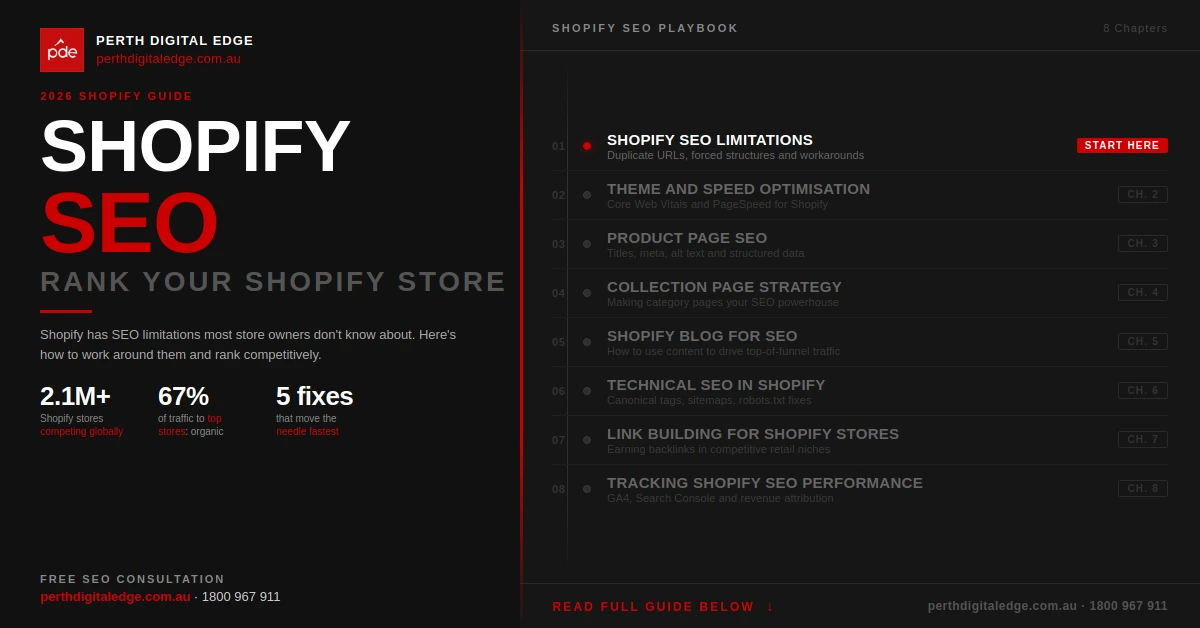
That is what this guide covers. Not theory. Not a list of plugins. The actual work required to rank a shopify store in Google, based on what we do for ecommerce clients across Perth every week.
Why Shopify SEO Matters For Online Businesses
Shopify powers over four million online stores globally, making it one of the most popular ecommerce platforms for small and medium retailers. Excellent for getting live quickly, processing payments, managing inventory. Mediocre at search engine optimization out of the box.
That is not a criticism. It is a trade-off Shopify makes deliberately. The platform prioritises simplicity, which means many of the technical seo decisions that affect search engine rankings are either automated in ways that are not always optimal, or buried in settings most store owners never find. If you want your shopify store’s visibility in Google to grow, you need to understand what the platform handles, what it handles poorly, and what it leaves entirely in your hands.
A skincare brand in Cottesloe we work with illustrates why this matters in dollar terms. They spend $4,200 per month on Google Ads. Their organic traffic, which costs nothing per click, now generates more revenue than those ads. Took seven months to get there. But every month since, that organic traffic has arrived without an invoice attached. Paid ads stop the moment you stop paying. Organic traffic from search engines keeps showing up. For a Shopify store with healthy margins, the difference between paying for every visitor and earning free ones is the difference between a business that survives and one that actually builds wealth.
Conducting Keyword Research For Your Shopify Store
Every piece of seo for shopify starts with understanding what your potential customers actually type into Google. Not what you think they type. What they actually type. The gap between those two things has cost more Shopify store owners more money than any technical SEO issue we have ever encountered.
A pet supplies store in Joondalup came to us after six months of DIY SEO that produced zero results. They had optimised thirty product pages. Every single one targeted keywords with literally zero monthly search volume. Not low volume. Zero. The owner had brainstormed search keywords based on how he described his products to friends, never once checking whether anyone actually searches those phrases. Six months of evenings and weekends, gone. When Ben showed him the search volume data for his chosen keywords versus the ones people actually use, he said something that stuck: “I feel like I’ve been posting letters to addresses that don’t exist.”
Start by listing your product categories and the problems your products solve. Then use tools like Google’s Keyword Planner, Ahrefs, or SEMrush to find the actual search keywords real people use. You need three types.
Transactional keywords signal purchase intent: “buy linen tablecloth online”, “organic dog treats Perth”, “handmade ceramic mugs Australia”. These belong on your product pages and collection pages.
Informational keywords signal research: “how to style a linen tablecloth”, “best dog treats for sensitive stomachs”, “difference between stoneware and ceramic”. These go in your blog posts. Informational keywords often have higher search volume than transactional terms, and they build the topical authority that helps your product pages rank for the commercial queries.
Long tail keywords are longer, more specific phrases with lower search volume but higher conversion rates: “Australian made organic dog treats grain free” or “hand thrown ceramic coffee mug 350ml”. Smaller Shopify stores beat major retailers here because the big players do not bother optimising for phrases this specific. Ten long tail keywords each bringing five visitors per day is fifty daily visitors converting at three to four times the rate of broad terms. That maths adds up fast.
When you conduct keyword research, pay attention to search intent. A keyword like “ceramic mugs” could mean someone wants to buy one, learn how they are made, or browse google images. Google’s own search results tell you the intent. First page dominated by product listings and ecommerce stores? Transactional. Blog posts and guides? Informational. Getting this wrong means you are optimising a product page for a query Google has decided should be answered by a blog post. You will not rank regardless of how good the page is.
Map each keyword to a specific page. Your primary keyword for each page should appear in the title tag, the meta description, the H1, and naturally within the page content. Do not fall into keyword stuffing. Google’s algorithm recognises synonyms and related terms. Pages that read like they were written for a crawler rather than a person get penalised in search rankings.
On Page SEO For Shopify Product And Collection Pages
On page seo is where most Shopify stores have the largest gap between current state and potential, because the platform’s defaults here are genuinely poor and manual effort produces the most visible gains.
Title Tags And Meta Descriptions. Every page on your shopify site has a title and meta description that appear in search results. You edit these through the search engine listing preview section in your shopify admin for each product, collection, and page. Most store owners never touch these fields. Shopify auto-generates them from the product name and the first lines of the description. The result fails to include target keywords and gives the searcher no reason to click yours over a competitor’s.
Write every title tag manually. Front-load your primary keyword. Keep it under 60 characters. For meta descriptions, you have roughly 155 characters. Use them to describe the product benefit, include a secondary keyword, and differentiate from the ten other listings on the same search engine results page. This is tedious, repetitive work. Ben hates doing it. He also knows it is the single highest-impact change most Shopify store owners can make, because you are optimizing individual pages for the exact queries customers search. The stores where we skip nothing on title tags consistently outperform the ones where we cut corners to save time. Every time. No exceptions in five years of doing this.
Product Descriptions That Rank. Your product descriptions serve two audiences simultaneously: the human deciding whether to buy and the search engine deciding whether to rank. Three-line descriptions with dimensions and materials give Google nothing to work with. Write at least 150 to 300 words of unique copy per product page. Use your relevant keywords naturally. Do not duplicate the manufacturer’s description that appears on twenty other sites, because duplicate content dilutes your search visibility.
A jewellery store in Claremont we took on had 180 product pages using manufacturer descriptions word for word. So did their three biggest competitors. Google had four identical pages to choose from and no reason to pick theirs. We rewrote 60 of their highest-value product descriptions. Those 60 pages saw a 340 percent increase in organic impressions within three months. The untouched pages stayed flat. The owner kept the spreadsheet we gave her tracking the before-and-after performance and showed it to another jeweller at a trade fair in Sydney. That jeweller called us the following week. First-hand evidence travels faster than any marketing we could do.
Collection Pages Need Content Too. Shopify’s collection pages are ranking opportunities most store owners waste. By default, a collection page shows a product grid and nothing else. Add 200 to 400 words of introductory copy above the grid. Explain what the collection contains, who it is for, and why these products belong together. This helps search engines understand the page’s relevance and gives it enough content to compete for category-level keywords. A collection page for “Linen Tablecloths” with 300 words targeting “buy linen tablecloths Australia” will outrank a bare product grid.
Page Titles And Header Structure. Use a clear H1 on every page including your primary keyword. Shopify automatically creates the H1 from your product or collection name, so make names descriptive rather than clever. “The Wanderer” as a product name tells Google nothing. “Hand Poured Soy Candle – Australian Bushland Scent 300g” tells Google exactly what the page sells. We have argued with clients about this more than any other SEO recommendation. People love their creative product names. Google does not care about clever. Google cares about clear.
Technical SEO For Shopify Sites
Most store owners treat this section the way people treat the terms and conditions on a software update. Eyes glaze, scroll to the bottom, accept and move on. That instinct costs rankings. Shopify handles several technical seo elements automatically, which is a genuine strength. But the gaps are specific and knowing them matters.
Site Speed And Core Web Vitals. Google uses core web vitals as a ranking signal. Shopify’s hosted infrastructure is generally fast, but themes with excessive JavaScript, unoptimised images, and too many third-party apps degrade performance badly. The Claremont jewellery store had 23 Shopify apps installed. Eleven injected scripts into every page load. Removing the dead weight cut load time from 4.8 seconds to 1.9 seconds. Rankings moved within three weeks. The owner had installed most of those apps during a single Sunday afternoon trying to “improve” the site. Each one silently slowing the thing Google weighs heavily. Compress images before uploading. Use Shopify’s built-in lazy loading. Limit apps from the shopify app store to ones you actually use weekly. If you installed it six months ago and forgot it existed, it is still loading on every page.
Canonical Tags And Duplicate Content. Shopify automatically creates canonical tags on product pages to handle a quirk of its URL structure. Products can be accessed via multiple URLs through collections, search, and direct links. The canonical tag tells search engines which version is authoritative. This works well by default. Where duplicate content bites is product variations listed as separate pages with near-identical descriptions, or collection page filtering creating indexable URL parameters. Check google search console for duplicate content warnings regularly.
XML Sitemap. Shopify automatically generates an XML sitemap at yourstore.com/sitemap.xml and submits it to search engines. You cannot edit it directly, which is occasionally frustrating. For pages you want excluded from indexing, use the “noindex” tag via theme Liquid code or a seo apps solution. Verify your sitemap in google search console. A sitemap with broken URLs or redirected pages sends poor signals.
Structured Data And Schema Markup. This is the piece that separates the stores getting rich snippets in search results from the ones showing plain blue links. Structured data is code on your pages that helps search engines understand your content in granular detail. Schema markup for products can display price, availability, and product ratings directly in search results, which lifts click-through rates substantially.
Shopify themes vary wildly in their structured data implementation. Some include basic product schema. Most skip review schema, FAQ schema, and breadcrumb schema entirely. Use an app from the shopify app store or custom Liquid code to add comprehensive schema markup to your product and collection pages. A pet supplies store in Morley saw a 22 percent increase in organic clicks after we added review schema. Their ranking position did not change. Same position, more clicks, because a listing with star ratings looks more trustworthy than a plain text link. Ben calls this “earning clicks you already have” and it is one of the fastest wins in ecommerce SEO.
SEO Friendly URLs. Shopify generates URLs based on page titles, which is fine. But it enforces /products/, /collections/, and /pages/ in the path. You cannot change that. What you control is the handle. Keep it short, descriptive, keyword-inclusive. “Hand-poured-soy-candle-australian-bushland” beats “the-wanderer-v2-new”. Edit handles in your Shopify admin before the page goes live. Changing URLs after indexing requires redirects and temporarily costs rankings.
Content Strategy Beyond Product Pages
Here is something that took Ben a long time to accept about ecommerce SEO, and he resisted it initially because it felt counterintuitive: the stores that rank best for transactional keywords are almost never the ones that only publish transactional pages. They are the ones that also create content answering the questions people ask before they buy.
A Shopify store without a blog is competing for transactional keywords only. Adding a content strategy built around informational keywords expands the query footprint your site covers and builds topical authority that strengthens product page rankings. The Mount Lawley ceramics store published twelve blog posts over three months targeting informational keywords like “how to set a table for a dinner party”, “linen vs cotton tablecloths”, and “Australian made homewares brands”. Those posts now account for 40 percent of her organic traffic. More importantly, they funnel visitors to product pages through internal linking. A reader arriving at “how to set a table for a dinner party” who sees a natural link to her tablecloth collection is already engaged with the brand. Those visitors convert at rates that cold paid traffic cannot touch.
But content strategy fails for most Shopify owners for one specific reason: impatience. They publish five posts, see no immediate traffic, and stop. The Mount Lawley store owner almost quit at month two. She messaged Ben on a Friday night asking whether the blog was a waste of time. He pulled up her google search console data and screenshotted the impression graph: a clear upward curve that had not yet translated into clicks. Google was noticing her content. The clicks were coming. She stuck with it. By month four she was on page one for three informational terms and the product pages they linked to had moved from page four to page two. By month six, page one.
When you create content for your Shopify blog, target one primary keyword per post. Use your keywords naturally. Answer the searcher’s actual question thoroughly. Include internal links to relevant product and collection pages. Add descriptive alt text to every image. Publish consistently.
Internal linking is the most underused tactic in ecommerce seo. Every blog post should link to two or three relevant product pages or collection pages. Every product page should link to related products. This internal linking structure tells search engines which pages matter most and distributes page authority across your site. Without it, pages exist as isolated documents Google has to discover independently.
Image Optimisation For Shopify
Images are a major ranking factor for ecommerce, both for standard Google Search and for google images, which drives real traffic for visual products.
Shopify compresses images on upload, but optimise before uploading regardless. Use WebP or compressed JPEG. Keep files under 200KB. Name files descriptively: “hand-poured-soy-candle-australian-bushland-300g.jpg” not “IMG_4582.jpg”.
Every image needs alt text. Add descriptive alt text that describes what the image shows and includes relevant keywords where natural. Shopify lets you set alt text through the shopify admin for each product image. This is not optional. Alt text helps search engines understand images, makes your site accessible, and determines whether products appear in google images results. The Cottesloe skincare brand gets 18 percent of their organic traffic from Google Images specifically because their photography is excellent and every image has properly written alt text. That is traffic their competitors miss entirely because they left alt text fields blank.
Google Shopping And Merchant Center Integration
If you sell physical products, connecting your shopify store to google merchant center is not optional. Your google merchant center account feeds product data into Google Shopping, displaying your products with images and prices in search results and the Shopping tab.
Shopify has a native Google channel app that syncs your product feed automatically. Install the shopify app, connect your google merchant center account, and verify your google shopping feed is accurate. Product titles, descriptions, images, pricing, and availability all pull from your Shopify store data. This is another reason to optimise at the source rather than patching things in Merchant Center after the fact.
Free product listings in Google Shopping are available to any retailer with a merchant center account. No ad spend required. Paid Google Shopping ads give priority placement. Both use the same feed. Every improvement to your product data lifts visibility across paid and free channels simultaneously.
Connect google analytics and google search console to your Shopify store. Google analytics shows how visitors behave, which pages hold attention, where they abandon, which sources produce purchases. Google search console shows how Google sees your site, which queries drive impressions, and where technical issues lurk. Both free. Without them you are guessing, and guessing is expensive when you are running an ecommerce store.
Local SEO For Shopify Stores With Physical Locations
If you have a physical location alongside your online store, local SEO multiplies organic visibility. Claim your Google Business Profile. Make your name, address, and phone number consistent across your website, Google, and every directory listing.
For Shopify stores serving a geographic area, create page content targeting local queries. A store selling candles from Fremantle should mention the area specifically, not just publish generic product descriptions. This positions you for “near me” searches and queries like “handmade candles Fremantle” or “soy candles Perth”.
Westside Auto Wholesale does not run a Shopify store. They sell used cars from their yard on Ewing Street in Bentley. But the local seo principles we applied to their Google presence are identical: consistent NAP data, location-specific content, customer reviews, and a properly optimised Business Profile drove a 140 percent increase in local search visibility over six months.
Link Building For Ecommerce Stores
High quality backlinks from relevant websites tell Google your site is trustworthy. Link building for ecommerce is harder than for content sites because product pages rarely attract links naturally.
Build links to blog content first. Publish genuinely useful guides, comparisons, or original research that people in your industry would reference. Reach out to local bloggers, industry publications, and complementary businesses. Supplier and manufacturer links are overlooked constantly. If your products come from Australian brands, ask those brands to link to your store from their stockist page. Relevant, legitimate high quality backlinks that also send referral traffic.
Do not buy links. We inherited a Shopify store from a previous agency that had purchased 200 directory links over six months. Every one from irrelevant sites with no real traffic. Organic traffic had actually declined during that campaign. We spent five months disavowing toxic links and building legitimate ones to get back to pre-penalty levels. Five months of lost revenue because someone took a shortcut that felt productive at the time.
Advanced SEO And Ongoing Optimisation
Advanced seo for Shopify is not a different skill set. It is the same fundamentals reviewed and refined against data, month after month.
Review google search console data monthly. Queries driving impressions but not clicks are opportunities to rewrite title tags and meta descriptions. Pages declining in search performance need diagnosis: outdated content, stronger competitors, or a technical issue that crept in.
Monitor core web vitals regularly. What loaded in 1.8 seconds six months ago might load in 3.2 today if you have added apps and unoptimised images. Update blog posts annually. Refresh statistics. Add sections covering new angles. Google favours content that stays current.
Test structured data using Google’s Rich Results Test. Broken schema markup means lost rich snippets, which means fewer clicks from the same ranking position. And something we have been doing lately that has produced surprisingly good results: auditing competitor Shopify site technical SEO for weaknesses. If a competitor has broken structured data, missing alt text, or four-second page loads, those are advantages they are handing you for free. Search rankings are zero-sum. For you to move up, someone moves down. Knowing where competitors are weak tells you where your effort produces the fastest return.
How Long Does Shopify SEO Take To Work?
Most Shopify stores see measurable improvements within three to six months of implementing a comprehensive SEO strategy. Technical fixes produce results fastest, sometimes within weeks. The Claremont jewellery store saw movement within three weeks after speed optimisation. Content strategy is slower. The Mount Lawley ceramics store reached consistent page-one positions at month four. Timelines vary by competition and starting point, but expecting results in under three months from content and link building is unrealistic.
Does Shopify Have Good SEO Built In?
Shopify provides a solid foundation: automatic XML sitemap generation, canonical tags, SSL certificates, mobile-responsive themes. The limitations include rigid URL structures, limited robots.txt control, and default title tags and meta descriptions that are rarely optimised. Shopify automatically creates these defaults from your product names, which is a starting point, not a solution. With manual optimisation of page titles, product descriptions, structured data, and a deliberate content strategy, Shopify can compete with any ecommerce platform for search engine rankings.
What Are The Best SEO Apps For Shopify?
Several seo apps in the shopify app store automate tasks like schema markup, image alt text, redirect management, and broken link detection. Popular options include SEO Manager, Smart SEO, and JSON-LD for SEO. No app replaces writing quality product descriptions, conducting keyword research, creating content, and building links. Apps assist a strategy. They do not generate one.
Should I Hire A Shopify SEO Agency?
If your ecommerce store generates revenue but you lack the time or expertise to maintain an SEO strategy, professional Shopify SEO services will typically pay for themselves within six to twelve months. A store with 20 products in a niche category might manage with guided DIY effort. A store with 500 products competing against established retailers needs professional work. The honest answer is that most store owners who try to learn SEO while also running their business end up doing neither well, which is not a criticism of their intelligence. It is a statement about time.
Get Your Shopify Store Ranking Where It Should Be
Your shopify store is sitting in front of an audience already searching for what you sell. Whether Google recommends your pages depends on whether you have given it enough information to understand them, enough quality signals to trust them, and enough content to justify ranking them above competitors who have done more work. That is not a technology problem. It is an optimisation problem, and it is solvable.
At Perth Digital Edge, Ben Tippett and our team provide Shopify SEO services for online businesses and ecommerce stores across Perth that want more organic traffic converting into revenue. We handle keyword research, on page SEO, technical audits, content strategy, and link building. We set up your google search console and google analytics tracking, connect your google merchant center account, optimise your google shopping feed, and deliver monthly reporting showing exactly what improved and why.
If your Shopify store is not generating the search performance it should, talk to us. We will audit your site on a shared screen, show you the specific gaps, and tell you what fixing them is worth.