Google changes search more often than most business owners realise. Some of those changes are small enough that nobody notices. Others reshape search results, shift website traffic overnight, and send site owners into Google Search looking for answers. My name is Ben Tippett. I run Perth Digital Edge from Wanneroo, and in ten years of managing Perth SEO campaigns for businesses, the past eighteen months have been the most disruptive stretch in Google’s history.
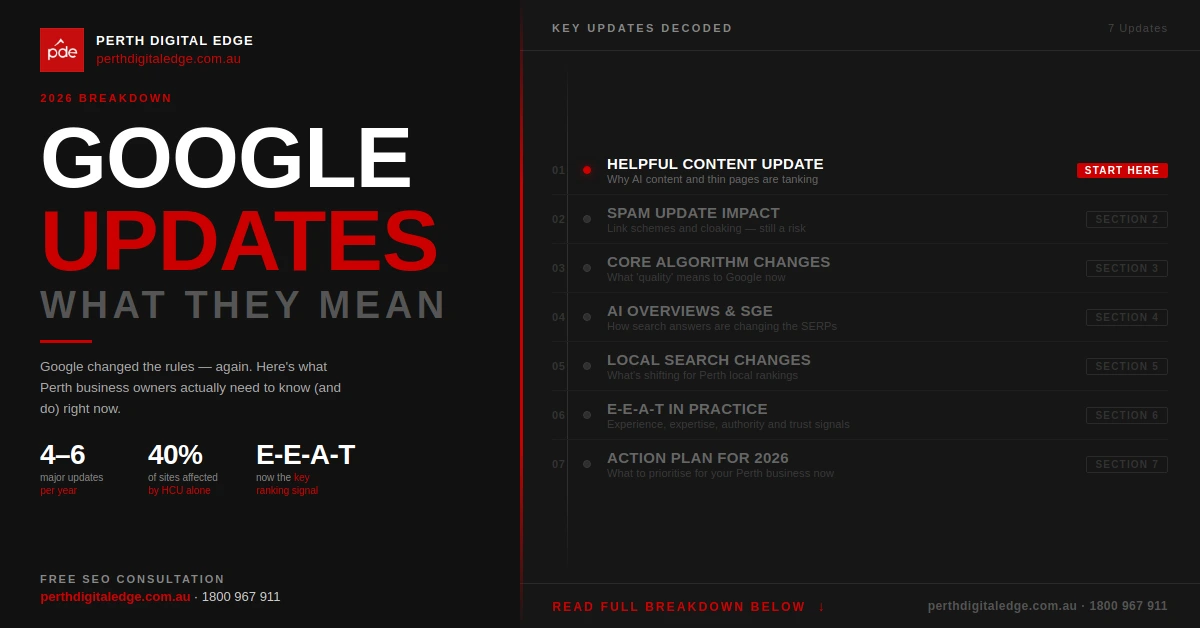
Between the November 2024 broad core update, the December core update, spam updates, AI Overviews rolling out across search, and AI Mode launching through Search Labs, Google has made one thing very clear. Search is moving further away from generic content and thin content, and further toward pages that show genuine expertise, real authority, and a better search experience. For a Joondalup tradie or a Fremantle retailer, that shift matters because it changes what actually earns visibility in 2026.
Why Businesses Are Feeling More Volatility
A lot of businesses are asking the same question right now. Why did our search results change when we did not touch the site?
The short answer is that Google touched the search index. A core update is not a penalty aimed at one weak page. It is a broad reassessment of how Google evaluates content across the entire index. Google’s own documentation says sites affected are not necessarily doing anything “wrong.” They may simply be reassessed against stronger alternatives. The Google Search Status Dashboard shows how active this cycle has been: the November 2024 core update, the December core update, and the December 2024 spam update all landed within weeks of each other.
We saw this directly with a client in Osborne Park. An industrial supply company that had held steady rankings for two years dropped 30 positions on three key service pages after the November core update. Nothing on the site had changed. But their competitors had published stronger, more specific content. Google noticed. The pages that lost ground were the ones with the thinnest content and the weakest alignment with search queries. We rebuilt those three pages with deeper product comparisons, genuine installation guidance from their technical team, and cleaner internal linking. Two of the three returned to page one within eight weeks of the December core update. The third is still climbing.
That pattern is worth paying attention to. Rankings suffer more easily when the site has weak differentiation. If content quality is thin, if the same keyword stuffing patterns sit underneath the copy, or if the site relies on old techniques, the broad core update environment becomes much less forgiving.
What The Core Update Pattern Is Telling Us
One of the biggest mistakes a business owner can make is treating each core update like a temporary storm.
The pattern in Google’s history tells a different story. Previous updates often looked like separate events, but taken together they point in one direction. Google evaluates pages more holistically now. A page does not win because it has the right keywords alone. It wins because the page is useful, well structured, aligned with what the searcher actually needs, and supported by enough trust signals for Google’s core algorithm to feel confident ranking it.
This is why E-E-A-T (Experience, Expertise, Authoritativeness, Trust, sometimes written as E E A T) thinking matters even though it is not a direct ranking factor in the mechanical sense. It is a lens through which content quality and real expertise become easier to evaluate. When we reviewed the pages that held or gained rankings across our Perth client base during the November and December core update cycle, the pattern was clear. Pages written by or with input from actual practitioners, containing specific Perth examples, real pricing context, or verifiable project details outperformed pages that simply described a service in broad terms. Castle Security’s service pages, built around entity SEO and specific security scenarios for Perth commercial properties, gained 14 new page-one positions during a period when many competitors in the same space lost ground.
What Spam Updates Mean In Practical Terms
Spam updates close loopholes that some sites have relied on for years.
Google’s spam update documentation explains that its automated systems are always working, but notable spam updates reflect improvements to how Google detects and reduces search spam. Over the past two years, Google has sharpened its policies around scaled content abuse, expired domain abuse, and site reputation abuse. In plain terms, that means Google is less tolerant of content farms, low quality content published at volume, and third-party pages sitting on otherwise reputable domains to capture search rankings.
For a Perth business, the lesson is practical. If your digital marketing strategy still depends on generic pages, AI generated content with minimal editing, or volume-first publishing, the risk is no longer theoretical. Google notices. A smarter approach is to publish fewer pages, give them more depth, and make sure each page has a clear reason to exist. When we rebuilt the content strategy for Fremantle Roofing Services, we removed 12 thin blog posts that were diluting the site’s authority and redirected that crawl equity to six stronger service pages. Their page-one keyword count increased from 23 to 41 over the following quarter. Fewer pages. Stronger results.
What Google’s AI Overviews Mean For Organic Traffic
AI Overviews changed the conversation because they alter what many users see before they click.
Google expanded AI Overviews and introduced AI Mode as part of its broader push into AI search. In early 2026, Google confirmed that Search now uses the Gemini 3 model for AI Overviews. Google has also said that with AI Overviews and AI Mode, people are asking longer and more complex search queries, which can create new opportunities for site owners exploring a wider range of sources.
That sounds positive, but businesses need to be realistic. AI generated summaries and AI generated answers can reduce clicks for some informational searches. If a page’s only value was answering a basic question now covered by AI summaries, its website traffic may soften. This is especially visible for thin explainers and low quality content. Travel sites, independent publishers, and comparison-heavy categories have all been watching this closely because AI search changes the balance between visibility and click-through.
The upside is that pages with real expertise, unique data, or stronger human insight become more valuable. If AI Overviews handle the obvious answer, your job is to publish the page people still want after the obvious answer. For Eco Style Pool Renovations, that meant creating detailed before-and-after project galleries with suburb-specific context, cost breakdowns, and material comparisons that no AI generated summary could replicate. Those pages now account for over 40% of their organic traffic because they offer something a summary cannot.
What AI Mode Means For Site Owners
AI Mode is not just another visual feature in Google Search. It changes how users interact with the search engine.
Google introduced AI Mode through Search Labs and has continued expanding it as a conversational, follow-up-friendly search experience. For site owners, this matters because user journeys become less linear. Traditional search often meant one query, ten blue links, and a click. AI Mode encourages follow-up questions, deeper comparisons, and multi-step exploration. That changes which pages win attention.
The practical consequence is that your content strategy should anticipate the second and third question, not just the first. Technical SEO also matters more here because the site needs to be clean enough for search algorithms to interpret page relationships properly. Internal links, structured data, content hierarchy, and relevant content all help Google understand the site with more confidence, which becomes even more important in a search environment shaped by generative AI and machine learning. Google also updated its documentation in 2026 to confirm that AI Mode traffic counts in Search Console Performance reporting, which means businesses tracking key metrics now need to interpret their numbers with that context.
What Google’s Guidance On AI Generated Content Really Says
A lot of businesses heard “Google allows AI generated content” and stopped listening there. That is not what Google said.
Google’s guidance explains that the issue is not AI generated content by itself. The issue is low quality content created primarily to manipulate search rankings rather than help people. Google has long focused on rewarding helpful content, and it says using automation or AI can be fine if the output is useful, original, and created for people first. The content can also serve multiple languages and markets if the quality holds up.
For businesses, that means AI tools are not the problem. Lazy use of them is. If your team uses AI to speed up outlines, summarise research, or draft first versions, that can be perfectly sensible. If the result is thin content or generic content that reads the same as every other site, the problem is the lack of human oversight, real expertise, and editorial judgement. This is why so many businesses are rethinking what high quality content actually means in this new era of AI search. Consumer behavior is shifting, and the bar for what Google considers worth ranking is shifting with it.
What Businesses Should Do Next
The safest response to Google’s recent updates is not panic. It is better standards.
Start with your existing site. Look at pages that lost search rankings or website traffic and ask hard questions. Is the page genuinely useful? Does it show genuine expertise or just recycled SEO language? Does it answer the search intent cleanly? Is it supported by good technical SEO, clear internal links, and content quality that holds up under comparison? If the answer is no, rewriting the page around real authority will usually do more than adding more keywords.
Then review your content strategy. A lot of businesses still publish because they think more pages equals more visibility. That logic is weaker now. Google’s spam updates, helpful content systems, and AI search changes all point toward the same conclusion: fewer pages with stronger insight will often outperform broad, repetitive publishing.
Finally, tighten your measurement. Use Google Search Console and analytics platforms to review key metrics properly. Look at which pages still earn strong organic traffic, which search queries are changing, and where your presence is thinning. We run this exact review for clients across Perth, from Rockingham service businesses to Subiaco professional firms, and the businesses that treat this as an ongoing process adapt faster than those waiting for rankings to recover on their own.
How Perth Digital Edge Reads This Shift
At Perth Digital Edge, the clearest lesson from these major updates is that Google is becoming less patient with pages that are technically present but strategically weak.
That means SEO strategy now needs more than basic optimisation. It needs sharper page roles, better technical SEO, stronger internal links, higher content quality, and a more serious commitment to genuine expertise. It also means businesses need to stop treating AI generated summaries, AI Overviews, and traditional search as separate worlds. They are now part of one search experience, and your site has to be useful inside that environment.
The businesses that come through these updates best are not chasing hacks. They are the ones building pages that deserve to rank whether the user arrives through classic Google Search, AI Overviews, or AI Mode. Westside Auto Wholesale held and gained positions through both core updates because their vehicle listing pages were built around genuine product detail and suburb-level search intent, not generic category descriptions. That is the standard Google is moving toward, and the businesses investing in it now are the ones who will not be scrambling after the next update.
Frequently Asked Questions
These are the questions Perth business owners have been asking us most since the recent update cycle.
What Is A Core Update?
A core update is a broad change to Google’s ranking systems. It is not aimed at one niche tactic. It reflects a wider reassessment of how Google evaluates content quality, relevance, and authority across the search index.
Do AI Overviews Mean SEO Is Dead?
No. Some search behaviour is changing, and informational clicks may be reduced in some cases. But businesses with real expertise, stronger content quality, and clearer page value still have strong opportunities. The pages that lose are the ones that offered nothing beyond a basic answer.
Is AI Generated Content Automatically Bad?
No. Google’s position is that AI generated content is not automatically a problem. Low quality content created mainly to manipulate search rankings is the problem, regardless of how it was produced.
What Should Businesses Prioritise Now?
Focus on helpful content, technical SEO, clear search intent matching, stronger internal links, and content that demonstrates genuine expertise rather than generic digital marketing phrasing. Review your weakest pages first.
Review Your Search Strategy Before The Next Update Does It For You
If your rankings have shifted, your website traffic feels less predictable, or your content strategy looks too thin for where Google is heading, Perth Digital Edge can help.
Book a strategy review and we will assess your site, your search visibility, and the changes most likely to strengthen your position. We have been helping Perth businesses navigate Google’s updates for ten years, from Balcatta trades to Joondalup medical practices, and the approach that works has not changed: build pages worth ranking, and the rankings follow.
Ready To Get Ahead Of The Next Update?
Book a strategy review with Perth Digital Edge and find out where your site stands after Google’s recent changes.