What is international SEO, and why does it matter so much for any Australian business with ambitions beyond the domestic market? The short answer is that international SEO is the practice of optimising your website so that search engines understand which countries and languages you serve, and then show the right pages to the right audiences in the right places. After more than a decade running campaigns for clients out of our Wanneroo base at Perth Digital Edge, we have watched WA exporters, resources consulting firms, and ecommerce brands use international SEO to turn a single-country website into a trusted presence across global markets. This international SEO guide walks through what international SEO actually is, how it works, and what a robust international SEO strategy looks like in practice.
International SEO sits at the intersection of technical SEO , keyword research, content strategy, and cultural awareness. It involves telling search engines which language versions of your site serve which target country across different countries and languages, making sure local search engines can find those pages, and shaping the content so international audiences and global audiences actually trust and enjoy reading it in their local language. When done properly, international SEO lifts organic traffic, opens new markets, and gives your business a genuine global reach. When done poorly, it confuses search engines, splits authority, and leaves international pages floating invisibly in search results nobody ever sees.
The Simple Definition Of International SEO
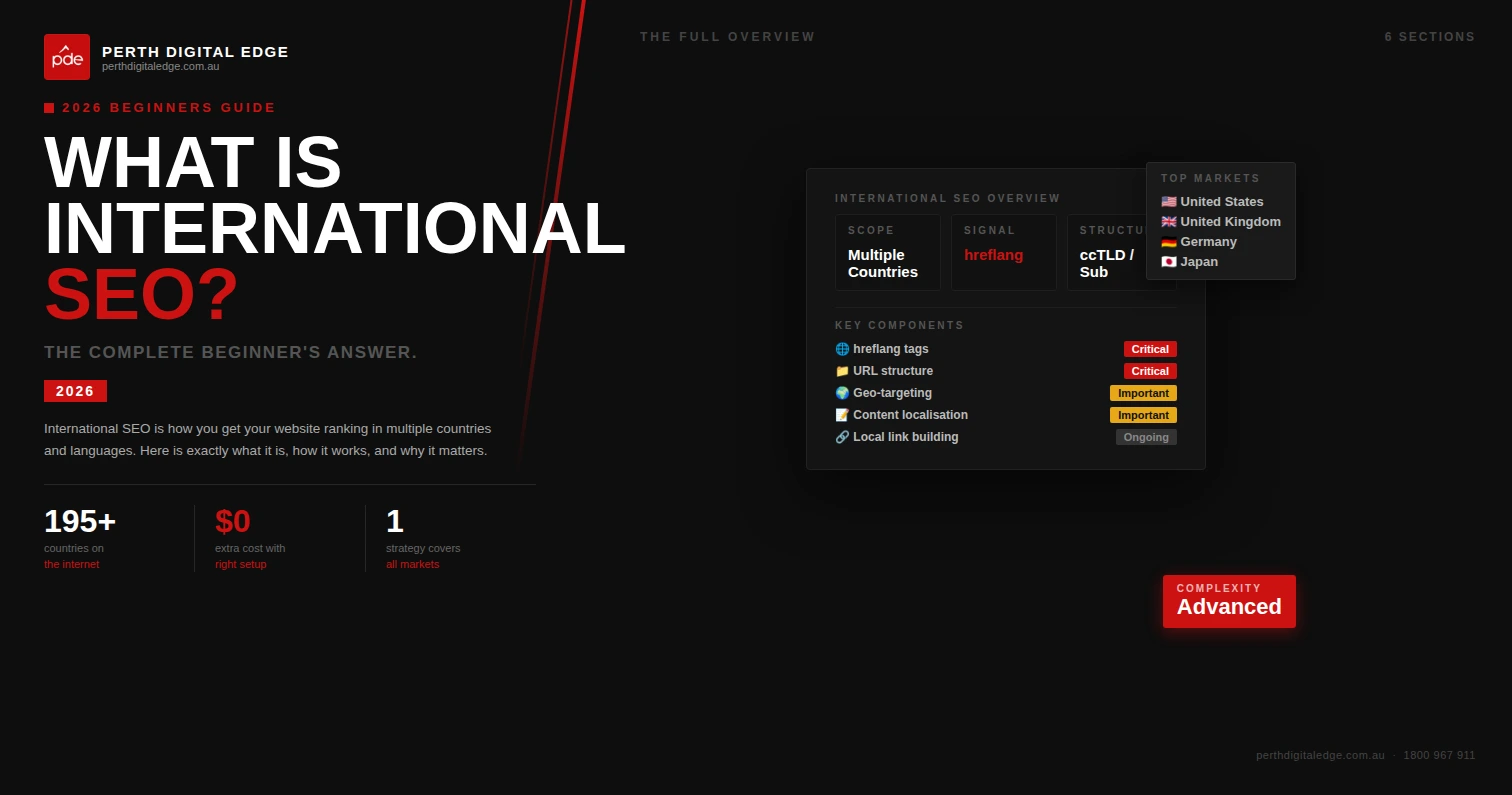
At its simplest, international SEO is the process of optimising a website to rank in search results across different countries, different regions, and different languages. It covers everything from the url structure you choose for each country version, to the hreflang tags that tell search engines which page belongs to which audience, to the keyword research process you follow for a target market you may never have visited in person. Unlike local SEO, which focuses on a single city or suburb, international SEO focuses on helping search engines interpret your website as a legitimate option for users in multiple countries at once.
Our working definition at Perth Digital Edge is that international SEO is the technical and editorial work required to make a website rank well in local search results for every market you want to serve. That includes language targeting, cultural references that actually land with your target audience, local keywords researched against real local search behaviour, and the technical scaffolding that helps search engines understand exactly which version of a page to serve. Every effective international seo strategy we have built for a Perth client has combined these elements into something genuinely coherent.
Why International SEO Matters For Australian Businesses
Australia is a wealthy market but a small one by global standards. For any WA business with genuine ambitions, from a Fremantle wine exporter to a Subiaco software company to a West Perth resources consulting firm, the addressable audience sitting outside Australia dwarfs the audience inside it. International SEO is how you reach those potential customers at the moment they are searching for what you sell. Without it, your website is invisible to anyone typing a query into their local search engines in their own language, and your competitors in those foreign markets pick up every lead you should have had.
The case for international SEO is also one of resilience. Relying on a single national audience leaves any business exposed to local market downturns. Opening organic traffic channels in multiple countries diversifies revenue and softens the impact of any single market slowing down. We have watched Perth clients ride out domestic slumps because their international seo efforts were already delivering leads from overseas when the home market cooled.
How Search Engines Handle International Content
Search engines interpret international websites by looking at a bundle of signals. The country code top level domain you use, the hreflang tags on each page, the language and cultural nuances in your copy, the server location hosting the site, the local backlinks pointing at each version, and the google analytics and google search console configurations you have set up all contribute to how search engines understand your geographic intent. Get these signals aligned and search engines will happily serve your pages to the right audience. Get them contradictory and search engines will hesitate, confused about which version to trust.
Each of the other search engines that matter in your target markets, from Baidu in China to Yandex in Russia to Naver in South Korea, has its own expectations. Google dominates most global markets, but assuming Google is the only game in town is a mistake for any serious international SEO guide. Understanding how local search engines in each target country handle international sites is part of what separates amateur effort from a successful international SEO strategy.
The Core Components Of An International SEO Strategy
Every robust international SEO strategy we build for a client starts with the same building blocks. The balance between them shifts depending on the target market and the business model, but the components themselves are consistent. Skipping any one of them leaves gaps that eventually cost you search rankings.
Target Market Research And Audience Selection
Thorough market research is where every effective international SEO strategy begins. Before any technical work, before any content, we spend time understanding which markets are worth pursuing, what the target audience in each market actually looks like, and how local search patterns differ from what we see in Australia. For some clients, that means prioritising three target markets where demand already exists. For others, it means opening new markets where competition is thin and the opportunity is wide open. Market research also helps us decide whether a target country deserves a full language version of the site or simply regional content in English.
Keyword Research For Global And Local Terms
Comprehensive keyword research for international markets is harder than domestic keyword research because the same language does not mean the same search behaviour. British English and American English produce different relevant keywords for the same product. Mexican Spanish and Spanish from Spain use different words for the same concept. We build keyword lists for each target market from scratch using native language tools and local search volume data rather than trying to translate Australian keyword research word for word. Finding relevant keywords this way surfaces opportunities machine translation would miss entirely.
Hreflang Tags And Language Targeting
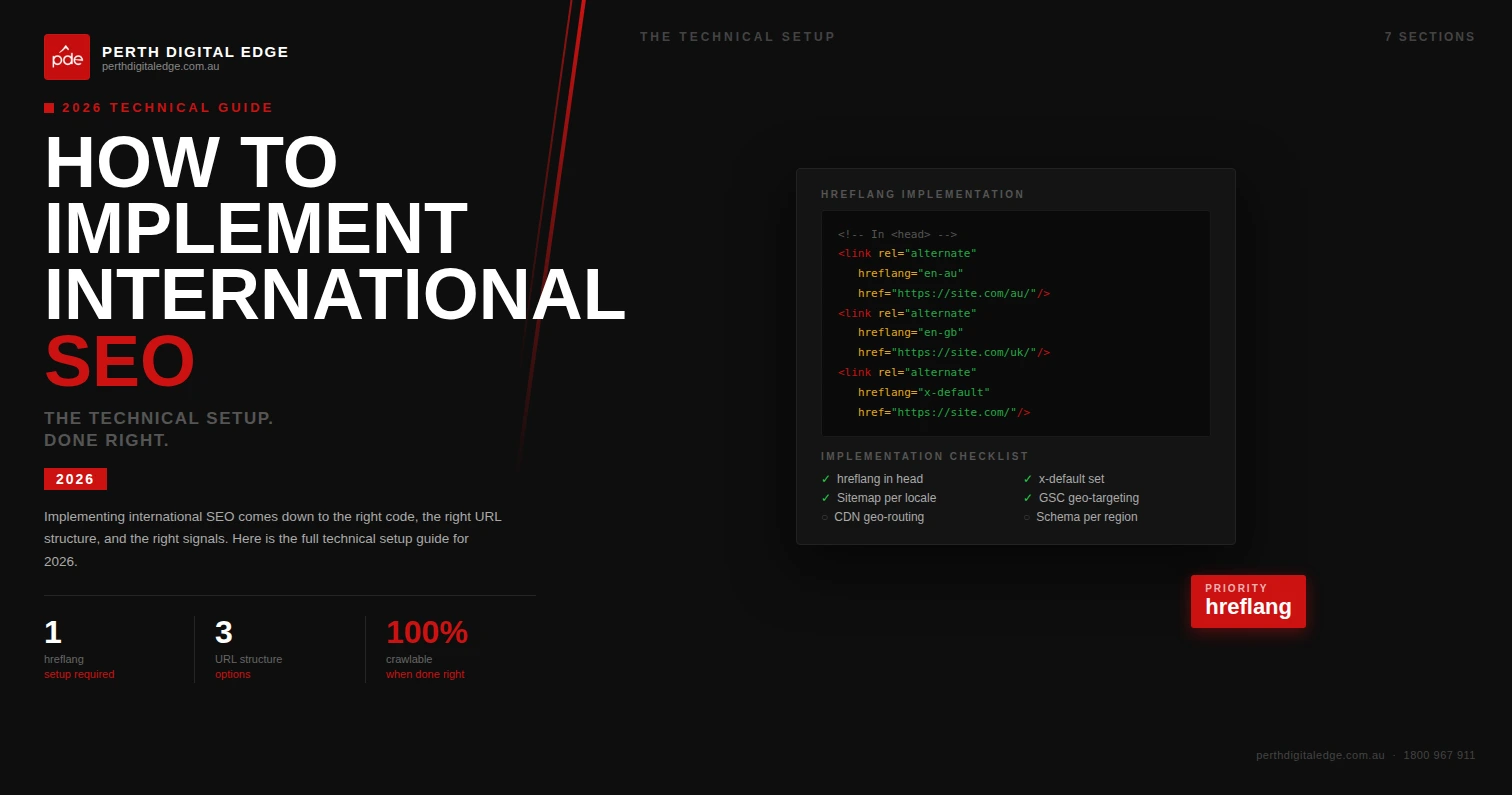
Hreflang tags tell search engines which page is intended for which language and region. They are one of the most important technical signals in international SEO, and they are also one of the most commonly broken. Language targeting through hreflang lets search engines interpret your site as multiple coordinated language versions rather than as duplicate content. Without correct hreflang, an English page targeted at the United States and an English page targeted at Australia can cannibalise each other in international search results and confuse search engines about which version deserves to rank where.
URL Structure And Country Code Top Level Domains
Choosing the right URL structure is one of the bigger decisions in any international SEO strategy. You can use country code top level domains like .com.au, .co.uk, or .de, which give the clearest geographic signal. You can use subdirectories like example.com/fr/ on a single global domain, which keeps authority consolidated. You can use subdomains like fr.example.com, which sit somewhere between the two. Each option has trade-offs around authority, maintenance, and user trust. We help clients choose the right structure by mapping it against their target market, their technical resources, and their long-term international SEO performance goals.
Technical SEO Foundations
International SEO rests on solid technical SEO. If search engines cannot crawl, index, and render your pages properly, none of the language targeting or keyword research will matter. Page speed, mobile friendliness, correct canonical tags, clean internal linking, and a valid XML sitemap that includes every language version are all baseline requirements. International sites typically have more moving parts than single-country sites, which means technical debt accumulates faster and audits need to happen more often.
Content Creation With Cultural Nuances
Creating content for international audiences is about more than translation. A direct word-for-word translation often misses cultural nuances, local idioms, and the tone readers expect. We work with native speakers and in-market reviewers to make sure every piece of content we create content for reflects the local culture rather than an outsider’s guess at it. Cultural references that land in Perth can sound tone-deaf in Berlin. A phrase that charms American readers can baffle Japanese ones. Getting this right is what turns a translated website into one that genuinely serves a diverse audience.
Local Backlinks And Authority Building
Local backlinks from publications, directories, and partners based in the target country tell search engines that your site has genuine credibility in that market. Authority built in Australia does not automatically transfer to a .de or .co.uk domain. We run targeted outreach for each target country, building relationships with local publishers, trade associations, and industry bloggers to earn the local backlinks that lift local search rankings. This is slower and more expensive than buying a link list, but it is the only thing that works at scale.
How International SEO Differs From Local SEO And Global SEO
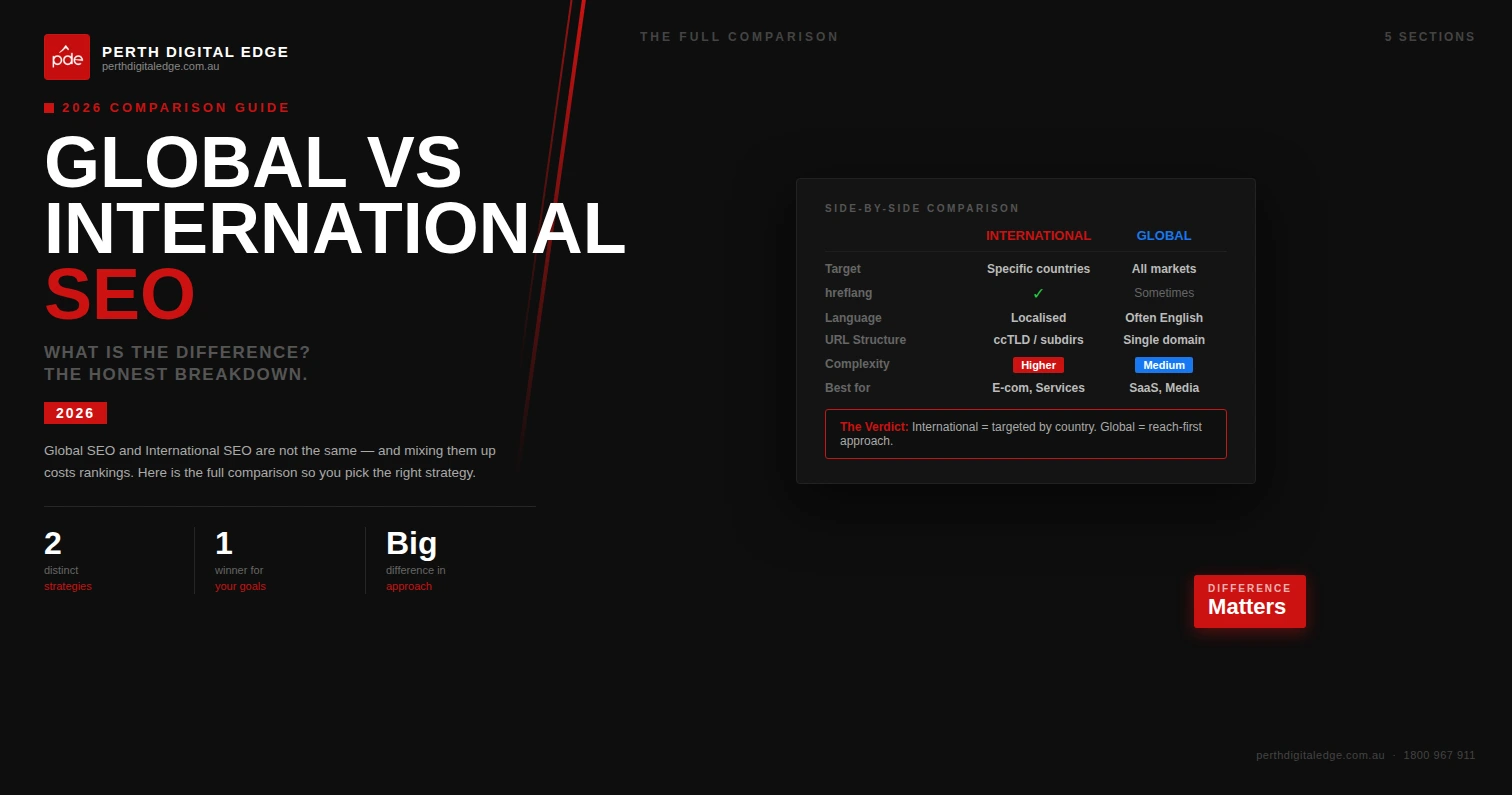
International SEO gets confused with local SEO and global SEO regularly. Local SEO focuses on helping a business rank for searches tied to a specific city or suburb, like a Perth plumber ranking for Scarborough or Joondalup queries. Global SEO is a broader term that usually refers to the overall strategy of competing on a global scale across many markets at once. International seo sits in the middle, specifically targeting multiple countries with coordinated language versions and geographic targeting, while still caring about local market knowledge in each target market.
If you want a deeper side by side comparison, our article on the difference between global and international SEO walks through exactly how the two disciplines overlap and where they split apart in practice.
What International SEO Looks Like In Practice
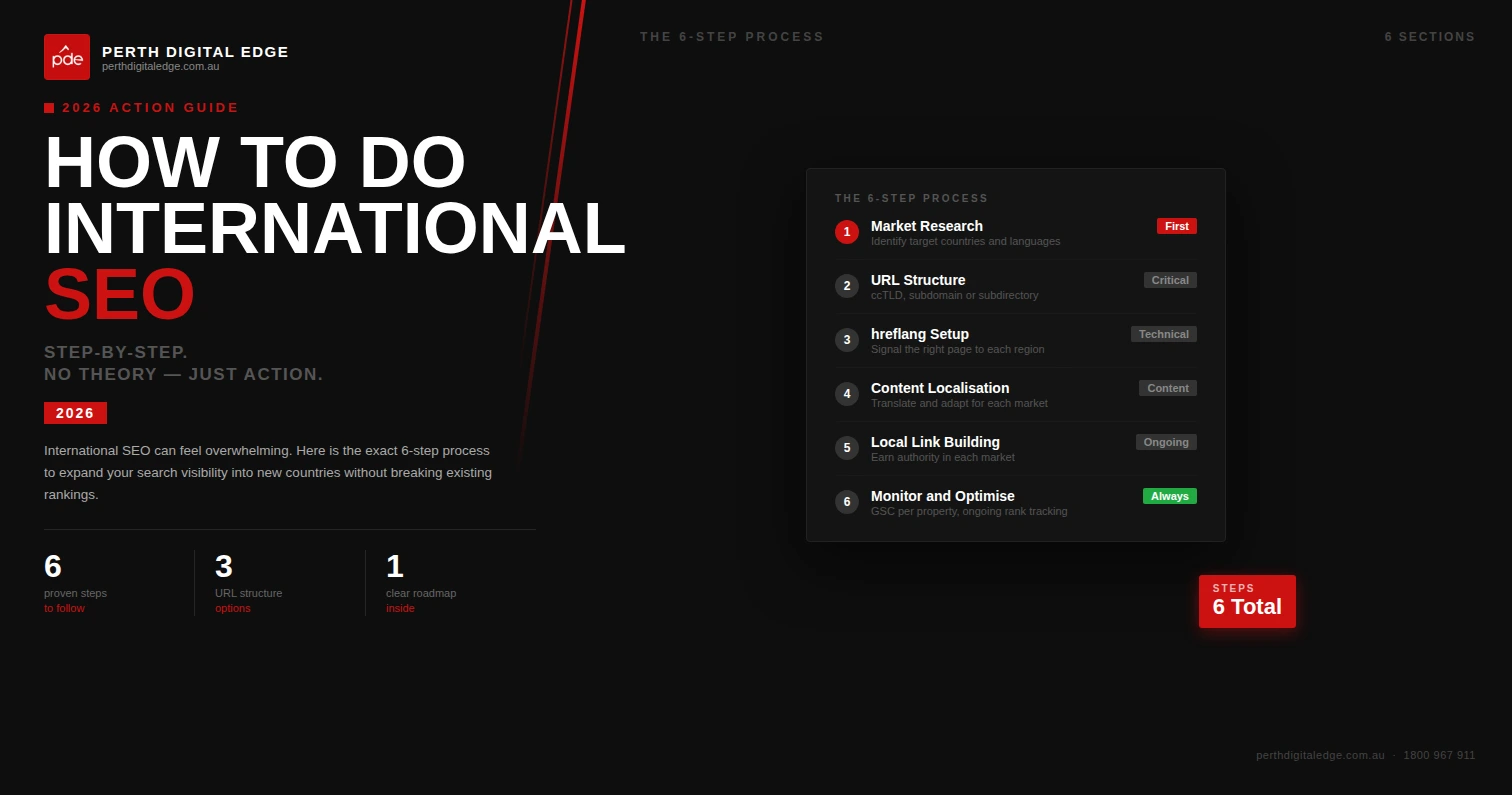
For a Perth ecommerce client selling into the UK, US, and New Zealand, an international SEO engagement typically begins with a market research phase to confirm which target markets will produce the fastest return. From there we set up hreflang tags across every page, decide between a country code top level domain strategy or a subdirectory strategy, and begin comprehensive keyword research in each target country. Once the technical foundation is solid, we focus on content, cultural adaptation, and building local backlinks. Within six to twelve months, international search results start producing organic traffic and sales from the new markets at a meaningful scale.
The process is neither fast nor glamorous. It requires thorough market research, careful keyword research, disciplined technical execution, and patience while search engines re-evaluate each language version. But for clients who stick with it, international SEO success becomes one of the most durable competitive advantages they ever build. Organic traffic from well-optimised international sites compounds quietly year after year.
Measuring International SEO Performance
Measuring international SEO performance requires a slightly different dashboard than measuring domestic SEO. We track search engine rankings per country, organic traffic per language version, conversion rate per target market, and revenue attribution per country. Google analytics and google search console both segment data by country and language, which gives us most of the signals we need. We also monitor search volume trends in each target market to catch shifts in demand before they show up in organic traffic numbers.
For clients targeting multiple countries, we build a simple scoreboard that compares performance across every target market on the same metrics. This makes it easy to spot which markets are delivering and which need more investment. Over time, the scoreboard tells a clear story about where international SEP efforts are paying off and where they need to be rebalanced.
Common Mistakes That Hurt International SEO
The same international SEO mistakes show up on almost every site we audit. The most common is treating international expansion as a translation exercise rather than a localisation exercise. Dropping a machine-translated version of your Australian site into a French domain will not move the needle because the content ignores cultural nuances, local keywords, and local search patterns. Another common mistake is missing or broken hreflang tags, which split authority across language versions and confuse search engines about which page deserves to rank.
We also see clients launch international sites without any local backlinks strategy at all. A brand new .de domain with no German backlinks looks essentially invisible to Google.de, regardless of how good the content is. Finally, we see clients forget to configure google search console and google analytics to track international sites separately, which leaves them flying blind on international SEO performance for months after launch.
International SEO Best Practices We Follow
Our international SEO best practices are drawn from real client engagements, not theory. We always start with thorough market research. We always choose a url structure deliberately rather than by accident. We always implement hreflang tags correctly the first time because fixing them later is painful. We always conduct comprehensive keyword research in each target language using native language tools. We always write content for the local market rather than translating Australian copy. We always build local backlinks in each target country. And we always monitor international SEO performance against clear success metrics.
These international SEO best practices sound obvious in a blog post but they are surprisingly rare in real engagements. Most international websites we audit break at least three or four of them, which is why rankings underperform relative to the investment the client has made.
The Role Of Technical SEO In International Campaigns
Technical seo matters more for international sites than for single-country sites because there are so many more ways for things to go wrong. Multiple domains, multiple language versions, multiple url structures, and multiple sitemaps all need to be kept in sync. Broken hreflang, missing canonical tags, or a badly configured XML sitemap can silently cripple an international seo strategy for months before anyone notices. We treat the technical layer as the foundation every other piece of the strategy rests on.
For a deeper dive into how international SEO actually functions under the hood, read our breakdown of how international SEO works which covers the mechanics of search engines interpreting multi-language content in detail.
International SEO And The Perth Business Perspective
Running international SEO campaigns out of Perth gives us a particular lens on the work. Perth is the most isolated capital city on earth, over two thousand kilometres from Adelaide and even further from Sydney and Melbourne. Our WA clients already think globally because they have to. A FIFO worker on rotation in Karratha, a Subiaco law firm serving mining companies in Africa, a Fremantle exporter shipping to Asia, a West Perth engineering consultancy pitching Gulf states. Every one of these businesses lives in a world where international SEO is not a luxury, it is the only way to reach the audiences that matter to them.
That isolation also builds a certain patience into the way we work. WA businesses are used to playing the long game. International SEO success takes months and sometimes years, and we find Perth clients tend to accept that timeline more readily than clients in faster-paced east-coast markets. The combination of global ambition and patient execution is a surprisingly good fit for what international SEO actually requires.
Our Experience And Case Studies
Ben Tippett founded Perth Digital Edge more than a decade ago, and our team has built international seo campaigns for clients across ecommerce, professional services, tourism, and resources. For Westside Auto Wholesale, our broader SEO work delivered a 4,900% return on investment, 1.4 million visitors, and 120,000 leads. For Castle Security, we drove organic traffic up 364% and placed 109 keywords on page one within six months. For Wholistically Healthy, technical and content work combined lifted traffic 118% and conversion rate 51%. For Eco Style Pool Renovations, PageSpeed improvements took the site from a score of 27 to 86.
These results were not all pure international SEO engagements, but they illustrate the kind of outcomes that become possible when technical, content, and strategic work are done properly together. The same discipline that delivered those results for Australian clients is what we apply when we help a business expand into international markets.
International SEO Across Different Markets
Different markets demand different emphases inside the same international SEO strategy. A global SEO strategy for a B2B software client selling across Europe looks nothing like the same client’s strategy in Southeast Asia. European markets typically reward precision with hreflang tags and strict adherence to local language conventions. Asian markets often demand heavier adaptation for cultural context and reliance on local search engines other than Google. North American markets reward aggressive content velocity and local backlinks from mainstream publications. Implementing international SEO strategies well means recognising these differences rather than copying a single playbook across every country.
A global SEO strategy also needs to account for local search behaviour, which varies enormously from country to country. Search engine results pages in Germany are dominated by direct, factual content. Search engine results pages in Brazil reward personality and emotional tone. Global audiences respond differently to the same messaging, and an international SEO strategy that ignores this ends up producing technically correct pages that simply fail to convert. A seamless user experience across different markets is what ties this together, because even the best optimised page fails if local users find it confusing to navigate or read.
Global Presence Versus Global Success
There is an important distinction between building a global presence and achieving global success. A global presence means your website is accessible in multiple countries and languages. Global success means those language versions actually rank, convert, and contribute revenue. Many businesses build the presence and never achieve the success because they stop at technical setup and skip the content, cultural, and link building work that converts presence into results. Target market searches are how real users find you, and if your content does not answer those searches in the local language, the presence is cosmetic.
How To Get Started With International SEO
Getting started with international SEO is usually less daunting than clients expect. The first step is a conversation about where your international audiences already come from. Google analytics usually shows pockets of organic traffic from countries you have not actively targeted, which is a strong signal that there is existing demand to build on. From there we run market research, shortlist target countries, and build a roadmap that lays out the technical work, content work, and link building work required to get to international SEO success.
We do not believe in selling clients into international SEO engagements they are not ready for. Sometimes the right answer is to get local SEO and national SEO fully optimised first before expanding. Sometimes the right answer is to go hard on one target country rather than spreading effort across five. The honest conversation at the start is what separates a successful international seo strategy from an expensive mistake.
We also make a point of revisiting the international SEO roadmap every quarter once the engagement is underway. Search rankings shift, search volume moves, competitors launch new content, and local search results change character as algorithms evolve. A strategy written twelve months ago and left untouched is rarely still optimal today. Quarterly reviews let us reallocate effort into the target markets that are gaining traction and pull back from the ones that are not earning their keep. This discipline is one of the biggest differences between agencies that deliver international SEO success and agencies that promise it.
Frequently Asked Questions
The questions we hear most from Perth business owners considering international SEO.
How Long Does International SEO Take To Show Results?
Most clients see early international SEO performance indicators within three to six months, including improved search rankings for long-tail queries in the target country and growing organic traffic from the new markets. Meaningful revenue usually arrives between six and twelve months in, depending on how competitive the target market is and how strong the existing domain authority already is.
Do We Need A Separate Website For Each Country?
Not necessarily. A single site with subdirectories and correct hreflang tags can serve multiple countries effectively. Country code top level domains give a stronger geographic signal but require more technical maintenance. The choice depends on your target markets, your technical resources, and how much local trust you need to build in each country.
Is Machine Translation Enough For International Content?
No. Machine translation is a useful starting point but it almost always fails to capture cultural nuances, local idioms, and local search patterns. Search engines reward content that genuinely serves local users, and local users can spot machine-translated content within the first few sentences. We always recommend native speaker review for any language version intended to rank in search results.
What Is The Single Most Important Technical Element?
Hreflang tags, by a wide margin. Hreflang is the signal that tells search engines which page belongs to which country and language, and getting it wrong confuses search engines across every international page on the site. We have unlocked significant rankings for clients simply by fixing broken hreflang on otherwise well-built international sites.
How Much Does International SEO Cost?
International SEO costs more than domestic SEO because the work is broader. Comprehensive keyword research, content creation in multiple languages, hreflang implementation, and local backlinks all add cost. For most clients, a meaningful international SEO engagement sits between two and five times the cost of a domestic engagement, depending on how many target markets are involved and how much existing work already serves as a foundation.
Final Thoughts And Next Step
International SEO is how ambitious Australian businesses reach audiences worldwide. It combines technical SEO, keyword research, cultural awareness, and patient execution into a discipline that compounds over years. If you want a team with a track record of delivering international SEO success for WA clients across ecommerce, professional services, and resources, our international SEO services can help. Book a free strategy session with our team and we will walk through where your biggest international opportunities are and how to capture them.