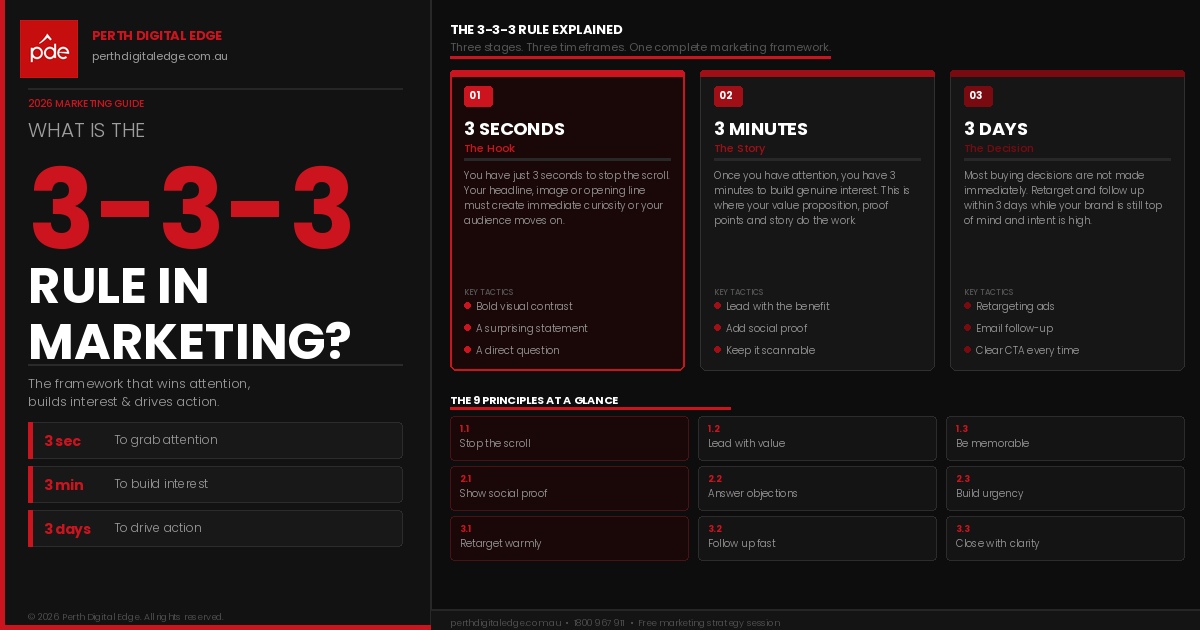
The 3 3 3 rule in marketing is a way to stop a campaign from drifting. You pick three marketing channels, settle on three key messages, and judge the work against three numbers that matter to the business. That is the whole rule. The value comes from what it prevents.
Most Perth businesses do not have a traffic problem in the abstract. They have a decision problem. Budget gets scattered across social media, search, email, content, promotions, and half-finished ideas. The marketing plan grows. The clear focus disappears. Soon the team is busy, but nobody can say which channel is driving qualified leads or which message is actually landing with potential customers.
That is where the rule earns its keep. It cuts away the extra moving parts and forces the campaign to revolve around a few decisions that can be tested, improved, and repeated.
Why This Rule Makes Sense For Perth Businesses
Perth is not one uniform market. Buyer behaviour changes by suburb, service category, urgency, and price point. A coastal roofing company, a finance broker, and a garage door installer do not win attention in the same way, even though all three operate under the umbrella of digital marketing.
That is why broad advice like “be on every platform” usually falls flat. A better question is this: where does the audience actually look when the need becomes real?
For some businesses, the answer is google ads because the search is urgent and intent is high. For others, the answer includes social media ads because the sale needs repetition, trust, and visual recall. For others again, email marketing matters because the buyer rarely converts on the first visit.
You can see this in local results. Easy Glide Garage Doors, a Perth-based installer, was spending on ads without solid tracking, geo-targeting, or campaign control. Once those basics were fixed and the mix was tightened, the account produced a 265% increase in users, a 92% increase in key events, 40+ qualified leads per week from Facebook, and a 53% drop in cost per conversion. easy-glide-garage-doors-case-st… easy-glide-garage-doors-case-st…
That is the 3 3 3 rule in practice, even if nobody labels it that way. Fewer variables. Better decisions.
What The Rule Looks Like In The Real World
Think of the rule less as a formula and more as a discipline.
A business starts with too many options. Search, Facebook, SEO, referrals, retargeting, blog content, video, direct mail. Every option sounds plausible. The danger is not choosing badly once. The danger is making ten half-committed choices and calling it a strategy.
The 3 3 3 rule asks for restraint.
Choose the three primary channels that can realistically carry the campaign. Shape three key messages that reflect the buyer’s problem, the commercial value, and the trust signal. Then decide which three numbers tell you whether the work is producing success or just activity.
That is why the rule works. It creates pressure in the right place. Instead of chasing more ideas, the team has to justify each inclusion.
How To Decide Which Three Channels Deserve The Budget
This is where many small businesses go wrong. They choose channels based on habit, trend, or what another business in a different industry is doing.
A smarter method is to check three things.
Look at demand first. Use search data, sales conversations, customer surveys, and platform signals to understand where the target market is already active. If people search for your service with urgency, search belongs in the conversation. If the buying cycle is longer, retargeting and email may matter more.
Then look at intent. A person searching “roof repair Fremantle” is in a different frame of mind from someone scrolling through Facebook. One is close to action. The other may need more warming up. Both can be useful, but they serve different roles in a successful campaign.
Finally, look at economics. A channel only earns a place in the mix when it can support business goals at a viable cost. That means checking conversion rate, lead quality, booking rate, and acquisition cost, not just reach or clicks.
For many local campaigns, the best blend is a mix of paid media, owned media, and earned media. Paid traffic creates momentum. Owned assets such as landing pages and email marketing capture and convert. Earned signals such as reviews, referrals, and word of mouth do the quiet work of credibility.
Messaging Usually Breaks Before Media Does
Most campaigns do not fail because the media plan is impossible. They fail because the wording is soft, interchangeable, or forgettable.
That is why the second part of the rule matters so much.
Your three key messages should not read like generic agency copy. They should come from real buying triggers and real pain points. One message should grab attention. One should explain the value. One should prove the business can deliver.
Perth buyers are practical. They want speed, proof, straight answers, and signs that the business understands the local context. A roofing company in the coastal corridor can talk about corrosion, storm exposure, and long-term maintenance. A finance broker can speak to approval speed, lender options, and application clarity. A garage door provider can focus on turnaround time, installation quality, and aftercare.
That level of specificity is what builds trust. It also makes the brand more memorable across different platforms.
Loan Warehouse is a good example of how better structure changes results. The project centred on clearer web content, stronger UX, SEO foundations, and proper tracking. The result was a 42% increase in leads and a 5% lift in conversion rate within weeks of launch. loan-warehouse-case-study loan-warehouse-case-study
The gain did not come from louder marketing efforts. It came from cleaner thinking.
What To Measure Before The Next Campaign Gets Away From You
There is a point where reporting stops being useful and starts becoming decoration.
The 3 3 3 rule is helpful here because it limits measurement to a few key points. If the goal is lead generation, the obvious starting set is qualified leads, conversion rate, and cost per lead. If the goal is better sales efficiency, you might care more about close rate, booked calls, and average deal value.
The important thing is that the numbers relate to business objectives, not platform vanity.
Fremantle Roofing Services is a strong local reminder of what happens when the right things are measured over time. The campaign took the business from no real digital presence to the number one market position, with a 300% increase in qualified leads, 76% year-on-year user growth, 41 of 49 keywords on page one, and 20 keywords in the top three. Eventually, paid ads became unnecessary because organic performance was carrying the load.
That is not the result of chasing every platform. It is the result of sticking with the channels, messages, and metrics that keep compounding.
Frequently Asked Questions
Is The 3 3 3 Rule Only For Digital Marketing?
No. The rule can guide offline and online marketing, but it is especially useful in digital marketing because performance is easier to track with google analytics and other analytics tools.
Which Three Channels Should Small Businesses Start With?
For many Perth small businesses, search, retargeting, and email make a practical starting point. In plain terms, that often means google ads, social media ads, and email marketing.
What Makes The Rule So Effective?
It is effective because each part has a unique purpose. The channels reach the right people. The messages make the offer relevant. The reporting shows whether the campaign is creating value.
How Can I Implement The Rule Properly?
Start with the buyer, not the platform. Identify where the audience spends time, what they need to hear before acting, and which measures reflect real commercial progress.
Conclusion
The 3 3 3 rule in marketing is not clever because it is neat. It is useful because it stops a business from wasting energy. When the focus stays on the right three channels, the right three key messages, and the right measures of performance, the campaign becomes easier to run, easier to improve, and more likely to support sustainable growth.
If you want a second set of eyes on your current marketing strategy, Perth Digital Edge, a digital marketing agency in Perth, offers a free consultation to review your channels, sharpen your messaging, and build a smarter plan for your next campaign.