If you are trying to price digital marketing for your business, the part that usually causes the most frustration is not the fee itself. It is the gap between what agencies say they do and what they actually include.
One proposal looks cheap until you notice ad spend is excluded. Another looks expensive until you realise it covers strategy, content creation, reporting, and ongoing support. A third sounds polished but still leaves you wondering what happens after month one.
That is why the real question is not just how much does it cost to hire a digital marketing agency. The better question is what the business is actually paying for, what level of work is required, and how much campaign complexity sits behind the quote.
For Perth businesses, Australian businesses, and brands selling nationally, digital marketing costs can vary significantly based on channel mix, business objectives, target audience, ad spend, content requirements, and the quality of execution. A lean local campaign is not priced like a multi-channel growth plan. And it should not be.
This page breaks down digital marketing agency pricing in practical terms. It explains the main pricing models, the key factors that shape agency costs, what is usually included in agency fees, where hidden costs show up, and how to evaluate agency proposals without getting lost in vague marketing language.
What Most Businesses Actually Pay
Most businesses do not buy “digital marketing” as one thing. They buy a mix of digital marketing services based on what the business needs right now.
That is why pricing structures vary. A company focused on Google Ads and lead generation will have a different budget from one investing in SEO services, social media management, email marketing, and content marketing at the same time.
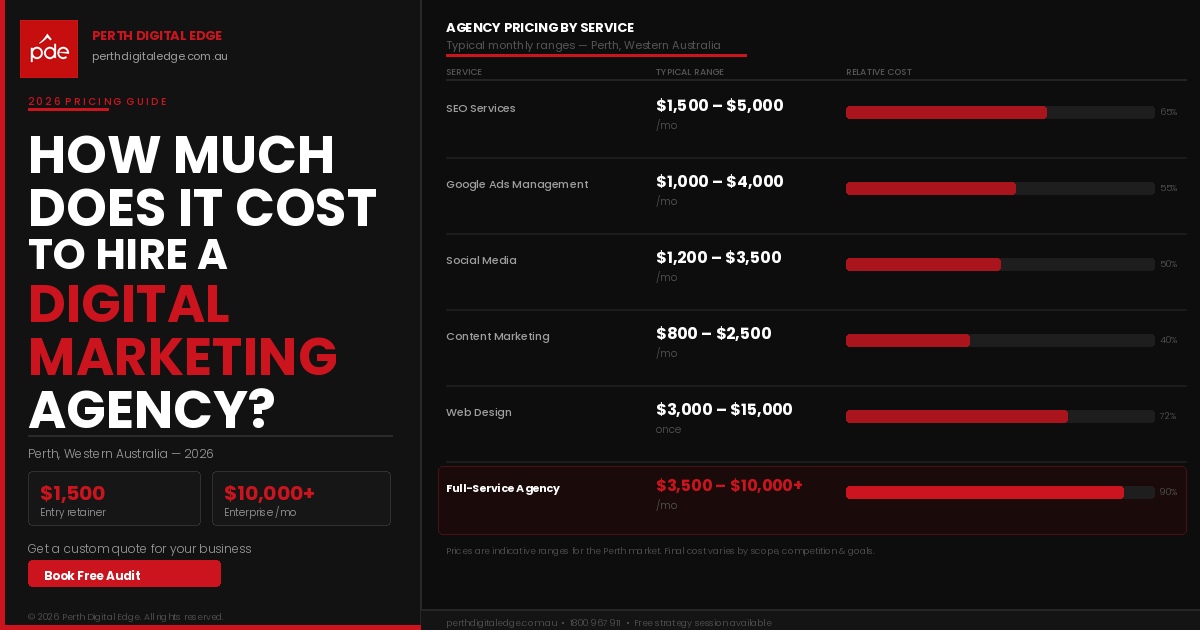
Here is a practical guide to common monthly ranges.
| Service | Typical Monthly Range | Best For | What Is Usually Included |
|---|---|---|---|
| Local SEO | $1,000 to $2,500 | Small businesses targeting local suburbs or service areas | Keyword research, on-page updates, Google Business Profile work, local optimisation, reporting |
| SEO Retainer | $1,500 to $4,000+ | Businesses improving online visibility across multiple pages | SEO audit, technical recommendations, internal linking, page optimisation, reporting |
| Google Ads Management | $1,200 to $3,500+ | Businesses focused on lead generation through paid search | Campaign setup, keyword research, ad copy, bid changes, search term reviews, reporting |
| Paid Social Campaigns | $1,000 to $3,000+ | Businesses running paid advertising on social media platforms | Audience setup, creative coordination, paid social campaigns, reporting |
| Social Media Management | $800 to $2,500 | Businesses building a stronger social media presence | Content planning, posting, captions, community management, reporting |
| Content Marketing | $1,000 to $3,500+ | Businesses building long-term search visibility and authority | Topic planning, keyword research, content creation, internal links |
| Email Marketing | $800 to $2,000+ | Businesses focused on retention, nurture, or repeat sales | Campaign setup, automations, copywriting, reporting |
| Full-Service Digital Marketing | $3,500 to $8,000+ | Businesses needing support across several channels | Digital strategy, SEO services, Google Ads, social media marketing, reporting, ongoing services |
These are guide prices only. They usually do not include ad spend, major development costs, or one-off web builds. More complex campaigns, larger target audience segments, heavier content creation, and broader paid media programs will increase the digital marketing budget.
What You Are Really Paying For
Most businesses are not paying for activity. They are paying for judgement.
That is the part proposals often hide. The monthly fee is not just for publishing content, adjusting bids, or writing reports. It is for the work behind those decisions.
When a digital marketing agency manages Google Ads properly, it is not simply turning campaigns on. It is checking keyword research, cleaning up wasted ad spend, refining audience targeting, reviewing search terms, improving landing page alignment, and making sure conversion tracking gives the account useful signals.
When SEO services are delivered well, the work is not just a ranking screenshot once a month. It is page priorities, search intent alignment, internal linking, heading structure, metadata, technical fixes, and content creation that makes the site more useful to both people and search engines.
When social media marketing is done well, the business should know whether it is buying social media strategy, social media management, community management, paid social campaigns, or a mix of all four. Each one carries different management fees, different workloads, and different business goals.
That is why digital marketing agencies charge very different amounts. The label on the proposal may look the same. The actual work usually is not.
The Main Pricing Models Agencies Use
Once the scope is clearer, the pricing models make a lot more sense.
Monthly Retainers
Monthly retainers are the most common model for ongoing services. The business pays a fixed monthly fee for a defined scope of work.
This is common for SEO services, social media management, Google Ads, content marketing, and email marketing because these channels improve through regular optimisation, not one-off setup.
Project Based Pricing
Project based pricing works when the deliverable has a clear beginning and end. This may include an SEO audit, a social media strategy, a landing page rewrite, a content refresh, or analytics setup.
This model is useful when the business needs a specific outcome before committing to broader agency services.
Percentage Of Ad Spend
Some agencies use a percentage model for paid advertising. This is common in Google Ads and paid social campaigns.
The logic is simple. As ad spend rises, campaign complexity often rises as well. Sometimes that model is fair. Sometimes it is not. The key question is whether the management workload rises with the spend.
Fixed Packages
Fixed packages appeal to small businesses because they are easy to compare. They can work when the scope is simple.
They become less useful when campaign complexity grows, when business objectives shift, or when the business needs tailored strategies rather than pre-set deliverables.
Why Costs Vary So Much Between Agencies
The biggest reason agency costs vary is workload.
A simple account may only need a narrow digital strategy, one landing page, one offer, and one main traffic source. A broader account may need SEO services, Google Ads, social media campaigns, content marketing, email marketing, and ongoing support across several products or service categories.
That difference shows up in:
- campaign complexity
- channel mix
- target audience size
- content creation volume
- reporting depth
- strategy development time
- ad spend
- community management requirements
- landing page needs
- internal cost calculations on the agency side
A small business targeting a local service area will not need the same support as a business competing across the Australian market. One may need tight local SEO and paid search. The other may need comprehensive packages, more complex campaigns, and broader customer acquisition activity across several channels.
Cheaper quotes can also hide weaker delivery. If the agency fees are low because the work is light, the business can still lose money through poor targeting, weak conversion tracking, or wasted ad spend.
A Real Example Of Why Pricing Can Differ
This is where a real case study matters more than generic agency language.
For 4×4 Extras, Perth Digital Edge did not run one broad Google Ads setup and hope for the best. The account was split into separate campaigns for product sales and training course bookings, with separate keyword sets, separate ad copy, and separate landing page alignment based on the intent behind each search. Perth Digital Edge then refined bidding strategy and audience targeting across both campaign types. That work delivered a 161% increase in active users, a 186% increase in key events, a 29% increase in course sales, and a 22% drop in cost per conversion. 4×4-extras-case-study 4×4-extras-case-study
That is a far better example of agency value than any broad claim about “full-service support”. It shows what businesses are actually paying for: structure, targeting, optimisation, and lower waste.
What Good Delivery Looks Like In Practice
A page about digital marketing agency pricing should be specific enough to prove it understands the work.
For SEO services, good monthly delivery usually includes keyword research, search intent mapping, service page optimisation, internal linking, technical checks, local SEO improvements, and reporting tied to business goals rather than vanity metrics.
For Google Ads, good delivery usually includes search term analysis, negative keyword expansion, bid adjustments, audience refinements, landing page feedback, ad testing, and close control over wasted ad spend.
For social media management, the role of each platform should be clear. Some social media platforms support visibility and trust. Others support direct response and paid social campaigns. Without that clarity, social media presence becomes busy work.
For content marketing, good content creation starts before the article is written. Topic choice, keyword research, search intent, page structure, internal linking, and business objectives all need to be clear first. Otherwise the business ends up publishing content that looks active but contributes very little.
Agency Vs In House: What The Real Cost Comparison Looks Like
Plenty of businesses compare agency fees with an in house marketing team. That is a fair comparison, but it often gets oversimplified.
An in house team brings direct access and internal knowledge. It also comes with salary, superannuation, software, leave, recruitment, and management overhead.
One digital marketer rarely covers everything at a high level. SEO services, paid media, social media strategy, email marketing, analytics, and content creation all require different skills. That is why many businesses either build a larger in house team or supplement internal staff with digital marketing specialists.
For many small businesses, hiring a digital marketing agency is more practical than building an in house team from scratch. For medium sized businesses, a hybrid setup often works best. Internal staff own brand and priorities. Outside specialists support execution.
Hidden Costs Businesses Miss
This is where digital marketing costs often become frustrating.
The proposal may look clear at first, but once work starts, associated costs appear around:
- setup fees
- tracking fixes
- extra content creation
- landing page development costs
- creative production
- software charges
- additional reporting
- community management
- management fees on top of ad spend
None of these are automatically unreasonable. The issue is transparency.
A clean proposal should separate agency fees, ad spend, one-off development costs, and optional extras. It should also explain what changes when the account grows or when more complex campaigns are added.
What Businesses Commonly Overpay For
Most businesses do not overspend because they are careless. They overspend because the work sounds sensible on the surface.
Common examples include:
- social media management without a clear social media strategy
- paid advertising without reliable conversion tracking
- content marketing without keyword research
- ongoing services that generate reports but very little improvement
- broad channel mixes before the fundamentals are working
This is where digital strategy matters. Not every business needs everything at once. More channels do not automatically lead to better results. In many cases, the smarter move is a narrower scope with stronger execution.
How To Evaluate Agency Proposals
If you are trying to evaluate agency proposals properly, ignore the polish for a moment and read them like an operator.
Look for:
- what is included each month
- what is excluded
- whether ad spend is separate
- how success will be measured
- who will manage the work
- what the first 90 days involve
- how the pricing structures change if scope changes
- whether the proposal reflects your business goals
A strong proposal should also show logic. If the business wants stronger online visibility, the proposal should explain how SEO services, content creation, and site improvements support that goal. If the focus is paid advertising, it should explain how targeting, landing pages, and reporting are handled.
That is also where real proof matters. Case studies, before-and-after examples, and clear performance data tell you far more than polished agency copy.
How Perth Digital Edge Approaches Cost And Scope
Perth Digital Edge should not need to lean on empty authority statements here. The better approach is to show how scope is shaped.
Some businesses need stronger Google Ads control because the ad spend is already there but the quality of leads is weak. Some need SEO services because the site is thin, poorly structured, or not giving search engines the right relevance signals. Others need a clearer social media strategy because activity is happening without a defined purpose.
That is the difference between selling a package and solving a problem.
The right scope comes from the actual workload required to improve performance. Sometimes that means starting small. Sometimes it means a broader mix of ongoing services. Either way, the costs should reflect the real work being done.
Frequently Asked Questions
These are the questions businesses usually ask before hiring a digital marketing agency.
How Much Does It Cost To Hire A Digital Marketing Agency In Australia?
Many Australian businesses spend between $1,500 and $7,500+ per month depending on scope, channels, and campaign complexity. Ad spend is usually separate.
What Is Included In Digital Marketing Agency Pricing?
Digital marketing agency pricing may include strategy development, SEO services, Google Ads management, social media management, content marketing, email marketing, reporting, and ongoing support depending on the scope.
Why Do Digital Marketing Agencies Charge Different Rates?
Digital marketing agencies charge different rates because the workload, channel mix, ad spend, reporting depth, and campaign complexity vary significantly.
Is It Better To Hire An Agency Or Build An In House Team?
For many small businesses, hiring a digital marketing agency is more cost-effective than building a full in house marketing team across several specialist roles. Medium sized businesses often use a hybrid model.
How Can I Avoid Hidden Costs?
Ask for a clear breakdown of agency fees, ad spend, one-off development costs, and anything billed outside the monthly scope. The more transparent the proposal, the easier it is to compare actual costs.
Conclusion
The answer to how much does it cost to hire a digital marketing agency depends on the scope of work, the number of channels involved, the level of competition, and how much active management the campaigns need. The fee alone never tells the full story.
What matters is whether the pricing reflects real delivery, whether the business objectives are clear, and whether the proposal explains how the work will improve performance over time.
If you want a clearer view of likely agency costs, pricing models, and the right digital marketing services for your business, contact Perth Digital Edge today. We can help you review your options, evaluate agency proposals, and build a practical digital marketing budget around your business goals.