The 70 20 10 rule in digital marketing is a way to stop a marketing plan from becoming a pile of half-tested ideas.
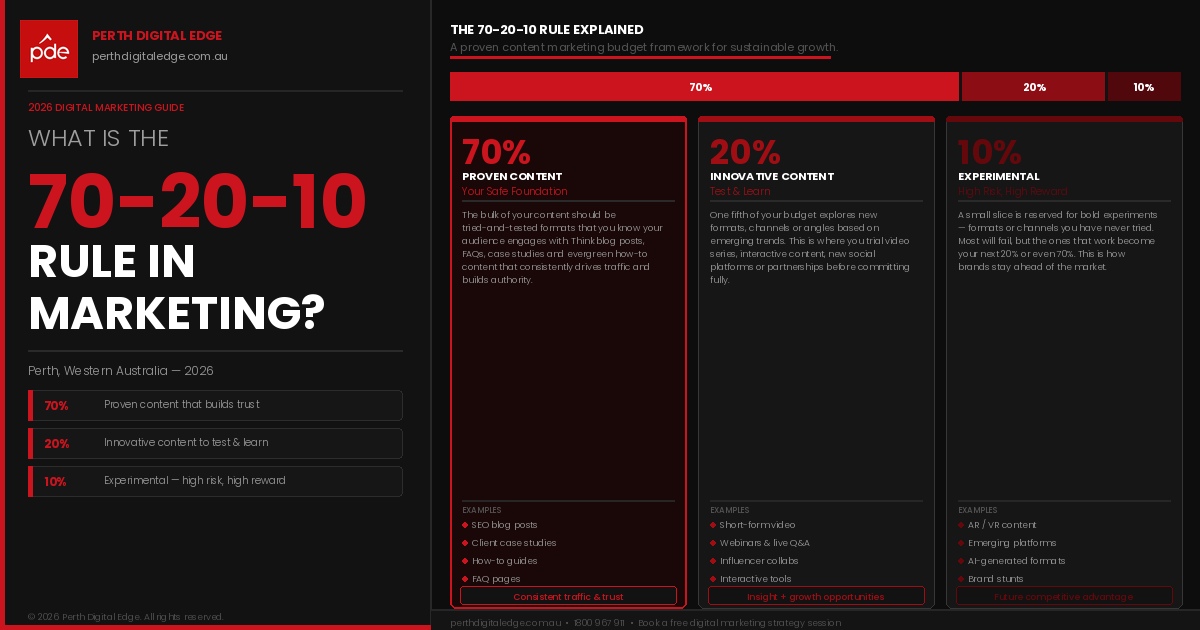
At its simplest, the model splits your effort into three buckets. Around 70% goes into the work that already pulls its weight. Another 20% goes into improving, adapting, or extending what is already showing promise. The final 10% goes into tests. Not random chaos. Not trend-chasing for the sake of it. Deliberate experiments with new ideas, new formats, new platforms, or new marketing tools that might become useful later.
The reason this rule still matters is painfully simple. Too many businesses swing between two extremes. One group plays it so safe that the whole strategy goes stale. The other chases every shiny update until the marketing budget is scattered across six platforms, twelve formats, and a long list of things nobody is measuring properly. Neither approach ends well.
For Perth businesses, this is not theory. It is a practical way to protect the work that drives revenue while still making room for innovation. That balance matters in local markets, where budgets are tighter, buying intent shifts by suburb and service type, and most teams do not have the luxury of wasting three months on “interesting” experiments.
Why Marketers Keep Coming Back To This Rule
There are several interpretations of the 70 20 10 rule, but they all circle the same question. How much of your effort should go into what already works, and how much should go into what might work next?
That is the eternal question in marketing.
It comes up in content marketing, in paid campaigns, in social media marketing, and in the quieter parts of a business too, like CRM nurture, landing page refinement, or the way a team handles content creation week after week. The answer is never “do more of everything”. That is how a marketing team ends up exhausted while performance barely moves.
The rule gives shape to the decision. It says: protect the core first. Improve what deserves more attention. Test a few things with intent. Then repeat.
That sounds almost too tidy, but the real power is not in the numbers. It is in the discipline.
What The 70% Looks Like When A Business Gets Serious
The 70% bucket is where grown-up marketing lives.
This is the work that has already earned its place. The proven channels. The campaigns that bring in real enquiries. The service pages that rank. The social media posts that do more than collect polite engagement. The landing pages that convert. The email sequences that quietly move prospects along. This is the part of the machine that pays the bills.
And yet this is the bucket businesses get bored with first.
That is the irony. The things that work often feel less exciting than the things that are new. Nobody brags about tightening conversion tracking, cleaning up a landing page, or improving lead quality from search. But that is exactly where serious results tend to come from.
Easy Glide Garage Doors is a good Perth example. The business already had demand. The problem was not awareness. It was the mess sitting underneath the ads. Tracking was poor, geo-targeting needed work, and the campaign structure was leaking spend. Once the foundations were corrected and Facebook was brought in more intelligently, the results shifted fast: a 265% increase in users, a 92% increase in key events, 40+ qualified leads per week from Facebook, and a 53% reduction in cost per conversion.
That is the 70% bucket in action. Not glamorous. Very profitable.
The 20% Bucket Is Where Smart Teams Get Their Edge
Now for the part people underestimate.
The 20% bucket is not where you reinvent the whole business. It is where you take something with traction and stretch it further. This is often the most productive part of the model because it turns existing expertise into more output without forcing the team to start from scratch every time.
A strong article becomes a short video. A service page becomes a sequence of facebook posts. A recurring objection from sales calls becomes a better FAQ block. A useful webinar turns into clips, email content, and supporting content blogs. A winning offer gets tested with a sharper CTA or a cleaner page structure.
This is where creating content starts to feel less frantic and more intentional.
Loan Warehouse gives a nice example of what good 20% work can look like. The project focused on clearer web content, better design structure, SEO foundations, and tracking setup. No fireworks. No dramatic pivot. Just a better version of the same digital presence. The result was a 42% increase in leads and a 5% lift in conversion rate within weeks of launch. loan-warehouse-case-study loan-warehouse-case-study
That kind of progress is often hiding in plain sight. Not in some futuristic channel. In the work you already own but have not developed properly.
The 10% Bucket Is Small On Purpose
This is the part people love talking about.
The 10% bucket covers experimental content, new ideas, new platforms, and the occasional high-risk test. This is where a business tries a different creative direction, trials a new paid format, experiments with AI-assisted workflows, or explores a new channel before the competition catches up.
Useful? Yes. Essential? Often. The future rarely announces itself politely, and the brands that never test anything eventually get left behind.
But the 10% bucket has a job description, and that job is not “be exciting”. It exists to create informed optionality. That is different.
The phrase “do not put all your eggs in one basket” gets thrown around a lot, usually without much thought. Here it actually applies. A business should not stake its full marketing budget on a new trend just because the internet is loud about it that week. Test it. Track it. Learn from it. Then decide whether it deserves a bigger share later.
That restraint is what makes the model useful. Otherwise the 10% bucket swallows the whole plan.
Why This Matters In Content Marketing
The rule in content marketing is especially helpful because content has a way of expanding to fill every available hour.
One request turns into ten. Someone wants more videos. Someone else wants more SEO blogs. Another person wants daily social media content. Then a new platform appears and suddenly the team is discussing whether the brand should be there too. Before long, nobody can tell the difference between “busy” and “effective”.
That is where the three buckets become practical.
The 70% bucket should hold the proven content. Evergreen pages. High-performing guides. Sales assets. Service content. Conversion-focused pages. Relevant content that continues to support rankings, trust, or lead quality.
The 20% bucket should hold the improvements. Repurposing, refreshing, updating, and extending. The work that builds on what is already showing signs of life.
The 10% bucket should hold the experiments. Perhaps a new brand post format. Perhaps short-form education clips. Perhaps more conversational, less hard sell content on social media marketing channels. Maybe even a test of a platform the team has been watching for months.
That split gives a content plan its spine.
One Size Fits All? Not Even Close
The worst way to use this model is to treat it like a law of nature.
It is not.
A mature brand with years of campaign data might be comfortable pushing more into testing. A newer business that still has not found stable proven strategies may need to stay heavily weighted toward the basics. Some industries move slowly. Others shift every quarter. Some audiences respond to polished content marketing. Others want straightforward proof and a phone number.
Context matters.
That is especially true in Perth, where local buyer behaviour can be more practical and less trend-driven than the online marketing world likes to imagine. The thing that works for a national ecommerce brand chasing scale is not always the thing that works for a local service business trying to book better jobs and stop wasting ad spend.
This is why the 70 20 10 rule makes more sense as a planning lens than a rigid formula. The numbers guide the decision. They do not replace judgement.
What A Good 70 20 10 Split Feels Like
A healthy split usually feels calmer than the average marketing department.
The team knows which channels carry the core load. They know which assets deserve more attention. They know which tests are running and why. There is less panic, less random content, and fewer meetings built around other people’s LinkedIn posts about the latest “must-try” tactic.
Better still, the data becomes easier to read.
You can see which marketing channels repeatedly support revenue. You can spot which refinements are worth rolling out more widely. You can kill weak experiments before they drain time. And you can share ideas without turning every brainstorm into a costly distraction.
That is what mature marketing strategies do. They make room for curiosity, but they do not let curiosity run the business.
Frequently Asked Questions
Is The 70 20 10 Rule Only About Budget?
No. It can apply to spend, time, production effort, creative energy, and team focus. For many businesses, the time split is just as important as the money split.
What Is The 70 20 10 Rule In Content Marketing?
The rule in content marketing divides work into three buckets. The 70% covers proven content, the 20% covers refinement and repurposing, and the 10% covers experimental content or newer formats.
Does The Rule Work For Small Businesses?
Yes. In many cases it works better for smaller businesses because it protects limited resources and stops teams from chasing too many ideas at once.
How Do I Decide What Goes Into Each Bucket?
Use performance data, lead quality, conversion behaviour, and business outcomes. If something repeatedly supports enquiries or sales, it belongs closer to the 70%. If it shows promise but needs refinement, it fits the 20%. If it is unproven, it belongs in the 10%.
Conclusion
The 70 20 10 rule in digital marketing is not valuable because it sounds neat in a strategy deck. It is valuable because it stops waste.
It keeps the business anchored to what already works. It creates room to improve the work that deserves more attention. And it gives the team permission to test new ideas without gambling the whole plan on them.
That balance is where the model earns its keep. Not in theory. In the day-to-day reality of running campaigns, producing content, managing budget, and trying to grow without losing your head.
If you want a second set of eyes on how your current split is really working, Perth Digital Edge, a digital marketing agency Perth, offers a free consultation to review your channels, content priorities, and next steps with a lot more honesty than the average marketing audit.