I’m Ben Tippett, founder of Perth Digital Edge, and I’ve spent the better part of a decade building and managing Google Ads campaigns for small businesses across Western Australia. Tradies in Joondalup. Allied health clinics in Subiaco. E commerce operators in Osborne Park. Hospitality venues along the Fremantle strip. Hundreds of accounts, across dozens of industries, with budgets ranging from $1,200 a month to $25,000.
So when someone asks me whether Google Ads work for small business, I don’t give them a vague “it depends.” I give them specifics. Because the honest answer is not a simple yes or no. It is: yes, powerfully, but only when certain things are in place. And most of the businesses I see struggling with Google Ads are missing those exact things.
Last quarter, Perth Digital Edge took over a Google Ads account for a pest control company in Joondalup. They had been running ads for five months, spending $2,800 per month, and could not point to a single job that came from it. No conversion tracking. Broad match keywords bleeding into irrelevant searches like “pest control jobs Perth” and “DIY ant removal.” Their ad was sending traffic to a homepage that talked about the company’s history instead of the service the searcher actually needed.
Within six weeks of restructuring that account, tightening keyword targeting to suburbs across Perth’s northern corridor, and building dedicated landing pages for each service, their cost per lead dropped to $38. They went from zero trackable leads to 47 qualified enquiries in a single month. Same ad spend. Completely different outcome. That is the gap this guide is about.
How Google Ads Actually Work For Small Businesses
Every time someone types a query into Google search, an auction fires in milliseconds. Advertisers bid on keywords related to that query, and Google decides which ads appear based on a combination of bid amount, ad quality, and landing page relevance. That combined score is your ad rank, and it determines your ad position on the search results page.
Here is what matters about that system: the biggest spender does not automatically win. A well structured Google Ads account with tightly themed ad groups, strong ad copy, and a fast, relevant landing page can consistently outrank a competitor spending three times as much on broad keywords with a generic website. I see this regularly at Perth Digital Edge when our clients go head to head with national franchises in the search results.
Google Ads campaigns come in several distinct formats, and choosing the right one matters more than most people realise. Search campaigns place text ads at the top of Google search results when someone types in relevant keywords. Display campaigns run visual ads across the Google Display Network, a collection of over two million websites, apps, and YouTube placements. Video campaigns appear on YouTube and partner sites. Performance Max campaigns use Google’s machine learning to distribute ads across all Google platforms automatically. And Local Services Ads sit at the very top of results for service based businesses, charging only when a customer makes direct contact.
For the majority of small businesses I work with, from Balcatta trade services to Scarborough cafes, search campaigns deliver the strongest return. The reason comes down to user intent. Unlike SEO, which builds visibility over months, Google Ads puts your business in front of people at the exact moment they are actively searching for what you offer. A Wanneroo homeowner searching “split system installation near me” is not browsing. They are buying. That distinction changes everything about how you should think about Google advertising versus traditional advertising.
Google Ads also lets you manage Google Ads campaigns at a level of precision most small business owners do not realise exists. You can schedule ads to run only during business hours, restrict visibility to specific postcodes across the Perth metro area, control which devices display your ads, and adjust bids based on time of day. A Cockburn plumber running ads only between 7am and 6pm on weekdays spends nothing on midnight clicks from people who will forget they searched by morning.
Why Google Ads Work For Small Businesses
The advantages go deeper than appearing at the top of a search results page. Having managed campaigns across nearly every service category in Perth, here is what I consistently see making the biggest difference for small operators.
You Capture High Intent Customers At The Point Of Decision
When someone in Morley types “emergency electrician now” into Google at 9pm on a Tuesday, they are not comparing options casually. They need someone immediately. That is a high intent customer, and they are worth significantly more than someone who passively noticed your logo on a bus shelter last week.
At Perth Digital Edge, we have trade clients where 70% of their Google Ads leads convert to paying jobs. Seventy percent. That conversion rate is unheard of in most marketing channels, and it exists because the searcher was already at the decision point when they clicked. You are not creating demand. You are capturing it.
Small Businesses Compete Directly With Larger Companies
A single operator air conditioning installer in Canning Vale can appear above a national chain in the Google search results for “aircon service Perth south.” Your ad position is earned through relevance, landing page quality, and bidding strategy, not brand size or marketing budget.
I have watched this play out dozens of times. A small business with a deep understanding of their local market, writing ad copy that speaks directly to what the searcher needs, will consistently outperform a corporate competitor running generic national campaigns with broad match keywords. The algorithm rewards specificity. And specificity is exactly what a local business has over a national one.
You Control Exactly Where Your Ad Spend Goes
Unlike a $4,000 newspaper spread that reaches everyone including people who will never need your service, Google Ads gives you precise control. You set daily caps, choose which keywords trigger your ads, and only pay when someone actually clicks. No minimum contract. No six month commitment.
That flexibility matters in ways that are easy to overlook. A Scarborough pool maintenance company can scale ad spend up through October to March and pull back over winter. A tax accountant in West Perth can push hard from May to October and dial down outside of tax season.
Every Dollar Is Traceable From Click To Customer
This is the one that still surprises business owners when I show them their first proper dashboard. With conversion tracking connected through Google Analytics, you know exactly which keyword, which ad, and which landing page generated each lead. Not “we think the campaign is working.” Actual data. Phone calls. Form submissions. Online sales. Even foot traffic to a physical location.
One of our e commerce businesses in Osborne Park can see that their “industrial shelving Perth” campaign generated $14,200 in online sales last month from $1,100 in ad spend. That kind of accountability simply does not exist in traditional advertising. And once you have that data, every decision about your marketing budget becomes dramatically clearer.
Why Google Ads Fail For Some Small Businesses
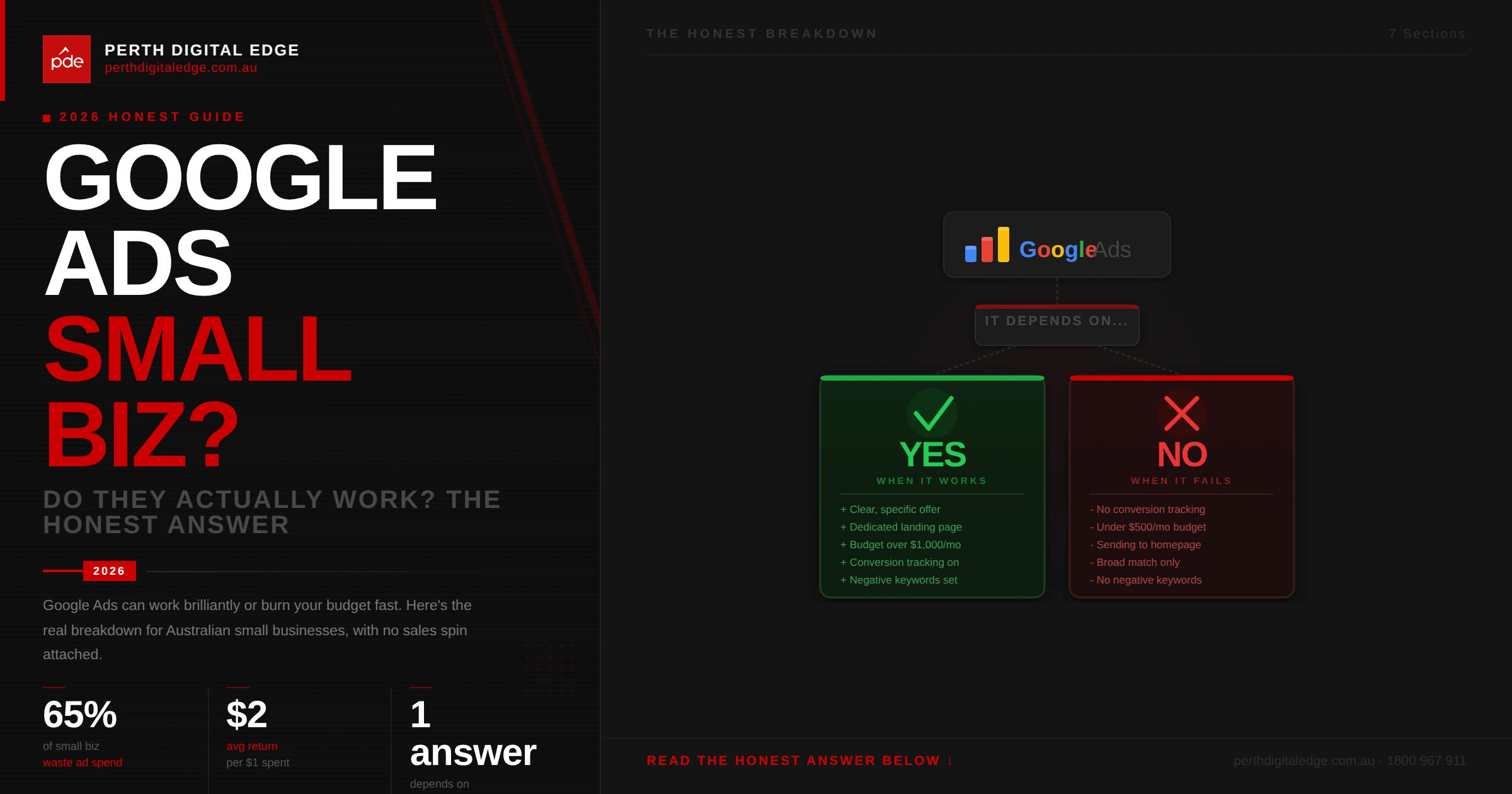
Here is where this guide earns the “honest” in its title. Google Ads do not work for every business, and when they fail, the reasons are almost always preventable. At Perth Digital Edge, we audit roughly 15 to 20 accounts per quarter for Perth businesses considering switching agencies or bringing management in house. The same problems surface again and again.
Targeting The Wrong Keywords Entirely
This is the most expensive mistake in Google Ads. A family law firm in Subiaco targeting the keyword “lawyer” is competing against criminal defence firms, immigration solicitors, and law degree programs. The search term is too broad, the intent is too vague, and the ad spend vanishes into clicks from people who will never become clients.
Effective keyword research means mapping the specific search terms your actual customers use. Long tail keywords with local intent, like “divorce lawyer Subiaco free consultation,” attract the right people at a fraction of the cost. But here is what most guides will not tell you: the keywords you think your customers use are rarely the ones they actually type. I have seen businesses completely miss their highest converting keyword because they assumed nobody would phrase it that way. The search terms report will always surprise you.
Letting Broad Match Keywords Run Unchecked
Google’s default match type is broad match, and it casts an absurdly wide net. We recently audited an account for a Perth cleaning company where their ad for “office cleaning Perth” was triggering on searches like “cleaning jobs Perth,” “house cleaning tips,” and “cleaning products Bunnings.” None of those people were potential customers. Every click was wasted spend.
The fix is two things working together: switching to phrase or exact match for your highest value keywords, and building a robust negative keywords list. Adding negative keywords like “jobs,” “DIY,” “free,” “salary,” and “tips” filters out irrelevant searches before they cost you money. One of our clients in the cleaning industry had 34% of their initial clicks going to job seekers before we built out their list. Eliminating that waste dropped their effective cost per lead by nearly half.
Sending Paid Traffic To A Weak Landing Page
You could build the most precisely targeted campaign in Australia, and it will still fail if the landing page does not convert. I think about a particular account we took over for an HVAC company in Midland. Their click through rate was excellent at 8.4%, which told me the ads were doing their job. But the conversion rate on the landing page was 1.2%. The page loaded in 6.8 seconds on mobile, had no clear call to action, and talked about the company’s 30 year history instead of addressing the searcher’s actual problem.
After Perth Digital Edge rebuilt that landing page, sub two second load time, a headline matching the ad’s promise, a click to call button above the fold, the conversion rate jumped to 9.7%. Same ads. Same keywords. Same ad spend. Eight times more leads. That is not an exaggeration or a best case scenario. It is what happens when the destination matches the intent.
Running Campaigns Without Conversion Tracking
If you cannot track leads, you cannot optimise. Full stop. Yet roughly half the accounts I audit have incomplete or broken conversion tracking. Without it, Google’s algorithms optimise for clicks instead of actual customers, and you have no way to know whether your $3,000 monthly spend generated 50 leads or zero.
At minimum, your Google Ads account should track phone calls, form submissions, and any purchase or booking action. Link it to Google Analytics for deeper behavioural data. If your business relies heavily on phone enquiries, as many Perth trade and service businesses do, call tracking is not optional. We have seen businesses discover that 60% of their leads come through phone calls that were previously invisible.
Launching A Campaign And Walking Away
Google Ads is not a billboard you put up and leave. The algorithm, the competitive landscape, and consumer behaviour all shift constantly. A campaign that performs brilliantly in March can deteriorate by June if nobody is reviewing search terms, testing new ad copy, refining audience targeting, or adjusting bids. The businesses that treat their campaigns as living systems consistently outperform those that set up and walk away.
Types Of Google Ads Campaigns That Work For Small Businesses
Choosing the right campaign type depends on what you sell, who your customers are, and what action you want them to take. Here is how each format performs based on what I see across Perth Digital Edge’s client base.
Search Campaigns For Generating Leads And Phone Calls
Search campaigns remain the highest returning format for most small businesses. They capture people with active purchase intent at the top of Google search results. For service businesses, tradies, professionals, and local operators, this is almost always where we start. A successful Google Ads campaign in search typically generates enquiries within the first week, and the data it produces informs every optimisation decision that follows.
Local Services Ads For Trades And Service Businesses
If you are a plumber, electrician, locksmith, or cleaner, Local Services Ads deserve serious consideration. These appear above standard search ads and above organic results. You pay only when a customer contacts you directly, not for clicks. For local businesses operating in defined service areas, whether that is Perth’s northern suburbs from Joondalup to Wanneroo or the southern corridor from Rockingham to Mandurah, this format consistently delivers some of the lowest cost per lead numbers I see.
Google Shopping For E-Commerce Businesses
Physical product sellers get a distinct advantage with Shopping campaigns. Products appear with images, prices, and reviews directly in the Google search results, meaning shoppers qualify themselves before they click. An e commerce business selling industrial equipment out of Welshpool or handmade homewares from a Leederville studio can reach buyers nationally with listings that convert at significantly higher rates than text ads. The visual format does much of the selling before the click even happens.
Performance Max Campaigns: Powerful But Not For Everyone
Performance Max campaigns use automated bidding and machine learning to distribute ads across Search, Display, YouTube, Gmail, and Maps simultaneously. When there is enough conversion data, typically 30 or more conversions per month, these campaigns can scale results impressively. But for a small business spending $2,000 a month with five to ten conversions, the algorithm simply does not have enough signal. I generally advise Perth Digital Edge clients to build their foundation with search first, then layer in Performance Max once the data supports it.
Display Campaigns For Staying Visible After The First Visit
Display campaigns place banner ads across the Google Display Network as people browse other websites and apps. Their real strength for small businesses is remarketing: showing your business to someone who visited your site but did not enquire. A prospective client who looked at your roofing services page on Monday sees your ad while reading the news on Wednesday. That repeated exposure brings people back when they are ready. Remarketing through the display network typically costs $0.30 to $0.80 per click, making it one of the most cost effective forms of online advertising available to a small business.
Video Campaigns On YouTube
Video campaigns place ads across YouTube and Google’s video partner network. For trust building, video is unmatched. A 30 second video showing your team on a job site in Henderson, or a client testimonial filmed in your Leederville clinic, builds credibility in ways text cannot. Video campaigns are not typically the first priority for lead generation, but they warm up potential customers and shorten the decision timeline when those people eventually search for you directly.
How Much Should A Small Business Spend On Google Ads?
This is the question I get asked more than any other, and I understand why. Committing real money to something you are not sure will work feels risky. So let me share the real numbers, not theory, from what we see working with Perth businesses across various industries and business goals.
Most small businesses see meaningful, measurable results with a monthly ad spend between $1,500 and $5,000. A Cockburn plumber spending $2,200 per month through Perth Digital Edge generated 62 leads last quarter at $35 per lead. At a 40% close rate and an average job value of $480, that is roughly $12,000 in revenue from $6,600 in ad spend. The maths works because the targeting is precise and the waste is minimal.
What matters more than total budget is how efficiently it is deployed. A $2,000 monthly spend managed with a deep understanding of the local market, tight keyword targeting, and proper conversion tracking will almost always outperform a $5,000 budget spread thin across broad keywords with no strategy. I have taken over accounts where halving the budget and tightening the targeting doubled the lead volume.
If you are just starting out, commit to at least 60 to 90 days before drawing conclusions. Month one is data collection. Month two is optimisation. By month three, you should have a clear picture of your cost per lead, your conversion rates, and whether the return justifies scaling. Pulling the plug after two weeks because results are not immediate is one of the most common and costly mistakes I see.
Google Ads Compared To Other Marketing Channels
I often get asked where Google Ads fits alongside other digital marketing options. The answer is not about choosing one over another. It is about understanding what each channel does best.
Google Ads Vs SEO
SEO builds organic visibility over time. It is a long term asset and Perth Digital Edge runs SEO campaigns alongside paid search for many of our clients. But SEO cannot help you if you need leads this week, and in competitive niches it can take 12 months to reach page one. Google Ads delivers visibility within hours. The smartest approach is running both simultaneously: use Google Ads for immediate enquiries while your SEO compounds in the background. Over time, as organic rankings strengthen, you can adjust campaigns and reallocate spend. The two channels feed each other.
Google Ads Vs Social Media Advertising
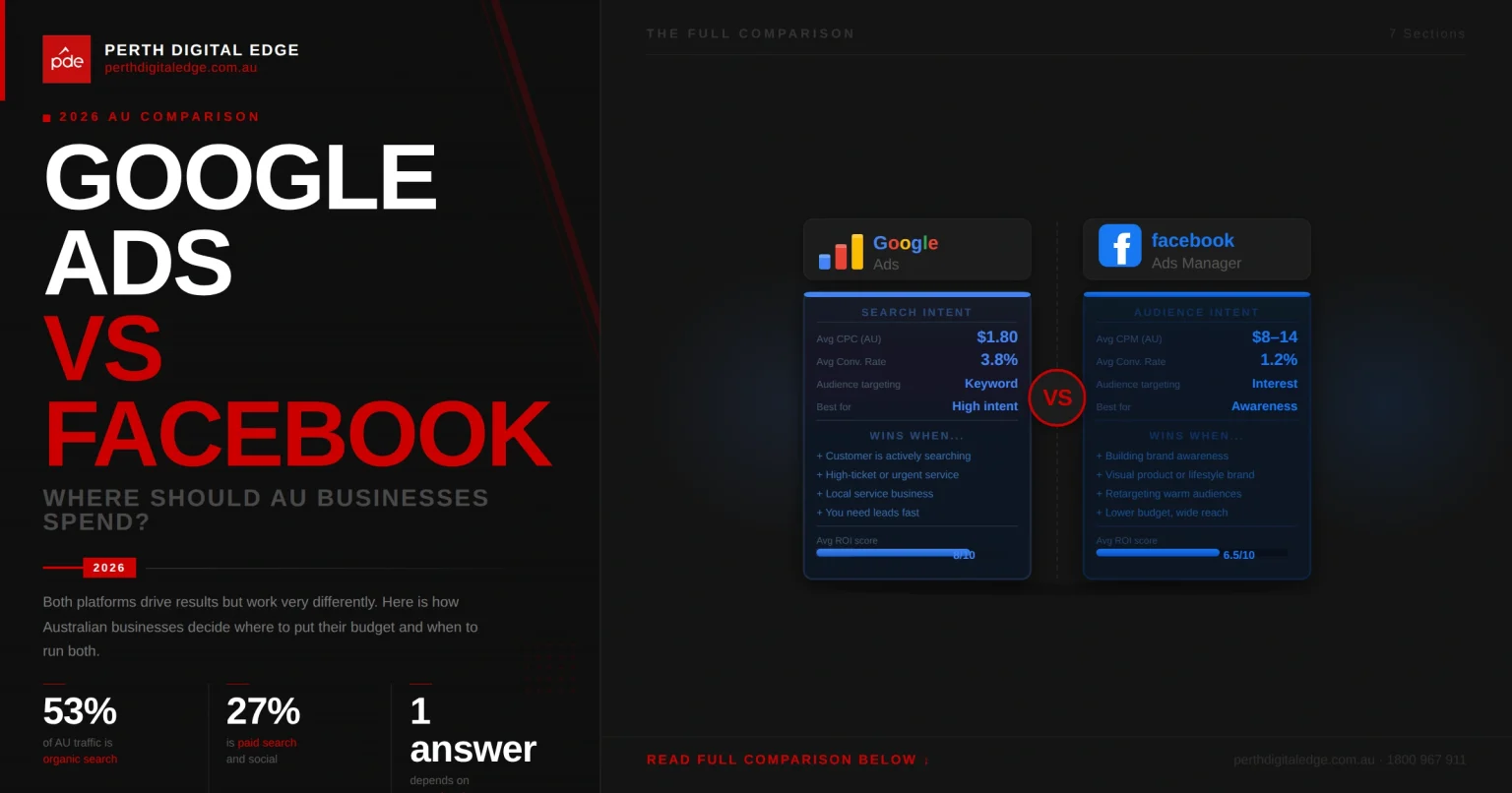
Facebook, Instagram, and LinkedIn ads are powerful for building awareness and reaching audiences based on demographics and interests. But the fundamental difference is intent. Someone scrolling through Instagram reels is not actively looking for a roof restoration company. Someone typing “roof restoration Joondalup” into Google is. For businesses focused on generating leads from people ready to buy, Google Ads typically delivers a stronger cost per acquisition. Social works best as a complementary channel for audience targeting and remarketing to warm audiences.
Google Ads Vs Traditional Advertising
Newspaper ads, radio spots, letterbox drops. They still play a role in brand recognition, particularly in tight knit communities. But the targeting is imprecise, the results are nearly impossible to measure, and the cost per lead is almost always higher than digital advertising through Google. A half page ad in a local Perth newspaper might cost $1,500 and reach 40,000 people, the vast majority of whom will never need your service. That same $1,500 on Google Ads, targeted to specific search terms in specific suburbs, can generate 30 to 50 trackable leads from people actively searching.
Many of the business owners I work with built their reputation on word of mouth and referrals. That remains valuable. But it is unpredictable and impossible to scale on demand. Google Ads for small businesses provides a consistent, controllable pipeline that works alongside your existing reputation. When you need more work, you increase the spend. When your calendar is full, you pull back. No other form of advertising gives a small business owner that kind of precision.
How To Get The Most Out Of Google Ads As A Small Business
These are the specific actions that separate profitable campaigns from expensive experiments. Every one of them applies whether you manage Google Ads yourself or work with a marketing partner like Perth Digital Edge.
Start With Keyword Research That Reflects How Your Customers Actually Search
Do not assume you know what your customers type into Google. A fencing contractor might think people search for “colorbond fencing installation” when the actual high volume term is “fencing quotes Perth northern suburbs.” Use Google’s Keyword Planner, review your Google search console data, and study what competitors bid on. Focus your budget on keywords with clear commercial user intent. “Best electrician Midland” converts. “What does an electrician do” does not.
Build Your Negative Keywords List From Day One
Your search terms report will reveal exactly which queries triggered your ads. Review it weekly and add irrelevant terms as negative keywords. For a Perth removalist, that might include “free,” “DIY,” “jobs,” “salary,” “tips,” and “interstate.” One Perth Digital Edge client in the cleaning industry had 34% of their initial clicks going to job seekers before we built out their negative keyword list. Eliminating that waste dropped their effective cost per lead by nearly half.
Write Ad Copy That Answers The Searcher’s Actual Question
Generic ad copy. You waste money on clicks that never had a chance of converting. “Quality service, great prices, call today” tells the searcher nothing specific. But “Same day emergency plumbing in Perth’s northern suburbs. Fixed price quotes. Fully licensed.”? That ad speaks directly to what the person searching “emergency plumber Joondalup” actually needs. Include your primary keyword, name the suburb or region, and give a concrete reason to click your ad instead of the one above or below it.
Build Landing Pages That Convert, Not Just Inform
Every landing page should answer three questions within five seconds of loading: “Am I in the right place?” “Why should I choose this business?” “How do I take the next step?” The headline must match the ad that brought the visitor there. Load speed matters enormously. Every second over three seconds increases bounce rate by roughly 32%. On mobile, where the majority of local searches happen, a slow page is a dead page.
Set Up Conversion Tracking Before You Spend A Dollar
This is non negotiable. Before a single ad goes live, your Google Ads account should be tracking phone calls, form submissions, live chat initiations, and any purchase or booking action. Link everything to Google Analytics for complete visibility into what happens after the click. If your business generates leads primarily through phone enquiries, which is common across Perth’s trade and service industries, implement call tracking so you can attribute each call to the specific keyword and ad that generated it.
Use Location Targeting To Eliminate Geographic Waste
A mobile mechanic operating in Perth’s southern suburbs has no business showing ads to someone in Geraldton. Location targeting restricts your ads to the specific suburbs, postcodes, or radius that matches your actual service area. For businesses serving specific corridors, say Stirling to Joondalup along the Mitchell Freeway, you can target precisely those areas. This alone can reduce wasted spend by 20 to 40% for local businesses that were previously advertising statewide instead of reaching local customers in their actual service area.
Review, Test, And Refine Every Single Week
The best Google Ads campaigns are never finished. Weekly, review your search terms report for new negative keyword opportunities, monitor which ads and keywords drive the strongest conversion rates, and test alternative ad copy. Monthly, step back: cost per lead trends, conversion rate shifts, whether your overall return justifies restructuring or scaling your budget. At Perth Digital Edge, this ongoing rhythm is built into how we manage every account. It is the difference between a campaign that improves month over month and one that slowly decays.
Signs Google Ads Might Not Be Right For Your Business Yet
Giving you the full honest answer means acknowledging when Google Ads is not the right move. I would rather talk you out of spending money prematurely than take your budget and watch it underperform.
If your website loads slowly, looks dated, or does not clearly communicate what you offer and how to contact you, fix that first. Sending paid traffic to a poor website is paying for a queue of people to walk up to a shop with no signage and a locked door. The ads are not the problem. The destination is.
If your product or service is so niche that virtually nobody is searching for it on Google, search campaigns will not generate enough volume. A specialist marine surveyor in Fremantle, for example, might find that only 20 people per month search for that service nationally. In cases like that, display campaigns, LinkedIn advertising, or industry platforms may serve you better as a starting point.
If you do not have the time or resources to manage campaigns properly, whether yourself or through a marketing agency, hold off until you can. A poorly managed campaign does more damage than no campaign at all. And if your margins are razor thin, do the maths first. If your average customer is worth $150 and your cost per lead is $80 with a 30% close rate, each new customer costs $267 to acquire. That does not work. The numbers need to justify the investment before you commit.
Smart Campaigns Vs Manually Managed Campaigns
When you first create a Google Ads account, Google steers you towards a Smart Campaign. These simplified campaigns handle keyword selection, bidding, and ad placement automatically. Google Ads lets you set one up in minutes, and Google sells them as easy advertising for busy business owners.
For a very small business testing the waters with $500 a month, a Smart Campaign can generate some initial visibility. But you sacrifice almost all control. You cannot see exactly which keywords trigger your ads, you cannot add negative keywords to block irrelevant searches, and the performance data Google provides is minimal. You are essentially handing Google your credit card and trusting their algorithm to prioritise your results over their revenue.
Manually managed campaigns give you full control over every variable. You choose the keywords, write the ad copy, set the bids, build the landing pages, and see exactly where every dollar goes. Whether you handle this yourself or work with a marketing partner who understands your market, manual management is where the real results live for any small business serious about growth. At Perth Digital Edge, the transition from Smart to manual campaigns is often where clients see their cost per lead drop and their lead quality jump significantly.
Frequently Asked Questions About Google Ads For Small Business
These are the questions that come up most often when I sit down with business owners considering Google Ads or trying to figure out why their current campaigns are not delivering.
How Long Does It Take For Google Ads To Work?
Clicks and impressions start within hours. Meaningful, optimised performance typically takes 60 to 90 days. The first month is data collection: which keywords generate clicks, which ads get the best response, which search terms are irrelevant. Months two and three are refinement. By day 90, you should have a clear view of your cost per lead, which campaigns are profitable, and where to scale. Resist the urge to make drastic changes in the first three weeks.
Can I Manage Google Ads Myself Or Do I Need An Agency?
You can. If you are willing to invest genuine time in learning the platform, there are solid resources available. But be aware: Google’s default settings are designed to maximise their revenue, not yours. Auto applied recommendations, broad match defaults, expanded audience targeting, these all benefit Google’s bottom line more than your own. Many of the business owners I work with at Perth Digital Edge tried managing their own accounts first and found that the money saved on management fees was more than lost in inefficient spend. A deep understanding of the platform and your specific market makes a measurable difference.
What Is A Good Cost Per Lead For Small Businesses?
It varies enormously by industry. A residential cleaning company in Perth might target $15 to $30 per lead. A family law firm might be comfortable at $120 to $250 because each new client is worth $5,000 or more. The metric that actually matters is return on ad spend. If you spend $2,500 on Google Ads and it generates $18,000 in revenue, the cost per lead becomes secondary. Focus on the return.
Should I Use Google Ads If I Already Rank Well In Organic Search?
Yes. Research consistently shows that having both a paid ad and an organic listing on the same search results page increases total click through rate by 25 to 35% compared to organic alone. Competitors can also bid on your brand terms and appear above your organic listing. Running Google Ads alongside strong organic rankings protects your online visibility and captures clicks that would otherwise go to someone else.
What Is The Minimum Budget For Google Ads?
There is no technical minimum. But realistically, most Australian small businesses need $50 to $100 per day to collect enough data for Google’s algorithms to optimise effectively. Below that, campaigns stall because there are not enough conversions to inform the bidding system. Your budget is an investment in data. The faster you collect conversion data, the faster the campaign improves.
Are Google Ads Worth It For Local Businesses?
Local businesses are arguably the strongest use case. You combine high intent keywords with precise location targeting: someone searching “dentist Claremont” or “plumber Armadale urgent” is ready to act. With call tracking, you see exactly how many phone calls each campaign generates. For local businesses, Google Ads helps bridge the gap between online visibility and real world foot traffic in a way no other channel matches at the same cost.
How Do I Know If My Google Ads Campaign Is Working?
Track three numbers: conversions (real leads, calls, and sales, not just clicks), cost per conversion, and return on ad spend. If you cannot answer the question “how many paying customers did Google Ads generate this month, and what did each one cost?” then your tracking needs attention before anything else. Clicks and impressions are activity metrics. Revenue is the performance metric.
The Bottom Line: Google Ads Can Help Your Small Business Thrive
Do Google Ads work for small business? In my experience managing hundreds of campaigns across Western Australia, yes. Decisively. But only when the account is built on solid keyword research, supported by landing pages that convert, measured with proper conversion tracking, and managed with consistent, informed attention.
Google Ads helps small businesses compete with larger companies for the same high intent customers. It reaches people at the precise moment they are searching. And it delivers the kind of traceable, accountable results that let you make real decisions about where your next marketing dollar goes. Whether you are a tradie in Balcatta wanting to fill your calendar with qualified work, an e commerce operator looking to scale online sales nationally, or a professional services firm in the CBD chasing qualified traffic, the platform gives you the tools. What matters is how they are used.
The businesses that succeed treat Google Ads as an ongoing investment in precision, not a one off experiment. The ones that fail almost always skipped the fundamentals that make it work.
If you are a small business owner thinking about Google Ads, or sitting on a campaign that is not delivering what it should, I am happy to look at it with you. No obligation, no ad promises. Just a straight assessment of what is working, what is not, and what it would take to fix it.
Ready To Make Google Ads Work For Your Business?
I’m Ben Tippett, and at Perth Digital Edge we build and manage Google Ads campaigns for small businesses in Perth Western Australia. No lock in contracts. No vague reporting. Just transparent, data driven management built around your specific market, your margins, and your growth targets. We show you exactly what your campaigns are doing, what they cost, and what they return.
Get your free Google Ads audit. Contact Perth Digital Edge today and I’ll personally review your current setup, identify where the waste is, and show you what a properly structured campaign could deliver for your business.