I will tell you a story that still bothers me. In 2019, a Fremantle café owner came to Perth Digital Edge after spending $4,200 over three months on Facebook ads. Beautiful carousel ads. Stunning food photography. Professional copy. The engagement metrics were impressive: thousands of likes, hundreds of shares. But when I asked how many new customers had actually walked through the door as a result, the answer was silence. She did not know. Nobody had set up conversion tracking. Nobody had asked.
That same month, a Balcatta electrician we manage spent $3,100 on google ads. No beautiful photography. No viral moments. Just text based search ads appearing when someone in Perth typed “emergency electrician near me.” Forty-seven phone calls. Thirty-one booked jobs. Ugly, effective, measurable. I’m Ben Tippett, Google Ads certified, founder of Perth Digital Edge, operating from 17 Bonnievale Tce in Wanneroo. I have managed over $1 million in combined ad spend across both platforms over the past decade. The google ads vs facebook ads question is one I answer almost every week, and the answer is never as simple as people want it to be.
The Core Difference Most Business Owners Get Wrong
Here is the distinction that matters more than anything else in this comparison, and it is the one most marketing content glosses over. Google ads captures demand. Facebook creates it. Those are fundamentally different jobs.
Think about it like fishing. Google is a net placed across a river where fish are already swimming toward you. The fish, your potential customers, have made the decision to swim. They typed a search. They have search intent. Your job is simply to be in the right spot with the right bait. Facebook is more like chumming open water. You are attracting fish that were not heading your way, hoping the scent of your offer is interesting enough to change their trajectory. Both catch fish. But confusing the two techniques, or expecting one to behave like the other, is how advertising budgets get wasted.
I have lost count of the small business owners who tried Facebook first because it was cheaper, got discouraged by low conversion rates, then concluded that digital advertising does not work. It does work. They were just using the wrong tool for the job.
How Google Ads Works: Meeting People At The Moment Of Need
Google processes over 8.5 billion searches daily. Each one represents a person with a question, a problem, or a buying decision in progress. Google ads campaigns place your business at the top of google search results at the exact moment intent is highest. That precision is what makes the advertising platform so effective for direct response: phone calls, form submissions, purchases.
The platform spans multiple ad formats. Google search ads appear as text ads above organic results when users search for specific keywords. Google shopping ads display product images and prices directly in search results, which is why google shopping dominates ecommerce advertising. The google display network places banners across more than two million websites. And youtube video ads reach audiences through skippable and non-skippable placements across google properties.
What most google ads formats share is a foundation in user intent. But here is a nuance that took me years to properly appreciate: not all intent is equal. Someone searching “best plumber Perth reviews” is researching. Someone searching “emergency plumber Joondalup now” is buying. The keyword tells you where the person sits in the customer journey, and your bid, your ad copy, your landing page should all adjust accordingly. This is something I wrote about in my analysis of CCIWA Business Confidence Survey data: when consumer confidence dips, search behaviour shifts from transactional to informational. Smart advertisers adjust. Most do not even notice.
How Facebook Ads Work: Reaching People Before They Know They Need You
Facebook, now operating under Meta, reaches over 3 billion monthly active users across Facebook, Instagram, Messenger, and the Audience Network. Meta ads do not wait for someone to search. They find people based on who they are: demographic targeting by age, income, job title, and relationship status. Interest-based targeting by what they follow and engage with. Behavioural targeting by purchase history and device usage. And life events targeting that reaches people who recently moved, got engaged, or had a child.
Facebook ads formats are built for visual engagement. Carousel ads showcase multiple products in a single swipeable unit. Collection ads create an instant storefront within the app. Interactive ads invite direct engagement. Instagram ads extend identical targeting across a platform built entirely around visual content. Video ads autoplay in the feed. The diversity of diverse ad formats makes Facebook a strong ad platform for businesses that sell visually or rely on impulse-driven purchases.
The sophistication of Facebook’s engine for targeting users goes well beyond demographics. Custom Audiences let you upload your customer database and find those exact people on Facebook. Lookalike Audiences take your best buyers and find statistically similar users at scale. These social media ads capabilities make Facebook a fundamentally different instrument from Google. You are not answering a question. You are creating desire by placing the right message in front of the right person at the right psychological moment.
Where Facebook ads excel is building brand awareness at scale. If your product solves a problem people do not yet know they have, or if your brand needs familiarity before anyone thinks to search for you, Facebook is often the more efficient starting point.
Google Ads Vs Facebook Ads: A Direct Comparison
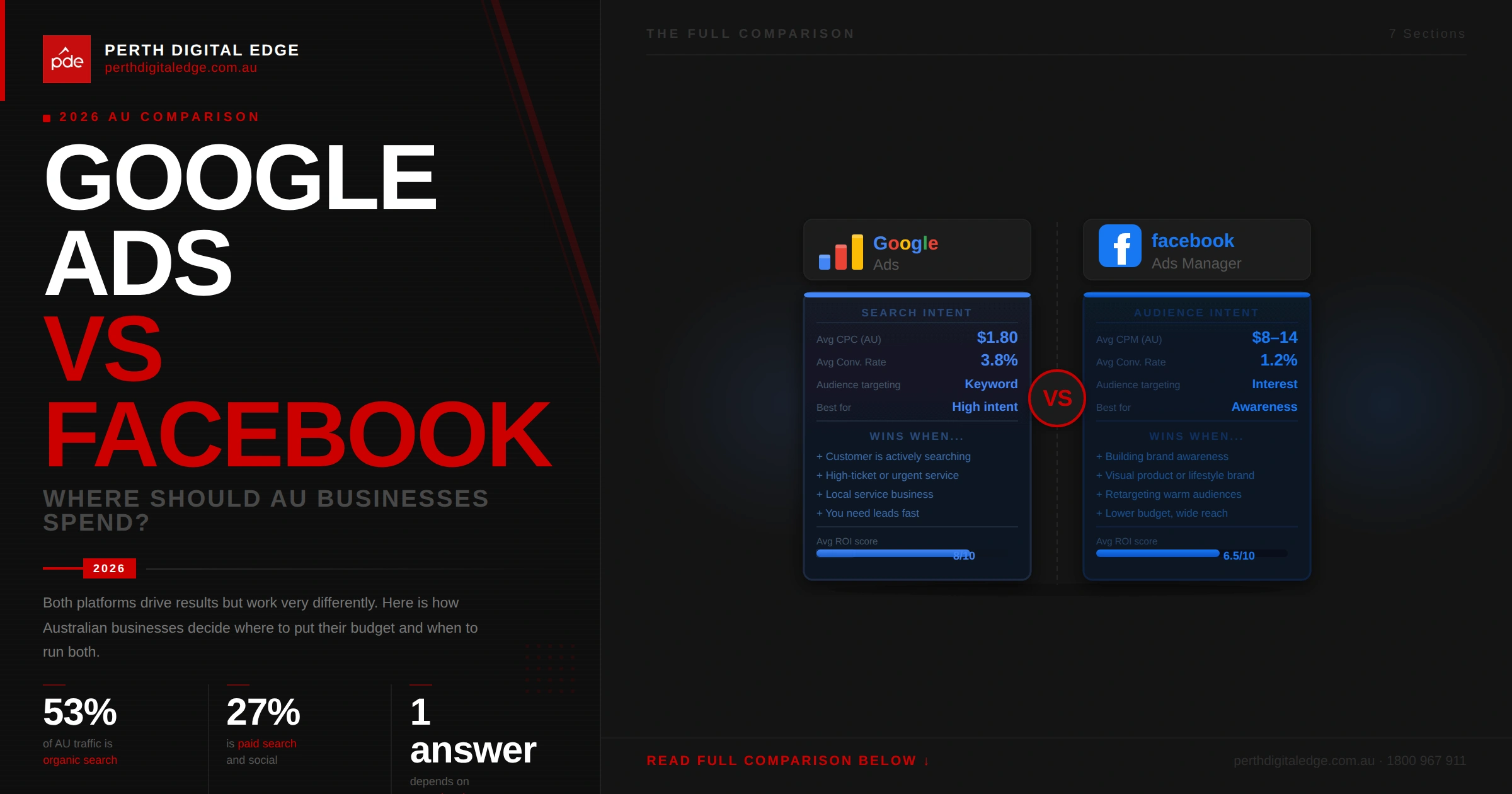
Placing both Google ads vs Facebook side by side reveals strengths and trade-offs across every metric that matters.
| Factor | Google Ads | Facebook Ads |
| Primary Strength | Capturing existing demand | Creating new demand |
| User Intent | High (actively searching) | Low to medium (browsing) |
| Best For | Service trades, legal, medical, B2B | Ecommerce, lifestyle, new products |
| Avg CPC (Australia) | $2.00 – $8.00 (search) | $0.50 – $3.00 |
| Ad Formats | Text, Shopping, Display, Video | Image, Video, Carousel, Collection |
| Targeting | Keyword + intent based | Demographic + interest + behaviour |
| Retargeting | Display + YouTube remarketing | Pixel + Custom Audiences |
| Conversion Path | Search > Click > Convert | See > Engage > Retarget > Convert |
Here is what the metric google ads consistently wins on, and it surprised me when I first saw the numbers clearly: cost per acquisition, not cost per click. Google charges more per click. That is not in dispute. But the conversion rate compensates so dramatically for service businesses that the cost to acquire an actual paying customer is frequently lower on Google than on Facebook. Perth Digital Edge regularly sees Google search campaigns convert at 5% to 12% for trades and professional services, while equivalent Facebook traffic converts at 1% to 3%.
The metric where facebook ads shine is cost per thousand impressions and raw audience reach. If your goal is putting 50,000 eyeballs on a new product launch, Facebook will do it at a fraction of what Google Display would charge. The trade-off: those 50,000 people were not looking for your product. You have to earn their attention, and earning attention is harder and more expensive than answering a question someone already asked.
When Google Ads Is The Stronger Choice
Google ads excels in scenarios where demand already exists and the buyer is actively searching for a solution.
Service businesses with clear search demand. Plumbers, electricians, lawyers, dentists, accountants: people search for these when they need them. There is no Facebook equivalent of someone typing “emergency dentist near me” at 11pm. A Balcatta plumbing client generates 85% of their paid leads through Google search and only 15% through Facebook retargeting. The Google leads cost more per click but close at nearly six times the rate.
Ecommerce with high purchase intent product searches. When someone types “buy Nike Air Max 90 size 11” into Google, they have already decided. Google shopping ads put your product, price, and image in front of that person. Shopping ads outperform Facebook for these searches because the buyer is comparing options, not discovering categories.
And here is something I wish more business owners understood before they fixate on CPC: the economics of lead quality. A Wanneroo conveyancer we manage pays $7.80 per click on Google and $1.40 on Facebook. Cheap clicks look better on a spreadsheet. But the Google leads close at 14%. The Facebook leads close at 2.3%. When you run the maths on cost per signed client, Google produces conveyancing clients at $312 each. Facebook produces them at $487 each. The cheap channel was actually the expensive one. I have seen this pattern repeat across legal, medical, and financial verticals so many times that I now consider it a near-universal rule for considered purchase categories.
When Facebook Ads Is The Stronger Choice
Facebook advertising has genuine advantages that Google cannot replicate, and dismissing it because the conversion rates are lower misses the point entirely.
New product launches. If nobody is searching for your product because it does not exist yet in the public consciousness, Google cannot capture demand that has not formed. Facebook creates it. An Osborne Park skincare brand we consulted for launched a new line with zero search volume. Instagram ads and Facebook video campaigns generated 1,200 email signups and 340 purchases in six weeks. By the time people started Googling the brand name, the launch had already paid for itself.
Visual products that sell on impulse. Fashion, homewares, food, beauty: these categories thrive in the Facebook feed because the format triggers desire. Carousel ads showing multiple angles, collection ads creating an in-app shopping experience, and video ads demonstrating the product in use tap into browsing behaviour that text ads on Google cannot replicate.
Businesses that need to target users based on who they are rather than what they type belong on Facebook. The targeting engine lets you reach people by age, income, relationship status, parenting stage, and hundreds of other data points. We manage Facebook campaigns for a Perth wedding photographer who targets engaged women aged 24 to 35 within 50km of the metro. That level of demographic targeting is simply not possible on Google, where you can only target based on the words someone types.
Google Shopping Vs Facebook Ads For Ecommerce
This is where the Google shopping vs Facebook ads comparison gets specific. For ecommerce, the answer hinges on where the buyer sits in their purchase decision.
Google shopping dominates when the buyer knows what they want. They type a product name, a brand, a specification. Shopping ads appear with images, prices, and availability. The click carries purchase intent because the buyer is comparing, not browsing. Perth Digital Edge manages shopping campaigns for WA retailers and consistently sees return on ad spend between 4:1 and 8:1 from Google Shopping, compared to 2:1 to 4:1 from Facebook for identical products.
Facebook ads compare favourably when the product is unknown. A new homeware line, a niche supplement, a handmade product with no search volume: these are scenarios where Facebook’s visual formats and interest targeting outperform because there is no demand to capture. The buyer discovers the product through an engaging ad, not a search query. The Facebook ads tend to work best when combined with a strong creative strategy that stops the scroll.
The smartest ecommerce operators we work with use both. Google Shopping captures buyers who already know what they want. Facebook builds awareness, generates interest, and feeds the remarketing audience that Google then converts. Combining google ads and Facebook into a single loop produces returns neither platform achieves alone.
Why The Best Strategies Use Both Google Ads And Facebook Together
The results I am most proud of at Perth Digital Edge do not come from one platform. They come from both google ads and Facebook working as interconnected parts of a single advertising strategy.
Here is how it works in practice. Google search captures high intent users at the moment they search. Some land on your website but do not convert. Facebook offer retargeting through the Pixel then serves those visitors a follow-up ad, reinforcing the message and nudging them back. This retargeting layer converts at two to three times the rate of cold Facebook traffic because the person already demonstrated interest through their search.
Meanwhile, Facebook awareness campaigns and social ads drive new potential customers to your site. Those visitors enter your google analytics audience pools and can be retargeted through the google display network and YouTube ads, creating a cross-platform loop that builds familiarity and captures conversions across both channels.
City Beach Basketball Club is a good example. Perth Digital Edge built their website, managed their marketing, and ran both google ads and Facebook together. Google Search captured parents actively searching for kids basketball programmes. Facebook reached new families in the catchment area based on parenting status and sporting interests. The combined ad campaigns delivered 62 conversions in a single quarter. Neither platform produced that number alone. The cross-platform loop, where awareness fed search and search fed retargeting, was the mechanism.
A Joondalup home renovation company we manage runs this exact marketing strategy. Google delivers 60% of qualified leads. Facebook retargeting delivers 25%. Cold audience Facebook delivers 15%, feeding the retargeting pool for both. Combined return on ad spend: 6.2:1.
Costs Compared: Google Ads Vs Facebook Ads In Australia
Cost is the first question most business owners ask. Here is what both google and Facebook actually cost in the Australian market in 2026.
| Metric | Google Ads (Search) | Google Ads (Display/Shopping) | Facebook/Instagram Ads |
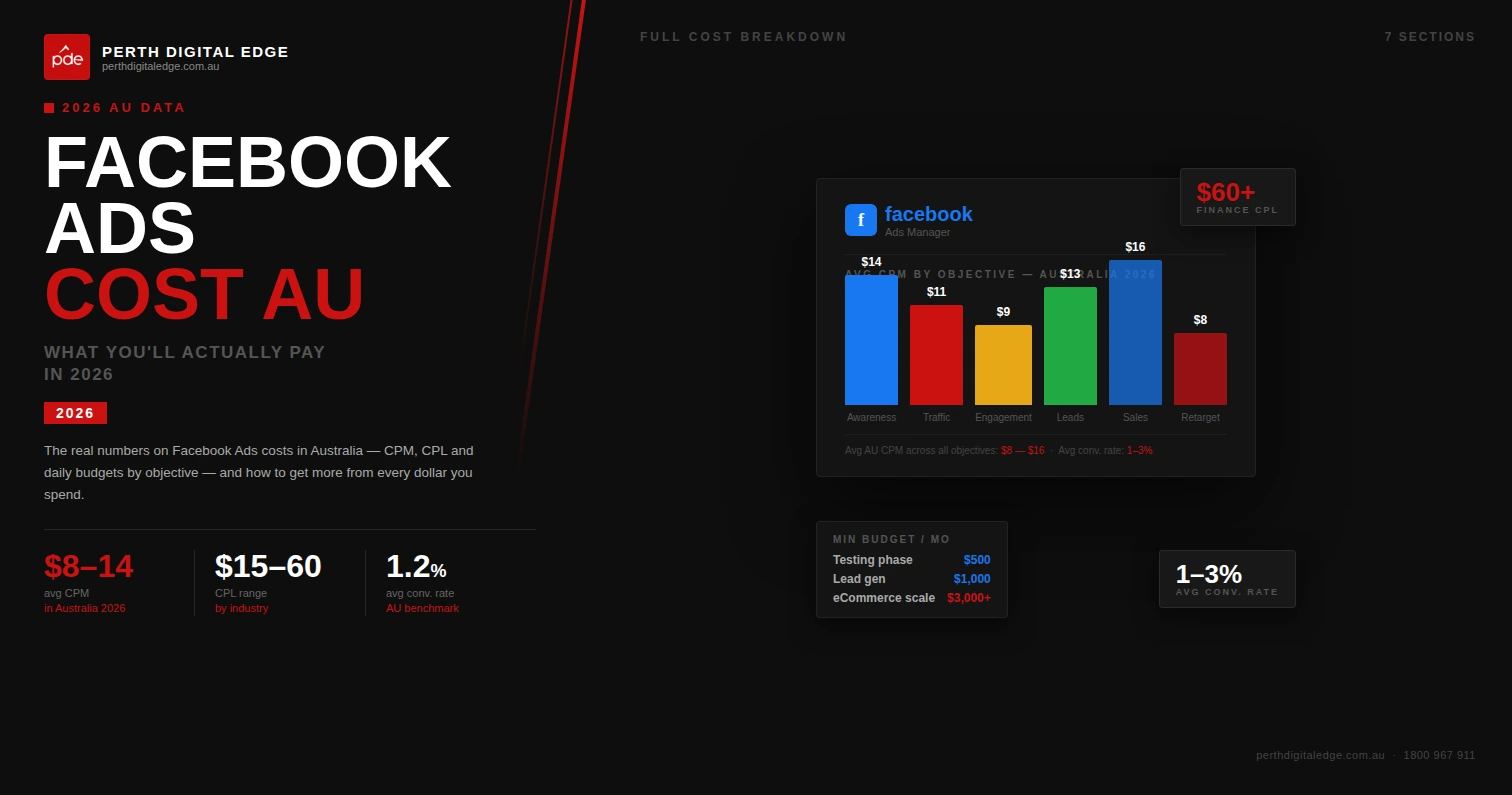
| Avg CPC | $2.50 – $8.00 | $0.30 – $2.50 | $0.50 – $3.00 |
| Avg CPM | $15 – $45 | $3 – $12 | $5 – $15 |
| Avg Conversion Rate | 5% – 12% | 0.5% – 3% | 1% – 4% |
| Min Monthly Budget | $1,500 | $1,000 | $800 |
Google ads costs more per click on search. But conversion rates for intent-driven queries are dramatically higher. Facebook costs less per click and per thousand impressions, but requires more touches before a user converts. The real comparison is cost per acquisition. Perth Digital Edge tracks this across every client running both platforms. For service businesses, Google consistently delivers a lower cost per acquisition despite higher CPC. For visual product discovery and impulse purchases, Facebook frequently wins.
How To Decide Where Your Money Should Go
The decision framework is simpler than the noise around it suggests. Three questions clarify the allocation.
First: are people already searching for what you sell? Check search volumes in Google Keyword Planner. If meaningful demand exists, Google should be your primary channel. If volume is low or non-existent, start with Facebook. This is basic digital marketing triage, but I am amazed how often it gets skipped.
Second: how does your customer buy? If the purchase is considered, researched, and compared, Google captures that research phase. Legal services, medical, trades, B2B: these are Google-first categories. If the purchase is visual, emotional, or impulse-driven, Facebook captures the browse-and-buy behaviour. Fashion, food, lifestyle, homewares: these are Facebook-first. Getting this wrong is the most common online advertising mistake I see, and it turns a promising advertising campaign into an expensive lesson.
Third: what is your advertising budget? If you can only afford one platform and your business has clear search demand, put everything into Google. If you are launching a new consumer product with no search volume, put everything into Facebook. At $3,000 per month or more, split it: 60% primary channel, 40% secondary, with retargeting on both. Define your target audience clearly, then adjust the ratio every 60 days based on what the google analytics data actually shows.
Tracking Performance Across Both Platforms
Running both Google ads and Facebook without unified tracking is running two businesses with no shared reporting. At Perth Digital Edge, we configure google analytics as the connective layer. UTM parameters on every ad. Conversion events matched between platforms. A shared dashboard showing which channel, campaign, and keyword produced each phone call, form submission, or purchase.
The mistake that makes me want to put my head through a wall is last-click attribution used as the only lens. A customer discovers your brand through a Facebook ad. Three days later they Google your business name and convert on a branded search click. If you only measure last click, Google gets 100% credit and Facebook looks like it produced nothing. That misattribution leads to catastrophically bad budget decisions. I have seen businesses kill their Facebook awareness campaigns based on last-click data, watch their Google branded search volume drop 40% two months later, and not understand why. The awareness was feeding the search. They severed the artery and blamed the leg.
Perth Digital Edge configures multi-touch attribution for every client running both platforms. You see which channel initiated the customer journey, which one assisted, and which one closed. That clarity is what makes budget allocation rational instead of reactive.
Frequently Asked Questions
The questions business owners ask most often about choosing between Google and Facebook.
Is Google Ads Better Than Facebook Ads?
Neither is universally better. Google ads vs Facebook comes down to your product, your customer, and your business goals. Google captures existing demand from high intent users who are actively searching. Facebook creates new demand by reaching people based on demographics and interests. For service businesses with established search demand, Google typically produces a stronger return. For visual products, launches, and brand building, Facebook often wins. The best results almost always come from using both.
Can I Run Both Google Ads And Facebook Ads Simultaneously?
Perth Digital Edge recommends it for any business with a monthly ad budget above $3,000. Running both google ads and Facebook creates a cross-platform funnel: Google captures high-intent search traffic, Facebook builds awareness and retargets visitors who did not convert. We manage this combined approach for multiple clients and consistently see 20% to 40% higher overall return compared to either platform in isolation.
How Much Should I Spend On Google Ads Vs Facebook Ads?
Start with your primary channel. If your business relies on people searching for your service, allocate 60% to 70% of your advertising budget to Google and the remainder to Facebook retargeting and awareness. If your business relies on visual discovery, flip that ratio. As data accumulates over 60 to 90 days, shift budget toward whichever platform produces lower cost per acquisition. Perth Digital Edge reviews this allocation monthly for every client and adjusts based on actual conversion data.
What Is Google AdWords And Is It The Same As Google Ads?
Google AdWords was the original name, rebranded to Google Ads in 2018 to reflect the broader suite beyond search: display network, video, shopping, and app campaigns. The functionality is the same. The ad formats have expanded significantly. Perth Digital Edge manages across every format within the current ecosystem, from search to google display network to YouTube to Shopping.
Choosing The Right Advertising Strategy For Your Business
The Google ads vs Facebook ads debate has no single winner because the two platforms solve different problems. Google captures people already looking. Facebook reaches people who match your buyer profile but have not started searching yet. The strongest digital advertising strategies use both, with each platform feeding the other through retargeting and cross-platform audience loops.
I have spent a decade at Perth Digital Edge managing both platforms for trades, ecommerce, allied health, and professional services across Australia. Watching how the two channels interact inside real accounts, seeing the data compound across hundreds of campaigns, is what gives me confidence that the combined approach works. It is not theory. It is pattern recognition earned over $1 million in managed spend and thousands of A/B tests.
If you are unsure where your money should go, or if you are running one platform and wondering whether the other would lift your results, I am happy to walk through the numbers with you. No pitch. Just data.
Get A Free Ad Strategy Review From Perth Digital Edge
I’m Ben Tippett, founder of Perth Digital Edge at 17 Bonnievale Tce, Wanneroo. I build and manage Google Ads and Facebook advertising campaigns for businesses across Western Australia and nationally. Whether you need to choose between platforms or want to see how combining Google ads and Facebook could transform your results, let me show you what the data says for your specific situation. Contact Perth Digital Edge today for a free, no-obligation strategy review.