

Back in 2016, Westside Auto Wholesale on Ewing Street in Bentley was spending $22000 a month on Google Ads when they first came to us. Every single lead had a metre running. Pause the ads, the phone stops. Resume the ads, the phone starts. It felt like control, but it was dependency.
Meanwhile, their organic search results were invisible. Ben searched for “used cars for sale Perth” and Westside did not appear in the first three pages of google. They were paying for every visitor while competitors down the road were getting that same search traffic through organic rankings.
That dependency is what bothers us most about businesses that run paid advertising without building organic alongside it. Not because google ads are bad, they are genuinely useful, and we run ads campaigns for clients every week. What bothers us is the vulnerability.
A business built entirely on ongoing ad spend has no fallback if costs spike, if a competitor with deeper pockets enters the auction, or if cash flow tightens for a quarter.
Ben learned this principle from an unlikely source. He spent his twenties in martial arts, where the coaches drilled a concept that stuck: never depend on a single technique. The fighter who only knows how to punch will eventually face someone who knows how to grapple. Your digital strategy works the same way. Seo and google ads are not competing techniques. They are different tools for different situations, and the businesses that win use both seo and paid with intention rather than default.
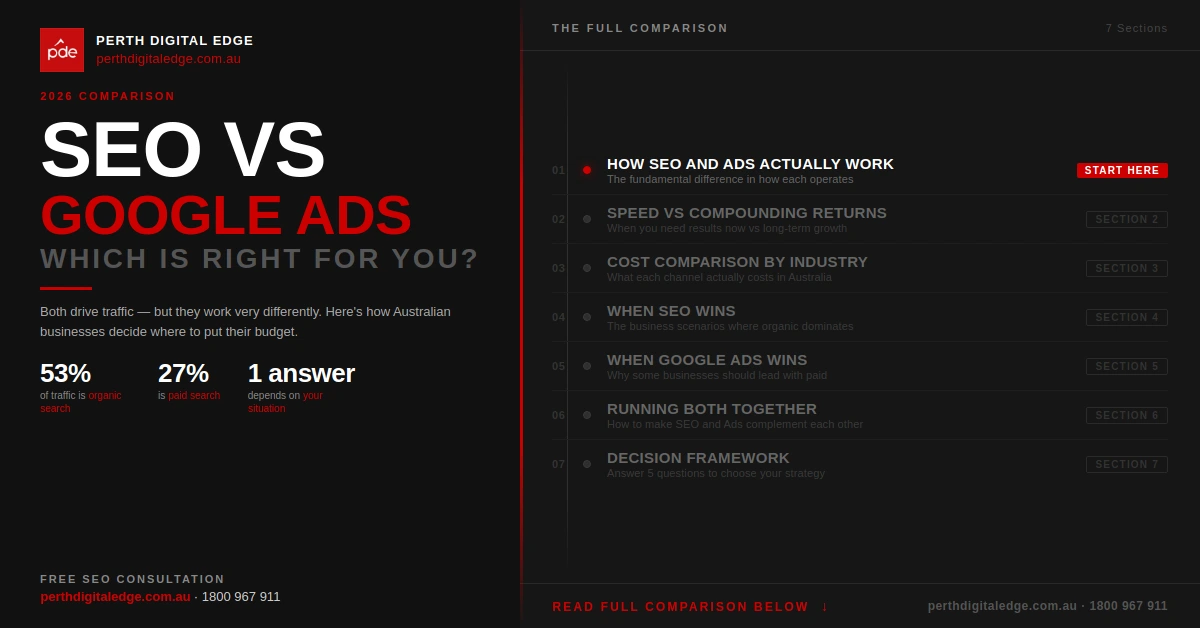
This guide breaks down seo vs google ads based on what we have actually observed working for Australian businesses over the past decade. Not theory. Not a vendor pitch for one channel over the other.
How Google Ads Work
Google Ads is a pay per click platform. You bid on specific keywords, write ad copy, and your paid ads appear at the top of search engine results pages when someone searches those search terms. You pay every time someone clicks. Stop paying, the paid advertisements disappear.
Google Ads offers genuine advantages. If you launch a campaign this morning with the right budget and targeting, your paid ads can appear in google search results by this afternoon. That immediate visibility is valuable when you need immediate traffic: product launches, seasonal pushes, new businesses with no web presence yet. Google ads helps you target particular keywords with precision, choosing exactly which search terms and search intent trigger ads, which landing pages visitors reach, and which postcodes see your paid advertisements. Google ads costs vary by industry, but for most Perth service businesses, expect $3 to $15 per click.
Here is the structural limitation. Paid advertising rents attention. The cost does not decrease over time. If anything, google ads costs tend to climb as more competitors enter the auction. Ongoing ad spend becomes a permanent line item for as long as you want paid traffic arriving. For Westside, that $7,200 monthly was a fixed cost of doing business, and it had been climbing 8 to 12 percent year on year for three consecutive years. That trajectory is not unique to them. We see it across every industry in Perth’s increasingly competitive market.
How SEO Works
Search engine optimisation is the process of improving your website’s content, technical foundation, and authority so that search engines rank your pages higher in organic search results. Unlike paid ads, organic rankings are earned. When seo works effectively, your pages appear in relevant search results without you paying per click.
SEO involves optimising multiple layers simultaneously. On-page factors include keyword research and targeting, content that pages match search intent for target queries, meta data, and internal linking. Technical factors cover site speed, site performance, mobile responsiveness, crawlability, and structured data. Off-page factors include backlinks from authoritative domains and your business’s online presence across the web. Google evaluates relevance across hundreds of signals to determine which pages deserve higher rankings in search engine results.
A well executed seo campaign addresses these signals systematically, building organic visibility that compounds month over month. Good seo does not produce overnight results. It requires an upfront investment of effort and budget before search rankings respond. Depending on your competitive landscape, meaningful organic traffic takes three to six months to develop. But unlike paid ads, the returns compound. A page ranking on page one today continues generating organic traffic for years with relatively modest ongoing improvements.
Here is a detail that often surprises business owners. The Fremantle Roofing Services team came to us spending $89 per lead through Google Ads. After twelve months of focused seo, organic search was delivering leads at $14 each. But the organic leads also converted at a higher rate. Why? Because someone who clicks an organic listing after reading a detailed, helpful page trusts you more than someone who clicks a paid advertisement. The organic search results carry an implicit endorsement from google that paid ads do not. That trust difference showed up directly in Fremantle Roofing’s close rate: 34 percent from organic versus 21 percent from paid. Nobody talks about this enough.
The Key Differences Between SEO And Google Ads
Understanding google ads vs seo comes down to three fundamentals.
Speed. Google Ads delivers immediate traffic the day you launch. SEO is a long term solution that builds gradually. Need leads this week? Prioritise google ads. Want leads flowing consistently in twelve months at a fraction of the cost? Prioritise seo.
Cost Structure. With Google Ads, you pay per click. Your cost per lead is directly tied to ongoing ad spend. With SEO, the upfront investment goes into content, technical improvements, and authority building. Once organic rankings improve, the marginal cost of each additional visitor approaches zero.
Longevity. Paid advertisements stop delivering the instant you pause spend. Organic results persist. We tracked this directly with Westside. After twelve months of combined seo and Google Ads, we reduced their ad spend by 35 percent. Organic search was already covering the volume paid had previously carried. By month eighteen, their organic traffic exceeded what paid had ever delivered, and their cost per lead from organic was one quarter of what Google Ads had been charging.
Both seo and google ads play unique but complementary roles. The question is not which one to choose. It is how to balance them based on where your business sits right now.
When To Prioritise Google Ads
There are specific situations where paid advertising is the correct first move, and being honest about that matters more than pushing seo as the answer to everything.
New businesses with no web presence. A brand new site has zero organic rankings. Google Ads gives you immediate visibility while seo ramps up behind the scenes. We ran this exact play for a physiotherapy clinic opening in Joondalup. Google Ads drove bookings from week one while we built their organic efforts through content and local SEO. By month six, organic carried 40 percent of leads and we began scaling ad spend down.
Competitive keywords where organic is unrealistic short-term. Some search terms are locked down by national brands and aggregator sites. Bidding through Google Ads while building authority is pragmatic, not defeatist.
Seasonal or time-sensitive campaigns. Promotions, event-based offers, holiday pushes. Paid ads are purpose-built for this. You cannot switch organic search on and off to match a promotional calendar.
Testing demand before committing seo budget. Before investing months of seo efforts into a new service line, run ads campaigns to validate that people search for it and convert. That data feeds directly into smarter seo strategies and prevents wasted content investment.
When To Prioritise SEO
SEO should be the foundation of any long-term digital strategy. These situations call for heavier organic investment.
You want sustainable growth that does not reset to zero each month. Every piece of content published, every technical fix implemented, every authoritative backlink earned adds permanent value to your organic visibility. SEO builds authority and sustainable traffic that paid advertising structurally cannot. The Fremantle Doctor blows through every afternoon and the roofing enquiries spike accordingly, but Fremantle Roofing Services does not need to increase ad spend to capture those seasonal queries anymore. Their organic rankings handle it.
Your google ads costs are compressing your margins. If cost per click is rising and your profit per lead is shrinking, that is a signal to invest in organic. After twelve months of seo, Fremantle Roofing’s overall cost per acquisition dropped 60 percent across both channels combined, because organic was doing heavy lifting that paid had previously shouldered alone.
You operate in a niche or local market. Local search engine results are far less competitive than broad national terms. A targeted seo strategy focused on your specific service area can achieve higher rankings faster than most marketing managers expect.
You want to reduce dependency on paid traffic. A business generating 70 percent of leads from organic search has a fundamentally more resilient web presence than one that needs ongoing ad spend just to keep the phone ringing. That resilience matters when a competitor decides to outbid you, when Google changes its ad policies, or when your cash flow needs breathing room.
How To Use Both SEO And Google Ads Together
The most effective marketing strategies combine both channels deliberately. Here is the phased approach we use at Perth Digital Edge, and it is worth noting that this is not a template we copied from a digital marketing blog. It is something we refined over years of running both channels for the same clients and watching how the data interacted.
Phase one: launch with Google Ads, build SEO simultaneously. Ads generate immediate sales and cash flow while your seo campaign builds organic rankings. The keyword data from your ads campaigns reveals exactly which search terms convert, which directly informs your content strategy and target keywords for organic efforts.
Phase two: shift budget as organic rankings improve. As organic traffic grows for your target keywords, reduce ad spend on those terms. Redirect that budget into seo for new keywords you have not cracked organically, or into online display advertising and remarketing.
Phase three: use ads as precision tools, not life support. Once good seo has established strong organic rankings for core terms, Google Ads becomes a scalpel rather than a crutch. Seasonal pushes. New product launches. Remarketing. The organic listing carries baseline traffic. Paid ads handle the spikes and the experiments.
This phased approach is how Westside went from $7,200 per month in ad spend with zero organic presence to $4,700 in ad spend with organic delivering 60 percent of total search engine marketing leads. Total lead volume increased. Total cost decreased. That is what happens when both seo and google ads operate within the same digital strategy rather than in silos managed by different people who never compare notes.
Should I Choose SEO Or Google Ads?
Most businesses benefit from both. Google Ads delivers immediate traffic and is ideal for testing demand. SEO is a long term solution that reduces cost per lead over time. The balance depends on your business goals, budget, and urgency. Start with ads if you need leads now, but invest in seo simultaneously so organic growth compounds behind the scenes.
How Long Before SEO Replaces Google Ads Traffic?
Three to six months before organic traffic contributes meaningfully. Twelve to eighteen months before organic can carry the majority of your search engine marketing volume. This varies by competition. A local service business in Perth may see faster results than a national ecommerce brand competing on broad search terms.
Can Google Ads Help My SEO?
Google Ads does not directly influence seo rankings. Google has confirmed that paid ads do not affect organic search results. However, ads campaigns provide keyword data, conversion data, and landing page performance insights that make your seo strategies more targeted. The two channels inform each other even though they operate independently within search engine results pages.
Build A Search Strategy That Does Not Depend On A Single Channel
The google ads vs SEO debate misses the point entirely. They are complementary channels serving different functions at different stages. Google Ads puts you in front of potential customers today to increase visibility immediately. SEO ensures you stay visible permanently. The businesses that treat them as parts of the same system, with shared data and coordinated targeting, consistently outperform those that run them in isolation.
At Perth Digital Edge, Ben Tippett and our team build Perth SEO marketing strategies that integrate both channels from day one. We have spent more than a decade watching Perth businesses waste money by treating paid and organic as separate activities with separate goals and separate reporting. The ones that win are the ones where ads data informs SEO, where organic growth reduces paid dependency, and where someone is actually measuring the combined picture against real business goals.
If your google ads costs keep climbing, if your organic visibility is flat, or if your current marketing strategies cannot tell you what each channel actually contributes to revenue, get in touch. We will audit both, show you where the gaps sit, and build a digital strategy where neither channel operates without the other.