

A lot of local SEO advice sounds tidy on paper and useless in the real world.
The real version is messier.
A business owner in Perth checks their phone and wonders why enquiries have gone quiet. They know the work is good. Their regulars stick around. Referrals still come in. But when someone nearby searches on Google for the service they offer, the business either does not show up at all or shows up looking second-rate. Thin profile. Old photos. Mixed details. Reviews from months ago. A competitor with a cleaner presence gets the call.
That is local SEO.
Not some abstract ranking exercise. Not a vanity project. Just the very practical question of whether your business looks easy to trust when a customer is deciding quickly.
From our side in Wanneroo, we see this pattern all the time. Good operators lose visibility for ordinary reasons. Their Google Business Profile was set up once and left alone. Their service pages are too broad. Their address and phone number do not match across local listings. The business itself is fine. The online picture is fuzzy.
This guide breaks down how local SEO works in Perth, what Google is actually paying attention to, and what to fix first if you want more calls, bookings, and enquiries in 2026.
What Local SEO Is And Why It Matters In Perth
Local SEO is search engine optimisation for businesses that need to be found by people in a specific area.
That includes shopfronts, clinics, offices, workshops, and service businesses that travel to customers across Perth. If a person in your local area can search for what you do and choose between you and three nearby competitors, local SEO matters.
Why? Because most local searches are not leisurely.
People looking for a tax accountant in Joondalup, an electrician near Duncraig, or a mechanic around Wangara are usually already in decision mode. They are not collecting ideas for later. They are narrowing the field now.
That makes local search unusually powerful. You can appear in the local pack, in Google Maps, and in the normal organic search results at the same time. When that happens, the business feels established. Familiar. Safe to contact.
When it does not happen, the opposite is also true.
How Google Ranks Local Search Results
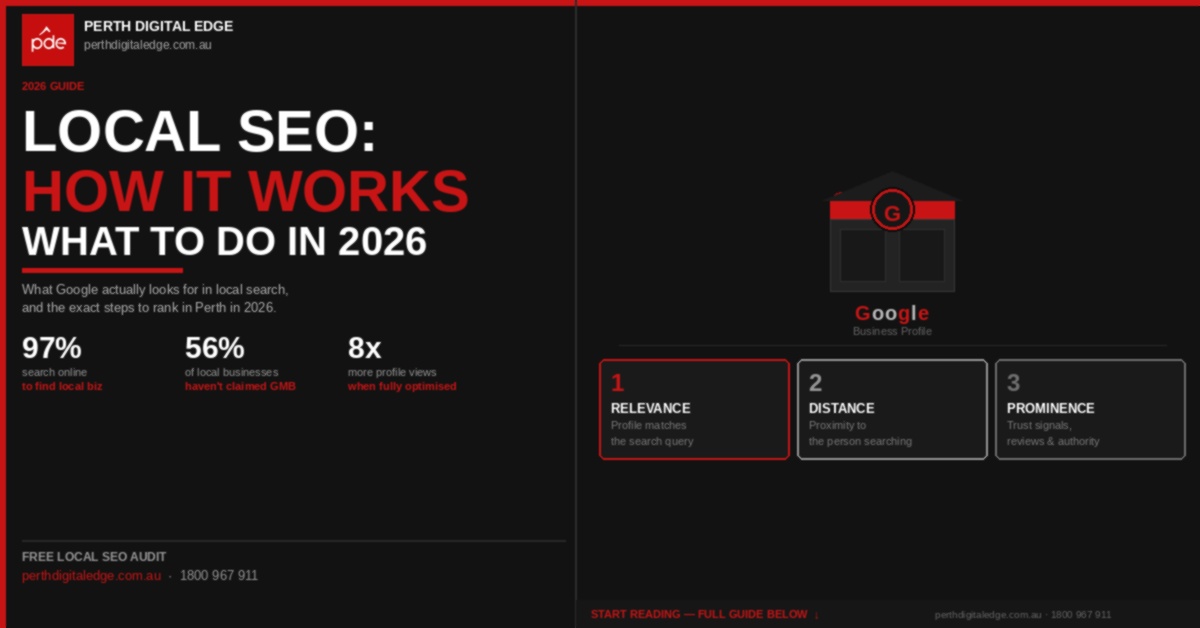
Google keeps the broad framework simple. Local search results are mainly shaped by relevance, distance, and prominence.
Relevance is the fit between the search and the business. If someone searches for a service and your business profile, categories, website content, and business details all clearly support that service, Google has a stronger signal to work with.
Distance is about proximity. How close is the business to the person searching, or how closely does the defined service area match where that search is happening? That is why the same keyword can produce different local results in different pockets of Perth.
Prominence is where local businesses often separate themselves. It reflects how established and credible the business appears online. Reviews, local citations, local listings, mentions, links, directory consistency, and the overall quality of the business profile all feed into that impression.
The short version is this. Google wants to recommend a business that matches the search, can realistically help the customer, and does not look like a gamble.
The Perth Reality That Changes Local SEO Strategy
Perth looks simple on a map. It is not simple when you are trying to win local searches.
Different parts of the city behave differently, and the businesses that do well in local search usually understand that without needing it explained to them.
Take Wangara. Searches around that area often come from practical, time-sensitive situations. The wider industrial belt, including the Northlink Industrial Park corridor, is full of businesses where people are trying to solve something during the workday, not browse for inspiration. They want clear service information, decent reviews, working phone numbers, and signs that the business is active now.
Joondalup has a different feel. The healthcare, education, and commercial mix changes the way people compare. Searches tend to involve a bit more checking, a bit more caution. The profile gets read more closely. Photos matter more. So does tone. A business that feels vague or overdone can lose trust quickly there.
Then you have the coastal strip and the more lifestyle-driven suburbs. In those areas, presentation often carries more weight than owners expect. Two businesses can offer the same service, but the one with cleaner photos, better review responses, and more complete business information usually gets the edge.
This is why local SEO strategy in Perth cannot be reduced to dropping suburb names into headings and calling it local. Local searchers are paying attention to different things in different parts of the city, and your local visibility improves when your pages, listings, and business profile reflect that reality.
Google Business Profile Optimization: The Fastest Local Lever
If a Perth business asks where to start, the answer is usually obvious once we open the Google Business Profile.
Not always flattering. Usually obvious.
The wrong primary category. Business hours that have not been touched in months. Thin service descriptions. Outdated photos. No review rhythm. Incomplete business details. Sometimes nothing is technically broken, but the profile still gives off the feeling that no one is minding the shop.
That matters because the profile sits right in the middle of local search results. It shapes relevance. It influences prominence. It often decides whether a customer clicks at all.
Start with the basics. Your business name, address and phone number need to be accurate and consistent. Close enough is not good enough here. If your website says one thing, your business listing says another, and old online directories still show a previous number, you create friction for both users and search engines.
Then check the categories. The primary category should reflect the service that actually drives revenue, not the broadest label that feels safe. Secondary categories should sharpen the picture, not blur it.
Service areas, business hours, and attributes come next. These need to reflect the business as it really operates. If you only travel within certain parts of Perth, say that. If your holiday hours change, update them. If an attribute is not true, leave it out.
The services, products, and business description should sound clear and grounded. This is where a lot of profiles go wrong. They become either too generic or too stuffed. Good Google Business Profile optimization reads like a business explaining itself properly, not like an SEO plugin wrote it.
Then there are the visuals. Real photos matter. Not because they are a magic ranking trick, but because people judge businesses quickly and visually. Staff, vehicles, signage, actual work, real premises, recognisable settings. That sort of material gives the profile weight.
Posts, Q and A, and review management matter too. Not because every profile needs to look busy all the time, but because a neglected profile is easy to spot.
Local Listings, Citations, And Directories That Build Trust
This is the unglamorous part of local SEO, which is probably why it gets ignored.
A business listing is any online mention of your business details. A local citation is usually your name address and phone showing up on local business directories, mapping platforms, and online directories.
The problem is not that one bad listing ruins everything. The problem is drift.
An old address stays live after a move. A tracking number gets added to one listing but not the others. The business name is shortened in one place and expanded elsewhere. Over time, the business information stops lining up.
That inconsistency chips away at trust. Quietly.
Search engines notice it. Potential customers notice it too, especially when they are trying to call or get directions and end up double-checking which details are right.
For local businesses in Perth, this work should be handled with a bit of discipline. Create one master version of the business details. Use it everywhere. Audit local listings for duplicates. Fix outdated records. If you operate across multiple locations, make sure each business listing points to the page that actually matches that location or service.
It is not exciting work. It is still worth doing.
Reviews And Customer Feedback: Where Local Rankings And Trust Meet
Reviews are one of the few parts of local SEO that matter to Google and to human beings in almost the same way.
Google reads them as a signal of prominence and activity. Customers read them as a clue about whether calling you is going to be easy or annoying.
That overlap is important.
A steady stream of positive reviews, recent customer feedback, and replies that sound like a real person wrote them will usually do more than a long-dead profile with one burst of five-star ratings from last year. It feels more believable. That matters.
The strongest review systems are not complicated. Ask satisfied customers while the experience is still fresh. Make the link easy to use. Keep the request simple. Then respond with some care.
Positive reviews do not need a corporate thank you template. Negative reviews do not need a defensive essay. They need calm, specific replies that show the business is paying attention and capable of handling friction without losing its head.
That tone matters more than many business owners realise. People read replies to judge temperament.
Customer feedback also gives you something better than marketing copy. It tells you what customers keep noticing. Slow callbacks. Unclear quotes. Poor follow-up. Great workmanship but average communication. Those patterns are useful because they point to the real operational issues affecting both the business and its local SEO performance.
Local Keyword Research That Matches How Perth People Search
Local keyword research is where a lot of businesses get too clever and not clever enough at the same time.
They chase terms that look important in a tool, but they skip the obvious question. How do local searchers in Perth actually describe this service when they need it?
Sometimes it is service plus suburb. Sometimes it is near me. Sometimes the query is broad and the phone location does the local work in the background. Sometimes people search by problem rather than by service name.
That is why local keyword research should start with evidence, not assumptions.
Google Search Console is usually the best first stop. It shows which local queries are already generating impressions in Google Search, which pages are getting seen, and where the gap sits between visibility and clicks. Those are often your quickest opportunities.
After that, use Google Search itself. Watch autocomplete. Study the local pack. Search your key services as if you were a customer in different parts of Perth. Notice how the results change. Notice which local businesses keep appearing and which phrases show up repeatedly.
Then group the keywords by intent. Some deserve service pages. Some belong on location pages. Some fit better in FAQs or supporting guides. If the page purpose is wrong, the ranking usually stalls no matter how well written the copy is.
And finally, keep the page mapping clean. One main keyword focus, one main page job. Local visibility gets harder when several pages on the same site are all trying to rank for the same thing.
Location Pages Without Duplicate Content
Suburb pages can help. They can also make a site worse in a hurry.
The problem is not the idea of location pages. The problem is the way many businesses execute them. They create ten versions of the same page, swap out the suburb name, and wonder why none of them perform particularly well.
Users can feel that kind of duplication straight away. Search engines can too.
A location page should justify its existence. It should say something useful about the service in that area. It should explain service boundaries, travel expectations, relevant local factors, or examples tied to that location. Ideally, it should contain proof that the business actually works there and understands the area.
A page for Joondalup should not read exactly like a page for Wangara or Fremantle with a few place names changed. The context is different. The customer expectation is different. The way the business is likely to be chosen may be different too.
That is the standard worth aiming for. Not scale for the sake of scale. Relevance with substance.
Website Signals That Support Local SEO Rankings
A Google Business Profile can get a business into the conversation. The website often decides whether the conversation goes anywhere.
This is where some local businesses quietly undermine themselves. The profile looks decent, but the site is vague. Or the service page barely explains the service. Or the mobile experience is clunky enough that the person gives up before making contact.
Good local SEO depends on the site making sense.
That means clear title tags, useful headings, sensible internal linking, and pages that answer the obvious questions without waffling. It means meta descriptions that reflect the page properly. It means service pages built around what customers actually need to know. It means local pages that add something real rather than repeating generic filler.
It also means coherence.
When the website, business profile, local listings, reviews, and customer experience all point in the same direction, search engines have less guesswork to do. So do people.
Structured data can help with that clarity. LocalBusiness schema and related business data markup are not substitutes for good content, but they can make the site easier for search engines to interpret.
And mobile still matters more than some owners want to admit. Most local searches happen on phones. If the page is slow, cluttered, or awkward to use, the opportunity is easy to lose.
Local Links, Sponsorships, And Community Signals
Prominence is partly about what people say about your business and partly about where the business shows up beyond its own website.
That can include local directories, industry bodies, nearby businesses, associations, suppliers, sponsorships, community mentions, and local media. Not every mention needs to be dramatic. It just needs to make sense.
A Perth business serving nearby customers does not get much value from random, irrelevant backlinks. It gets more value from signals that feel local and believable. A mention from a community organisation, a local partner, a supplier, or an industry group tied to the area usually carries more meaning because it reflects something real.
The same goes for sponsoring local events. It can work well when the fit is genuine. If the event has an actual connection to your audience, the mention can support both visibility and credibility. If it is purely transactional, it tends to show.
This part of local SEO is really about reputation in public view. Not hype. Not volume. Just visible evidence that the business is part of the market it serves.
How To Measure Local SEO Results Without Guessing
If local SEO is not tied back to outcomes, it becomes very easy to confuse activity with progress.
That is where a lot of reporting goes wrong.
Start with Google Business Profile insights. Look at calls, website clicks, direction requests, and the queries that triggered views. That tells you how the business profile is performing in local search results.
Then move to Google Search Console. It helps you see impressions, clicks, indexing issues, and which pages are gaining traction in organic search results. It is one of the simplest ways to tell whether the local keyword targeting is improving or just creating noise.
Listing audits and review management should be part of the picture too. They show whether the business information is staying consistent, whether review activity is improving, and whether negative reviews are being handled in a way that protects trust.
Local SEO tools can help with grid tracking and suburb-level visibility when you want more precision. They are useful. They are just not the whole story.
The real measure is whether local SEO results are producing something tangible. More calls. Better enquiries. More direction requests. More bookings. More customers.
First-Party Perth Examples From Perth Digital Edge
Local SEO advice is full of neat frameworks. Real campaigns are less tidy.
That is why first-hand work matters. It tells you what holds up once the theory meets an actual business, an actual market, and all the ordinary mess that comes with both.
Project Concrete did not need a complete reinvention. It needed clarity. The demand was there, but the site was not helping Google connect the right pages to the right searches. Once the page intent was tightened and the structure cleaned up, the campaign delivered a 312 per cent increase in website traffic in three months, 62 conversions in the first month, and 14 first-page keywords in month one.
Westside Auto Wholesale was a different shape of job altogether. Bigger footprint. More complexity. More ways for the site to drift if the architecture was not controlled properly. The campaign delivered 4,900 per cent ROI, 1.4 million visitors in 2023, more than 120,000 leads in 2023, 81 keywords in the top three, and 124 of 130 niche terms on page one. Those results came from sustained work on structure, relevance, content alignment, and authority over time.
Stelios Jewellers highlighted something many SEO pages miss. Retail local search is often emotional before it is logical. People compare, hesitate, leave, return, and buy later. The visibility matters, but so do the trust cues, the category structure, the product presentation, and the quality of the supporting content that helps someone feel comfortable buying.
Fremantle Roofing Services was more immediate. Roofing searches tend to happen under pressure. The customer wants reassurance fast. The campaign generated a 300 per cent increase in qualified leads, which is consistent with what we see when the profile, citations, reviews, and service pages all line up around the same local intent.
Local SEO FAQs
A lot of the same questions come up once businesses start taking local SEO seriously. Fair enough. It looks straightforward until you get into the details.
What Is Local SEO And Why Is Local SEO Important?
Local SEO is search engine optimisation aimed at improving how a business appears in local search results. It matters because local customers often make quick decisions in Google Search and Google Maps, especially when they are comparing nearby businesses in the local pack.
What Are The Biggest Local Ranking Factors?
The main local ranking factors are relevance, distance, and prominence. In practical terms, that means your Google Business Profile, local citations, reviews, website relevance, and service-area fit all influence local rankings.
Should Every Perth Business Create Suburb Pages?
No. Location pages only make sense when they add genuine value. If each page repeats the same wording and simply changes the suburb name, the content usually becomes thin and less useful for both users and search engines.
How Do I Improve Local Search Visibility On Google Maps?
Start with Google Business Profile optimization. Review your categories, business hours, service areas, photos, services, and core business details. Then support the profile with accurate local listings, better review management, and pages that align with relevant local searches.
How Long Does Local SEO Work Take To Show Results?
That depends on the baseline, the competition, and how many issues need to be cleaned up. Some businesses see movement fairly quickly once profile issues, citation inconsistencies, and relevance gaps are fixed. Harder markets usually take longer and respond best to consistent work.
Build A Perth Local SEO Plan That Produces Calls
If your business depends on nearby customers, local SEO has a direct say in how you are found, how you are judged, and whether you get the next call.
That judgement is often made quickly and with less generosity than business owners expect.
A thin business profile, mixed business information, weak location pages, poor review management, or stale local listings can make a solid business look uncertain. In local search, uncertainty costs enquiries.
The upside is that most gains come from getting the obvious things right and doing them with more care than the businesses around you. Better Google Business Profile optimization. Cleaner local citations. Better page intent. Stronger proof. Fewer mixed signals.
If you want a Perth-specific plan, book a free consultation with Perth Digital Edge in Wanneroo. We will review your Google Business Profile, local listings, Google Search Console data, and the pages that should already be doing more work, then map out a practical 90-day local SEO strategy based on how people actually search in Perth.