

Local SEO refers to the practice of optimising your business’s online presence to attract nearby customers through search engine results. When someone searches for a coffee shop near them or looks up a plumber in Perth, local SEO ensures your business appears prominently in those search results. At Perth Digital Edge, we help Australian businesses understand and implement local SEO strategy that actually works.
Here is something most business owners do not realise. Nearly half of all Google searches have local intent. Someone is looking for something nearby, right now, and deciding within seconds which business to call. Your competitors have already figured this out. What does local SEO mean for your revenue? It means the difference between your phone ringing and a competitor’s phone ringing when a customer searches for exactly what you offer. One, the other, rarely both.
Local SEO Defined
Local search engine optimization is the process of improving your business’s visibility in local search results and on Google Maps. It involves optimising your business information, website content, and online presence to rank for location-based searches relevant to your specific area. When customers perform local searches, they expect to find nearby, trustworthy businesses. Local SEO ensures you’re visible when they look.
Local keywords are how this plays out in practice. A customer searching for a dentist in Subiaco is not researching dental science. They have a toothache and they want someone close. A plumber in Fremantle, a cafe in Northbridge, same thing. These searches carry enormous commercial value because the person has already decided they need something. They are choosing who to buy from. That is local intent, and it converts at rates that would make most paid advertising look wasteful.
Local SEO is different from general SEO in fundamental ways. General SEO targets national or international searches with no geographic component. Local and general SEO share foundational principles, but their execution differs considerably. Local businesses do not need to compete nationally. You target highly specific location-based searches where your customers actually live and work. One thing few guides mention: Google’s local algorithm runs partly separately from its main organic algorithm, which is why a site can rank badly for broad terms yet dominate its suburb. The reverse also happens, which is confusing for owners who assume a pretty website automatically means local visibility.
This hyper-focus makes local SEO more cost-effective and easier to dominate than general SEO, especially for small to medium-sized businesses. A Melbourne restaurant does not compete nationally; it targets local customers searching within specific suburbs. A digital marketing agency in Perth can establish authority within its geographic service area far faster than building national authority.
How Local SEO Works
Search engines like Google use complex algorithms to understand local searches and determine which businesses should appear in local search results. When someone performs a local search, Google considers several critical factors: the user’s exact location, the relevance of the business to that specific search, the distance between the user and the business, and the prominence of the business based on reviews, citations, and authority. Other search engines like Bing also follow similar principles.
The process unfolds like this. A user searches using a location-based query, perhaps typing restaurant near Applecross or plumber Belmont. Google’s algorithm identifies the geographic intent behind that search and determines the user’s location through their device, IP address, or explicit location permission. It then retrieves businesses matching that search query.
Google ranks these businesses using its local ranking factors and name, address and phone number accuracy. Your business details must be accurate and consistent. Citations across online directories signal legitimacy. Your Google My Business profile status matters enormously. Website content relevance, reviews and ratings all combine to determine whether you rank in the local pack or below.
Local SEO success depends on three fundamental pillars: relevance, distance, and prominence. Relevance means your business genuinely serves what the customer is searching for. Your business categories, description, and website content must clearly demonstrate this. Distance refers to how close you are to the searcher. If you’re a local services provider, proximity matters significantly. Prominence comes from reviews, backlinks, and your overall online authority. Building these factors improves your local SEO rankings.
The mechanics are straightforward but require consistent execution. Every piece of business information must be accurate. Every online directories listing must be consistent. Your Google Business Profile must be complete and regularly updated. Your website must optimise for local keywords to improve your local rankings.
The Google Local Pack And Google Maps
The local pack is what most people see when they make a local search on Google. It shows three local businesses in a map view with their names, ratings, addresses, and phone numbers. Getting into the local pack is crucial because these top three results capture the vast majority of clicks and phone calls. Studies show local pack listings generate more inquiries than traditional paid advertising.
Google Maps is the distribution channel for local search visibility and the visual representation of local search results. Your Google Business Profile, which controls exactly how your business appears on Maps and in local search results, is absolutely central to local SEO efforts. Without proper optimisation of your business profile, your local search rankings suffer dramatically. Your potential customers may never see you.
The local map pack drives significant traffic and high-intent inquiries. When someone searches for a service locally, they are usually ready to buy or inquire. Here is a stat worth thinking about: roughly 76% of people who search for something local on their phone visit a business within 24 hours, and 28% of those searches end in a purchase. Those numbers come from Google’s own data, and they explain why local pack visibility matters so much more than most business owners appreciate.
Appearing in the local pack requires meeting Google’s ranking criteria. Business name and name, address and phone number precision is non-negotiable. Profile completeness, review quantity and quality, citation consistency, and local link building from community sources all strengthen your prominence.
Local SEO Versus General SEO
General SEO targets national or international searches with no geographic component. A company selling software might compete nationally across thousands of websites. Local and general SEO share the same fundamental principles around keyword research, link building, and on-page optimisation. Both require quality content and technical excellence. However, their execution differs considerably in scope, timeline, and methodology.
General SEO requires building domain authority across hundreds or thousands of pages. It often takes six to twelve months to see meaningful movement on competitive terms, and you are competing against established sites with massive backlink profiles. Local SEO moves faster. Much faster. A plumber in Fremantle is not competing against every plumber in Australia. They are competing against maybe fifteen other plumbers within a 10-kilometre radius. That is a contest you can actually win, even as a small business with a modest budget and a website built five years ago. We have seen owners go from invisible to dominating their suburb in under a year, which is a timeline that simply does not exist in general SEO.
With local SEO, your target local keywords include specific place names and suburbs, and search engine results page listings for local queries are dominated by the local pack and Google Maps. With general SEO, you are fighting for organic search results positions against potentially thousands of competitors nationwide. The stakes, competition and timeline are completely different.
Why Local SEO Is Important For Australian Businesses
Australia has over 2.5 million actively trading businesses, and the overwhelming majority serve local customers. Retail shops, tradies, service providers, professionals, hospitality operators. Local SEO important because it refers directly to how these businesses get found online. We worked with a physiotherapist in Perth who told us she had never once considered that people were Googling ‘physio near me’ and finding her competitor three streets away instead of her. That realisation changed everything. Your business online presence is not a nice-to-have. It is the shopfront most of your customers see first.
Australian suburbs each have distinct local communities and customer bases. Someone searching in Subiaco has different needs than someone in Northbridge. Local SEO strategy accounts for this geographic specificity. Sponsoring local events and maintaining community presence pairs well with digital efforts to build real local authority.
Mobile search dominance in Australia means local searches happen constantly. People commute, shop, eat out, and seek services while on the move. Honestly, this is the part that still surprises us. We have watched business owners sit in a coffee shop, pull out their own phone, search for their own service, and be genuinely upset by what they see. Their competitors showing up first. Their own listing buried. That moment tends to create more urgency than any sales pitch we could write. Highly targeted local traffic from mobile users creates qualified leads, and local website visibility on mobile directly impacts revenue.
There is also a trust factor that is easy to underestimate. Australian consumers genuinely prefer local businesses. When you appear in relevant local searches with positive reviews and consistent information, people view you as established and trustworthy. A business with 47 Google reviews and a complete profile feels safer than one with no reviews and a half-finished listing. We have seen businesses lose customers not because their service was worse, but because their online presence looked neglected. Perception matters.
Key Components Of A Local SEO Strategy
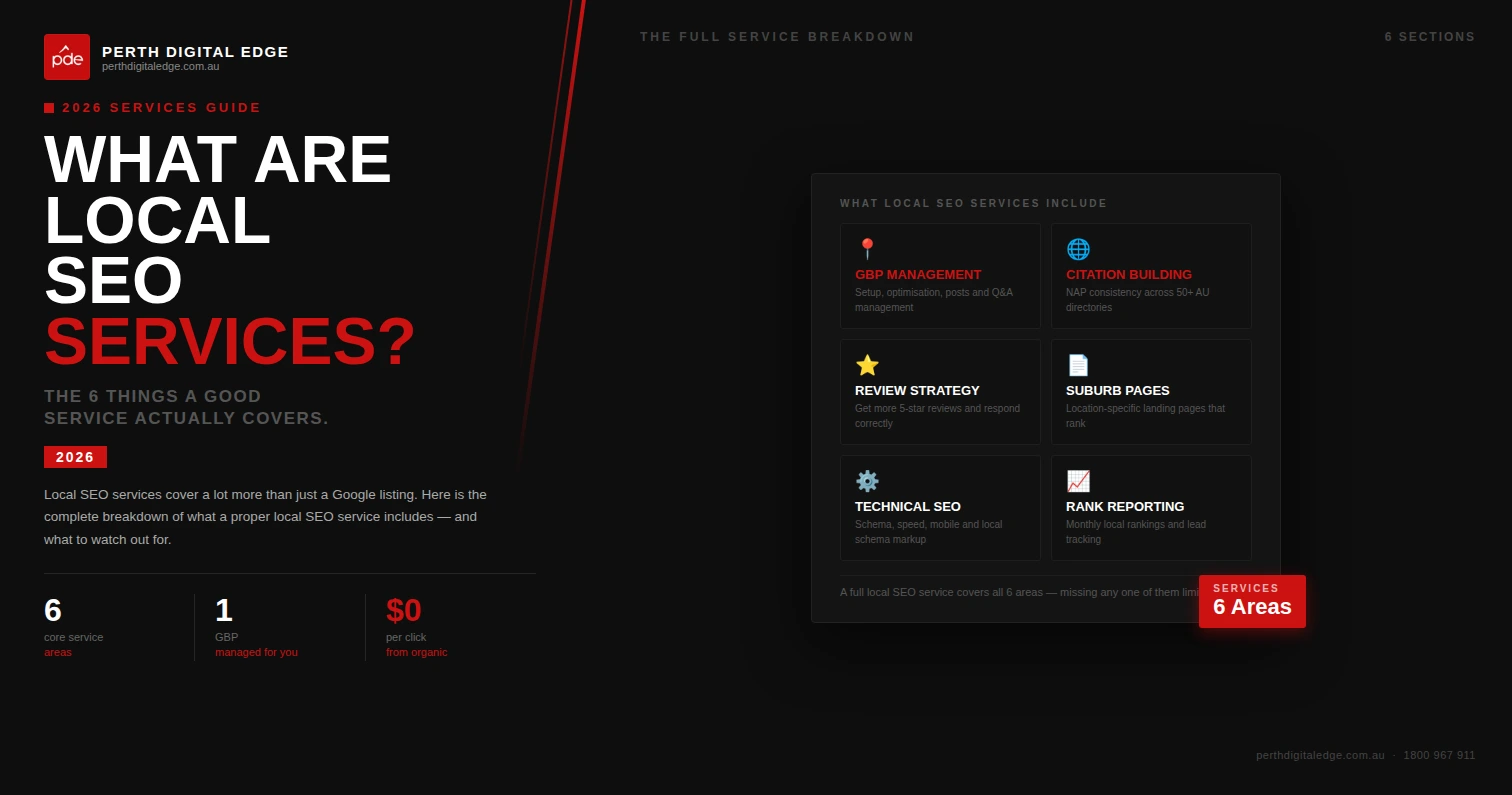
Google Business Profile Optimisation
Your Google Business Profile is your business’s official presence on Google search and Google Maps. Ben Tippett at Perth Digital Edge puts it plainly: if you fix nothing else this year, fix this. Every field in your profile matters: business name, address and phone number accuracy, hours of operation, business categories, photos, description, service areas, and website URL. Half-finished profiles quietly bleed leads every week and most owners never realise it.
Google business profile optimization means completing every section with care. Use proper business categories. Add high-quality photos of your location, team, and services in action. Write a compelling description that includes relevant local keywords naturally. Encourage customer reviews and respond professionally to every one. Update posts regularly to show your business is active.
Your Google Business Profile directly impacts local SEO results and local search visibility. A complete, optimised profile ranks significantly better than a sparse one, and customers often make their decision before ever clicking through to your website. Reviews, photos, and business details all influence conversion rates.
Local Keyword Research
Keyword research for local SEO is fundamentally different from general keyword research. You’re looking for search terms that local customers actually use within your area. Use local SEO tools like Ahrefs, SEMrush, and Google Search Console to reveal what nearby customers are searching for. Google Trends also shows local search patterns and seasonal variations.
Look for local keywords and phrases with location modifiers: coffee shop in Applecross, plumber near Cottesloe, dentist Belmont. These indicate strong local intent and commercial value. Search for both short-tail terms like plumber Perth and long-tail variations like emergency plumber in Belmont 24 hour. Both matter if they bring relevant local searches from nearby customers.
Analyse your competitors. Which terms are they targeting? What service areas do they cover? This reveals gaps and opportunities. Your research should also identify seasonal patterns. A holiday decoration business peaks before Christmas. An accountant sees demand increase before tax time. Seasonal local keywords deserve strategic attention.
Local Citations And Business Directories
A local citation is any online mention of your business’s name, address, and phone number. These appear in business directories, local listings, review sites, and industry-specific platforms. Local citations tell search engines your business is real, established, and legitimate. Search engines use citations to verify accurate business information and build local knowledge.
Consistency is critical for local citations. Your name, address, and phone must be identical across all directories. One directory with a different spelling, a different address format, or an old phone number confuses search engines and harms your local SEO results and rankings.
Build citations in major directories and Australian-focused platforms: Google Business Profile, Yelp, TripAdvisor, industry-specific directories, Chamber of Commerce listings, local associations. Quality matters more than quantity, but you want both.
On-Page Optimisation For Local Search
Your web pages must explicitly optimise for local search. Include your location in page titles, headings, and meta descriptions. Your homepage should mention your service area clearly and prominently. Create specific location-based pages if you serve multiple suburbs or regions within your local area.
Create content that answers questions your local audience asks. A Perth locksmith should write about rekeying in Perth, emergency lockout procedures, and security assessments for Perth homes. This establishes clear relevance for local queries and improves local rankings.
Optimise your contact page with your full address, phone number, and an embedded map. Include FAQ content that addresses local customer questions. Use schema markup to tell search engines about your location and local service areas. Technical SEO for local search includes location schema that helps Google understand your business.
Link Building And Local Authority
Link building for local SEO efforts involves obtaining links from local websites and community sources. Partner with local community organisations, sponsor local events, and build relationships with other local service providers and nonprofits. These links signal to search engines that your business is established, trusted, and active within your community.
Tools like Screaming Frog help you analyse your backlink profile and identify local link opportunities. Look for local directory links, chamber of commerce links, local news mentions, business association links, and community website mentions. Each local link contributes to your local authority and search engine rankings.
Local partnerships also build genuine relationships. When you sponsor local events or collaborate with other businesses, you create natural linking opportunities that boost your local SEO tactics and overall visibility.
Reviews And Reputation Management
Online reviews are a significant ranking factor for local businesses. More reviews and higher ratings rank better and convert better because customers trust reviews from real users. Review management is essential for local SEO results and reputation.
Encourage customers to leave reviews on Google, TripAdvisor, and industry-specific sites. Make it easy by providing direct links and simple instructions. Respond to every review, positive or negative, professionally and promptly. Address concerns directly in your responses. Thank customers for positive reviews. This shows you’re engaged and responsive.
Negative reviews sting. It is a strange feeling, reading a stranger criticise something you built, often over a misunderstanding or a bad day. We have had clients genuinely lose sleep over a single one-star review. But here is the counterintuitive part: a measured, kind response often wins more future customers than the glowing reviews do. Prospective customers scroll past the five-stars quickly. They linger on the one-stars, watching how you handle pressure. That moment is quietly one of the most important marketing decisions you ever make.
How Local SEO Helps Different Business Types
Different businesses benefit from local SEO in different ways. Attracting local customers works whether you are a dental practice in Nedlands optimising for ‘dentist Nedlands’, a plumber targeting ’emergency plumber Belmont’, a cafe competing for ‘coffee near CBD’ and ‘cafe Northbridge’, or an accountant chasing ‘tax accountant Subiaco’. Each business type has different keywords, different competitors, and different customer behaviour, but the local SEO framework applies to all of them.
Local SEO Case Study: Real Results
A home services company in Joondalup implemented a comprehensive local SEO strategy six months ago. Their situation was typical: they had a basic website, a Google Business Profile that hadn’t been updated in two years, inconsistent citations, and minimal reviews. They competed with larger companies dominating local search results.
They optimised their Google Business Profile completely, added twenty high-quality photos, wrote compelling service descriptions, and created a regular posting schedule. They built citations in 15 relevant local directories, corrected inconsistencies, created suburb-specific service pages, and implemented a systematic review generation process.
Results came steadily. Within three months, they appeared in the local pack for multiple service keywords. Within six months, local search visibility increased 240 percent. Inquiries rose from eight per week to twenty-two. Revenue increased 185 percent. The owner told us something we hear often: ‘We did not realise how much business we were losing until we started getting it.’ That is the frustrating thing about poor local visibility. You never see the customers you miss.
Local SEO worked because it targeted actual nearby customers ready to buy. It took consistent effort, not shortcuts. They learned that local SEO tactics require addressing all the ranking factors simultaneously: business information accuracy, citations, reviews, content, and local authority building. No single element alone was sufficient. But here is the encouraging part: most of their competitors were doing none of it. The bar was lower than they expected. Highly targeted local traffic converted into real, measurable growth.
Common Local SEO Mistakes
Inconsistent business information across platforms is the most common and damaging error we see. Your address changes slightly on one directory. Your phone number has a different format elsewhere. You list different business categories in different places. These inconsistencies confuse search engines and harm your local SEO results and rankings significantly.
Ignoring Google Business Profile is another critical mistake. Some businesses set it up years ago and never update it. They don’t post, don’t respond to messages, don’t add reviews. Your profile is your official presence on Google Maps and local search. Neglecting it costs you visibility and credibility constantly.
Poor review management matters tremendously. Some businesses do not ask for reviews and ignore the ones they receive. Others respond defensively or not at all. Reviews drive rankings and conversions, yet many businesses treat them as secondary.
Many businesses skip local keyword research entirely and guess at what people search for. They assume customers use the same language they do. A locksmith we worked with was optimising for ‘lock installation Perth’ when 90 percent of his customers were searching ‘locked out of house Perth’. That mismatch cost him months of wasted effort. Proper research using real tools reveals what nearby customers actually type into local queries.
Thin or irrelevant website content is another mistake. If your web pages do not clearly explain your services, your location, and your local relevance, you will not rank for local searches. We have also noticed an Australian-specific quirk: owners frequently underuse suburb names because they feel repetitive. In reality, Google treats ‘Mount Lawley’ and ‘Perth’ as distinct signals, and leaving the suburb out of headings, page titles and schema is often the difference between ranking locally and being invisible in the places your customers actually live.
Related Local SEO Resources
Explore our comprehensive local SEO services for your business.
Learn the fundamentals in our guide: How To Do Local SEO For Beginners.
Understand the technical side with our breakdown of What Are The Local SEO Ranking Factors.
Get clarity on service types: What Are Local SEO Services explains each component in detail.
Deep dive into one key element: What Are Local SEO Citations covers directory listings thoroughly.
Finally, answer the crucial question: Does Local SEO Still Work with current evidence and examples.
Frequently Asked Questions
How Long Does Local SEO Take To Work
Local SEO moves faster than general SEO. Most businesses see measurable improvements within three months if work starts immediately. Significant changes in local search visibility appear within six months. This assumes consistent, proper implementation. Quick fixes and shortcuts deliver nothing but frustration.
Can Local SEO Work For Online Only Businesses
Local SEO works best for businesses with physical locations or defined service areas. However, online-only businesses can use local SEO effectively if they serve specific regions or target local audiences. A virtual assistant in Perth can target local businesses in Perth and surrounding suburbs. A designer in Melbourne can focus on Australian clients. The principle remains the same: demonstrate local relevance, authority, and trustworthiness.
Do You Need To Hire An Agency For Local SEO
You can implement basic local SEO yourself. Optimise your Google Business Profile completely. Build citations in major directories. Encourage customer reviews. Create location-specific pages. However, comprehensive local SEO requires ongoing effort, technical knowledge, and access to professional tools. Many businesses benefit from working with SEO specialists who understand local search engine ranking factors deeply and have experience achieving results.
What Is The Difference Between Local Pack And Organic Results
The local pack is the map-based section showing three local businesses with ratings and addresses. Organic search results below show website listings ranked by general SEO factors and relevance. Getting into both increases your visibility significantly. Local pack results generate higher click-through rates and more qualified inquiries. Local intent searches show the local pack before organic results, making local pack visibility often more valuable than organic rankings.
Get Started With Local SEO Today
Understanding what does local SEO mean is the first step. Doing something about it is the second, and that is where most businesses stall. They read articles like this one, nod along, close the tab, and then Tuesday happens. Quotes to write, customers to serve, staff to pay. Meanwhile, their competitor down the road optimises their Google Business Profile and starts receiving the calls that should have been yours.
We are not saying this to create urgency artificially. Local SEO compounds over time. The businesses that start now build an advantage that gets harder to overcome with each passing month. Whether you are a tradesperson, professional, retailer, or service provider, local search visibility directly drives inquiries and revenue. The longer you wait, the more ground you give away.
Ready to attract more nearby customers and grow your local search visibility? Contact Perth Digital Edge today. Visit our contact page to discuss your local SEO strategy with Ben Tippett and our team. Let’s get your business found by the local customers searching for exactly what you offer.