

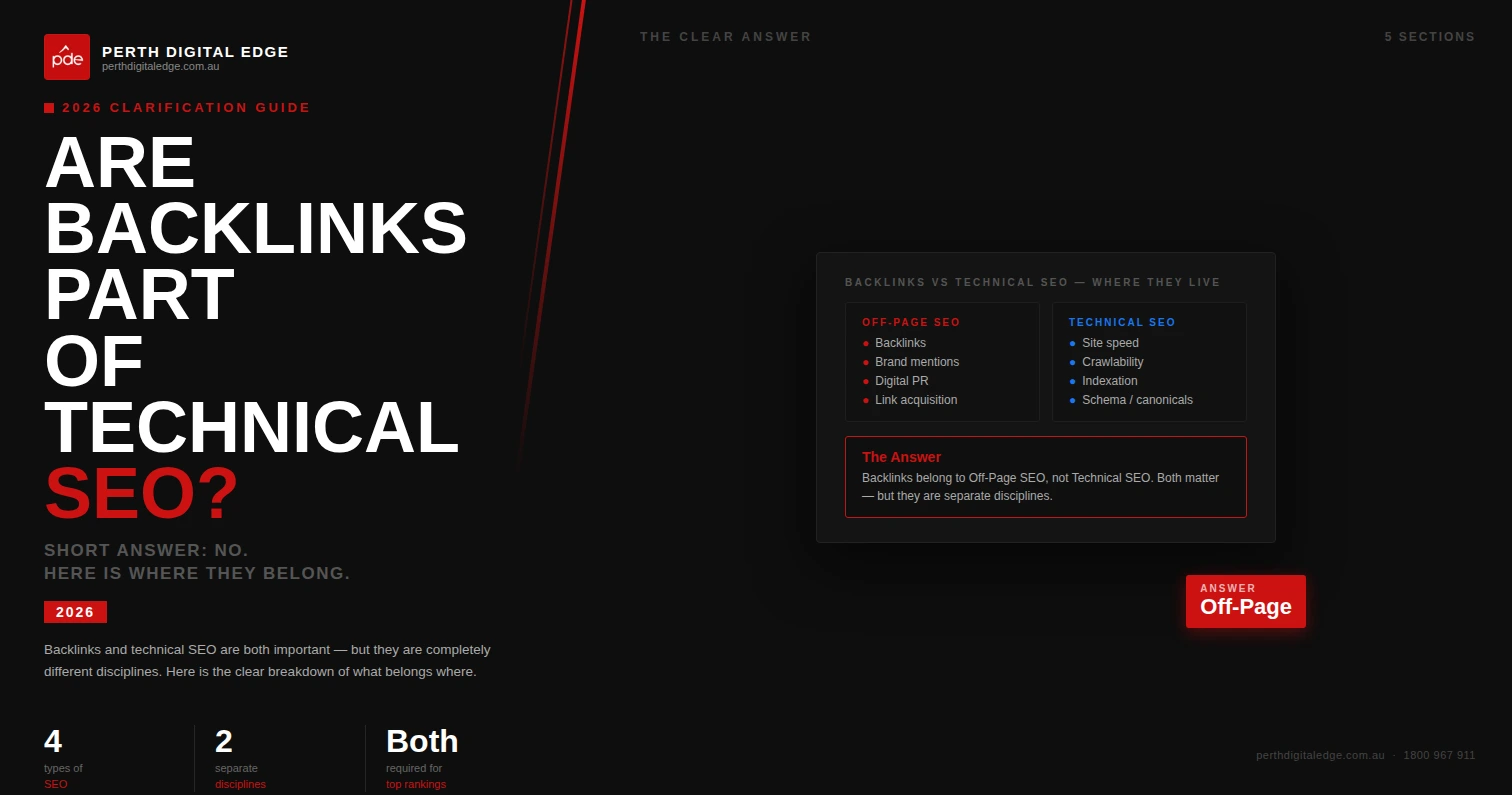
Are backlinks part of technical SEO, or do they belong somewhere else entirely? It is one of the most common questions we get from business owners trying to understand how search engines decide which pages rank. The short answer is that backlinks sit in off page SEO, not technical SEO, but the line between the two is thinner than most people think. After more than a decade running search campaigns at Perth Digital Edge, our view is that you cannot separate how Google sees your backlink profile from how it sees your site’s technical structure. The two work together, and neither reaches full potential without the other.
This blog post explains how backlinks fit into the wider SEO picture, why quality matters more than how many backlinks you have, and how our team blends backlink strategy with strong technical foundations to deliver real results for clients. We have pulled in examples from recent link building campaigns to show the difference between strong backlinks and wasted outreach.
Where Backlinks Actually Sit In SEO
Backlinks are a core part of off page SEO, not technical SEO. Off page SEO covers everything you do beyond your own website to build authority, including link building, digital pr, brand signals, and social mentions. Technical SEO covers everything on your own website that helps search engines crawl, render, and rank it. These are two separate disciplines, but they work together closely. A strong backlink profile cannot overcome fundamental technical problems, and a technically clean site still needs external validation through links to compete for high rankings on competitive keywords.
Think of technical SEO as the engine and backlinks as the fuel. A good engine with no fuel goes nowhere, and an engine full of fuel with a broken carburettor is just as useless. Both need to be pulling in the same direction for the vehicle to move at all. SEO backlinks from one website to another are how search engines measure trust, and strong inbound links are still a foundational part of any modern digital marketing strategy.
Why Backlinks Matter For Rankings
Backlinks remain one of Google’s most important ranking factors. They function as reliable signals of authority, telling Google that other websites trust your content enough to link to it. From Google’s perspective, a single link from a trusted domain carries more weight than dozens of links from low quality sources. High quality backlinks and high quality links from reputable sites, industry blogs, and credible sources still carry most of the ranking weight in any competitive SEO strategy. Not all backlinks are created equal, and understanding the difference is what separates effective link building campaigns from expensive waste. The goal is to help Google understand that your site deserves higher organic rankings and stronger search engine ranking positions than the competition.
Quality matters more than quantity. We would rather see one link from a relevant, authoritative publication than fifty links from unrelated directories. Relevance matter as much as authority, because a link from a closely related site in your client’s niche passes topical relevance signals that Google now weighs heavily.
Quality Matters More Than How Many Backlinks
How many backlinks does a page need to rank? There is no fixed threshold. Some pages rank on a handful of strong backlinks. Others need hundreds of lower-authority links. What matters more than raw count is whether the backlinks come from relevant sites, whether the anchor text reads naturally, and whether the link passes authority through dofollow signals. Nofollow links still have value for referral traffic and brand authority, but dofollow links carry more weight in the ranking calculation. A strong backlink profile is made of a diverse mix of anchor text, link types, and source domains.
High Quality Backlinks From Reputable Sources
The best backlinks come from reputable sources with high domain rating, strong domain authority, and authority metrics that Google actually trusts. Industry publications, news outlets, trade journals, and established bloggers in your sector all build website authority. A single link from one of these trusted domains can move the needle more than dozens of links from weaker sites. Digital pr and genuine editorial coverage from the wider web remain the most effective tactics for earning these kinds of links, and fresh content published regularly makes those links easier to attract.
Low Quality Links And What To Avoid
Low quality backlinks come from directories with no editorial standards, spammy blog comments, irrelevant guest posts on sites that accept anyone, and paid link schemes that violate Google’s guidelines. These links offer little value and in some cases actively hurt rankings by triggering manual actions. We never chase them and we recommend disavowing them when they appear in a backlink profile.
How Backlinks Interact With Technical SEO
Here is where backlinks and technical SEO blur together. Even the strongest backlink cannot pass full authority if the page it points to has technical problems. If the linked page returns a 404, the link wastes its potential. If the page is blocked by robots.txt or noindex meta tags, Google ignores the link entirely. If the page has canonical tags pointing elsewhere, the authority flows to the canonical target rather than the linked page. Internal links also matter, because a clear hierarchy lets the authority from one strong backlink distribute through the site to related important pages.
This is why technical SEO makes link building campaigns produce more value and more traffic. Clean site structure, logical canonical tags, zero broken links, and working XML sitemaps all help search engines flow link equity and pass authority through the site efficiently. Without these technical foundations, backlinks underperform and SEO performance suffers even when more backlinks start flowing in. External links from strong domains only help if your site is ready to receive them.
If you want to see how technical foundations amplify link building, our explainer on why technical SEO is important shows how the technical layer sits underneath every other SEO investment.
Other Ranking Factors That Matter Alongside Backlinks
Backlinks are one of several ranking factors. Page SEO signals like relevant content, meta tags, and internal links contribute heavily. Technical factors like page speed, mobile friendliness, and structured data all matter. Local SEO signals like Google Business Profile and local citations matter for location-based queries. User signals like click-through rate and dwell time factor into the equation too. Search intent is now one of the most important factors: a page that matches the searcher’s intent will rank above a page with stronger backlinks but weaker intent alignment. On competitive queries, backlinks often decide which page appears at the top of the search engine results pages and which one gets buried below the first set of search results.
Real Results From Smart Link Building
Our link building approach at Perth Digital Edge focuses on earning authority from relevant sites through digital pr, guest editorial, and broken link reclamation. For Westside Auto Wholesale, a multi-year campaign combining content, technical SEO, and targeted link building drove 1.4 million website visitors and over 120,000 leads. For Castle Security, a mix of technical cleanup and authority building took 109 keywords to page one and lifted traffic 364%. For Wholistically Healthy, better backlinks combined with technical fixes lifted organic traffic 118% and conversion rate 51%. These results came from quality links earned through relationships, not bought through shortcuts.
Every backlink campaign we run is anchored in content worth linking to. We create assets that industry publications, trusted domains, and relevant sites genuinely want to reference, then promote them through outreach. The result is a backlink profile built on relevance and authority, not volume.
What Backlinks Look Like For Perth Businesses
Backlink strategy looks a little different when you are based in Perth. We run outreach campaigns for clients from Joondalup to Fremantle, and the local angle actually helps. Coverage in The West Australian, mentions from Business News WA, features in Scoop and Perth Is OK, even a thoughtful reference from a Margaret River tourism blog all carry genuine topical authority for a WA business. We have pulled backlinks for Wanneroo trades, West Perth resources consulting firms, Cottesloe retailers, and Scarborough hospitality operators by building relationships with real journalists and editors who cover the local market. These are the links Google actually trusts because they come from sites with editorial standards and geographic relevance.
There is a part of this job that still surprises us. Every few months a Perth business owner calls in disbelief after seeing their phone light up for the first time in years because a single strong backlink from an authoritative WA publication finally moved them above an east-coast competitor. That moment of relief and vindication is why we still love this work, and why we get frustrated when we see local businesses chase cheap overseas link packages that will never move the needle for them. The WA market rewards patience and relationships, not volume.
Do Backlinks Still Matter In 2026
Yes. Backlinks remain one of the strongest ranking signals Google uses, and no other signal has fully replaced them. The role of backlinks has evolved. Google is better at discounting low quality links and better at weighting relevance, but reputable links from authoritative domains still drive high rankings, referral traffic, and paying customers. Brand signals from the wider web also matter more than they used to, and strong backlinks often come with valuable brand mentions that lift topical authority even when no link is attached.
For a wider view of how backlinks fit alongside on page, technical, and local work, our breakdown of the 4 types of SEO explains how each discipline contributes to successful search visibility.
Frequently Asked Questions
Common questions about backlinks and how they fit into the broader SEO picture.
Are Backlinks Part Of On Page Or Off Page SEO?
Backlinks are part of off page SEO. On page SEO deals with content and optimisation inside your own website, while off page SEO covers everything that happens on other websites that builds your authority, including backlinks, brand mentions, and user generated content.
How Many Backlinks Does A Page Need To Rank?
There is no universal benchmark. Pages with strong technical foundations and clear search intent can rank on a handful of quality links, while highly competitive keywords may need dozens or hundreds. Our focus is always on relevance and authority rather than volume.
Do Nofollow Links Have Value?
Nofollow links do not pass the same authority as dofollow links, but they still deliver referral traffic, brand exposure, and sign ups from new audiences. They also signal a natural backlink profile to Google, which looks for a mix of link types rather than an unnatural flood of dofollow links.
Can Bad Backlinks Hurt My Site?
Yes. Spammy or manipulative links can trigger manual actions or algorithmic suppression. We run regular backlink audits and disavow anything obviously low quality. Sites that have inherited bad link histories often need proactive cleanup before other SEO work can produce results.
How Long Do Backlinks Take To Work?
New backlinks usually show impact within four to eight weeks as Google discovers and evaluates them. Some links produce immediate ranking lifts when they come from highly trusted domains. Others take longer as the authority propagates through the site’s internal links to related important pages.
Final Thoughts And Next Step
So, are backlinks part of technical SEO? No, but the two disciplines lean on each other harder than most people realise. Strong backlinks need a technically clean site to deliver their full value, and a technically clean site still needs external authority to compete for top rankings. If your site has invested in content or links but rankings are not moving, the problem might be sitting in the technical layer underneath. Our technical SEO services in Perth combine technical auditing, fixes, and ongoing support to unlock the value of every backlink your site has. Get in touch with our team for a free initial review and we will show you exactly how the two disciplines should be working together.