

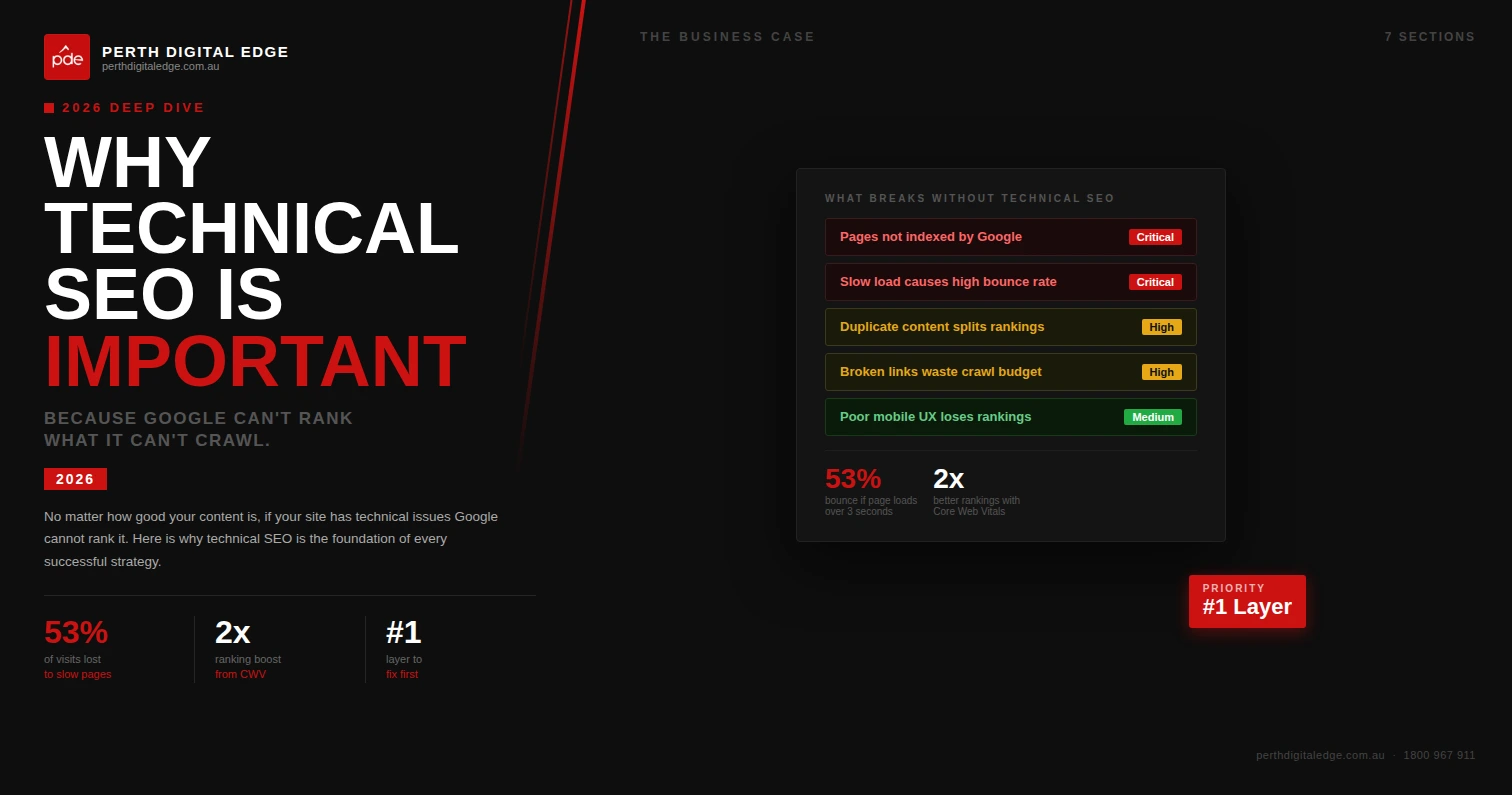
When a prospect asks us why technical SEO is important, our answer is usually the same. Every ranking, every click, and every lead from organic search sits on top of a foundation that most business owners never see. Get the foundation wrong and even brilliant content, strong backlinks, and a clever digital strategy will underperform. Get it right and everything else compounds. After more than a decade running SEO campaigns for Australian businesses through Perth Digital Edge, we have watched technical problems quietly strip away 30%, 50%, even 70% of a site’s potential organic traffic before the owner ever realised something was wrong.
This blog post walks through what technical SEO actually covers, the specific technical elements that influence rankings, and why the importance of technical SEO compounds with every new blog post you publish. We have pulled examples from real client work to show how fixing the technical side of a website can shift results in weeks rather than months.
What Technical SEO Means In Plain Language
Technical SEO is the part of search engine optimization that focuses on how search engines crawl, index, and render your web pages. It covers site architecture, page speed, mobile friendliness, structured data, canonical tags, the XML sitemap, broken links, duplicate content, and the dozens of smaller technical factors that determine whether Google can understand your website at all. While on page SEO focuses on content and keywords, and off page SEO focuses on high quality backlinks and authority signals, technical SEO ensures the website itself is something search bots can read without friction.
For a deeper definition and full checklist, we have written a complete explainer in our what is technical SEO guide. For the purposes of this article, think of technical SEO as everything that happens under the bonnet of your website’s architecture, and content and links as everything that sits on top.
Why Technical SEO Is A Ranking Factor
Google has been explicit for years that page speed, mobile usability, core web vitals, and HTTPS security are ranking signals. What is less well known is that good technical SEO makes every other ranking factor work harder. Backlinks from reputable sources cannot pass full link equity if canonical tags are misconfigured. Relevant keywords cannot rank if search engines cannot crawl the relevant pages. High quality content cannot earn search engine rankings if the page never gets indexed. This is why technical SEO ensures the rest of your digital marketing spend actually produces returns.
We audited a professional services firm in Perth that had invested over $40,000 in content production and social media marketing across eighteen months, yet their organic traffic had barely moved. The issue was not the content or the promotion. Their staging environment had been left crawlable, creating thousands of duplicate pages that confused search engines and split authority across multiple versions of the same content. Fixing the noindex rules and canonical tags lifted organic sessions by 184% within ten weeks without a single new piece of content.
The Technical Elements That Matter Most
Not every technical issue is equal. Some technical factors move the needle hard and fast while others are small refinements. When we scope a technical SEO engagement, we focus first on the high-impact elements that have the biggest influence on a site’s ranking.
Page Speed And Core Web Vitals
Site speed is one of the most important technical factors Google uses to rank pages. A fast loading website keeps visitors engaged, reduces bounce rate, and feeds positive signals back to search engines. Core web vitals measure how quickly the largest element on a page loads, how stable the layout is during loading (visual stability), and how responsive the page feels when a user interacts with it. We use PageSpeed Insights and Screaming Frog together to find the exact bottlenecks, whether that is an oversized hero image, render-blocking scripts, or a bloated theme. When we rebuilt the site for Eco Style Pool Renovations, their PageSpeed score jumped from 27 to 86, and organic leads followed within weeks.
Mobile Responsiveness And Mobile Usability
Google indexes the mobile version of your website first, which means mobile responsiveness is no longer optional. We check every template across real mobile devices, not just emulators, and confirm that buttons are tappable, text is readable, and nothing overflows the viewport. A mobile friendly website that loads fast on a 4G connection in regional WA will almost always outrank a desktop-first site that struggles on a phone, even if the desktop-first site has better content.
Crawlability And Site Architecture
If Google cannot reach a page, that page cannot rank. We audit internal links, the XML sitemap, robots.txt rules, and the website’s architecture to make sure every important page is only a few clicks from the homepage. We flag orphan pages, broken links, redirect chains, and any section of the site buried too deep for search bots to discover efficiently. Clean site architecture also helps search engines understand which pages are most important, which shapes how ranking distributes across the site.
Structured Data And Schema Markup
Structured data gives search engines extra context about what each page is about. Product schema, review schema, FAQ schema, local business schema, and article schema all help search engines understand content well enough to trigger rich results in the search engine results. Rich results dramatically improve click-through rates, and we implement schema as a default part of every technical SEO engagement.
Duplicate Content And Canonical Tags
Duplicate content is one of the sneakiest problems we see. It can appear through URL parameters, HTTP and HTTPS versions, trailing slashes, pagination, or filter pages on ecommerce stores. Canonical tags tell search engines which version is the preferred one so authority is not split across multiple pages. When we corrected duplicate content issues for Wholistically Healthy, their organic traffic lifted 118% and conversion rate climbed 51%.
How Technical SEO Affects User Experience
Technical SEO and user experience are the same conversation from two different angles. A fast loading, mobile friendly, well-structured website feels good to visitors and feels good to Google. A slow, cluttered, broken website creates a poor user experience that hurts rankings regardless of how good the content is. We have watched bounce rates drop by 40% and pages per session nearly double after nothing more than a technical cleanup. Users notice. Search engines notice. Both reward you for it.
If you are curious about the broader picture of how technical work fits with other optimisation activity, our breakdown of what the 4 types of SEO are shows how technical, on page, off page, and local SEO each contribute to a successful digital strategy.
What Happens Without Good Technical SEO
Ignoring technical SEO has a real cost. Broken pages leak link equity. Missing meta descriptions kill click-through rates in search results. Slow load times frustrate users and push Google to rank competitors above you. Security breaches flagged by browsers destroy trust overnight. We have seen businesses invest heavily in content and backlinks while their website quietly bled visibility through technical neglect. Without a strong technical foundation, every other SEO investment produces a fraction of the return it should.
If you want to dig into specific problems we commonly find during audits, our article on what are technical SEO issues breaks down the issues that cost rankings most often.
Our Approach To Technical SEO
When we run a technical audit for a client, we combine Google Search Console data with crawl data from Screaming Frog, real device testing, PageSpeed Insights, and a manual review of the website’s structure. We produce a prioritised action list that separates high-impact fixes from cosmetic tweaks, and we either implement the fixes ourselves through our web development team or hand the list to the client’s developer. The Castle Security project is a good example. When we started, they were invisible for competitive terms. Six months of technical and content work took them to 109 keywords on page one and lifted traffic by 364%.
Every audit focuses on the key elements and key components that shape how the site performs in search. We look at the website’s architecture, load times, internal links, meta descriptions, and the web content that sits on each page. It makes sense to start with the highest-impact technical issues because fixing them first usually delivers the fastest wins. Our ongoing relationships then move into quarterly check-ins on new pages, new blog post releases, and anything that might have been overlooked during a site update.
Frequently Asked Questions
The questions we hear most from clients weighing up whether technical SEO is worth the investment.
How Quickly Does Technical SEO Produce Results?
Some technical fixes produce near-immediate results. Fixing indexing problems, broken links, or canonical errors can lift rankings within two to four weeks. Larger projects like rebuilding site architecture or improving site speed typically show meaningful results within eight to twelve weeks.
Is Technical SEO A One-Off Job?
No. Search engines change how they crawl and rank the web regularly, and websites accumulate new technical debt every time new pages are published or a plugin updates. We recommend a full audit at least annually and ongoing monitoring through Google Search Console.
Can We Do Technical SEO Ourselves?
Small sites with simple structures can manage basic tasks like setting up Google Search Console, creating an XML sitemap, and checking for broken links. Larger projects involving structured data, core web vitals, and complex site architecture usually need specialist support.
Does Technical SEO Matter For Small Businesses?
Absolutely. Small businesses often benefit more than large ones because the fixes are cheaper and the competitive gap is easier to close. A clean, fast, crawlable website lets a small operator punch well above their weight in search results.
Final Thoughts And Next Step
The importance of technical SEO comes down to this: it is the foundation that makes every other part of your SEO investment work. Without it, content underperforms, backlinks are wasted, and rankings stay flat no matter how hard you push. With it, everything you do on page, off page, and through social media marketing produces compounding returns. If your site has never been audited properly, or if organic performance has plateaued despite steady investment, our team can help. Explore our technical SEO services in Perth or get in touch with our team for a free initial review of your website’s visibility and a clear plan for what to fix first.