A client came to me last year spending $4,200 a month on Facebook ads with almost nothing to show for it. Their campaign costs were bleeding out across poorly targeted brand awareness campaigns, their ad creatives had not been refreshed in five months, and their ad budget was split across six campaign objectives with no clear strategy behind any of them. Within three months of restructuring their account at Perth Digital Edge, we cut their ad spend by 35% and tripled their lead volume. The ads were not the problem. The strategy was.
I share that because the question “how much do Facebook ads cost in Australia” is one I hear weekly, and the honest answer is that it depends entirely on how well your campaigns are built. A poorly managed $5,000 monthly budget will return less than a well-optimised $1,500 one. This guide breaks down real Facebook ads cost Australia benchmarks, explains what drives costs up and down in the Australian market, and gives you a framework to set a realistic budget based on your actual business goals. I am Ben Tippett, founder of Perth Digital Edge, and I have managed Facebook advertising campaigns for trades, professional services, ecommerce, and local businesses across Australia for over a decade.
How The Facebook Ad Auction Actually Works
Before you can understand Facebook advertising costs, you need to understand the system that determines them. Every time your ad has the opportunity to appear in front of someone, it enters a Facebook ad auction. This is not a simple highest-bidder-wins scenario. Facebook evaluates three factors simultaneously: your bid amount, your estimated action rate (how likely the person is to take the action your campaign is optimised for), and your ad quality and relevance.
Your ad quality score reflects how well your ad resonates with the audience you are targeting. Facebook measures this through engagement signals, feedback from users who have seen the ad, and assessments of clickbait, engagement bait, and other low-quality patterns. An ad with high relevance that people genuinely engage with can win the ad auction against a competitor willing to pay significantly more per result. This is why ad creatives and audience targeting matter as much as budget. The Facebook ad auction rewards advertisers who create ads that their target audience actually wants to see.
When more advertisers compete for the same audience in the same ad space, costs rise. This is basic supply and demand. During high demand periods like Black Friday, Christmas, and end of financial year in Australia, the cost per click CPC and cost per thousand impressions (CPM) both spike because every retailer, service provider, and ecommerce brand is fighting for attention from the same pool of Facebook users. Understanding this cycle is the first step to managing your Facebook ad budget intelligently rather than reactively.
Average Facebook Ads Cost In Australia: 2026 Benchmarks
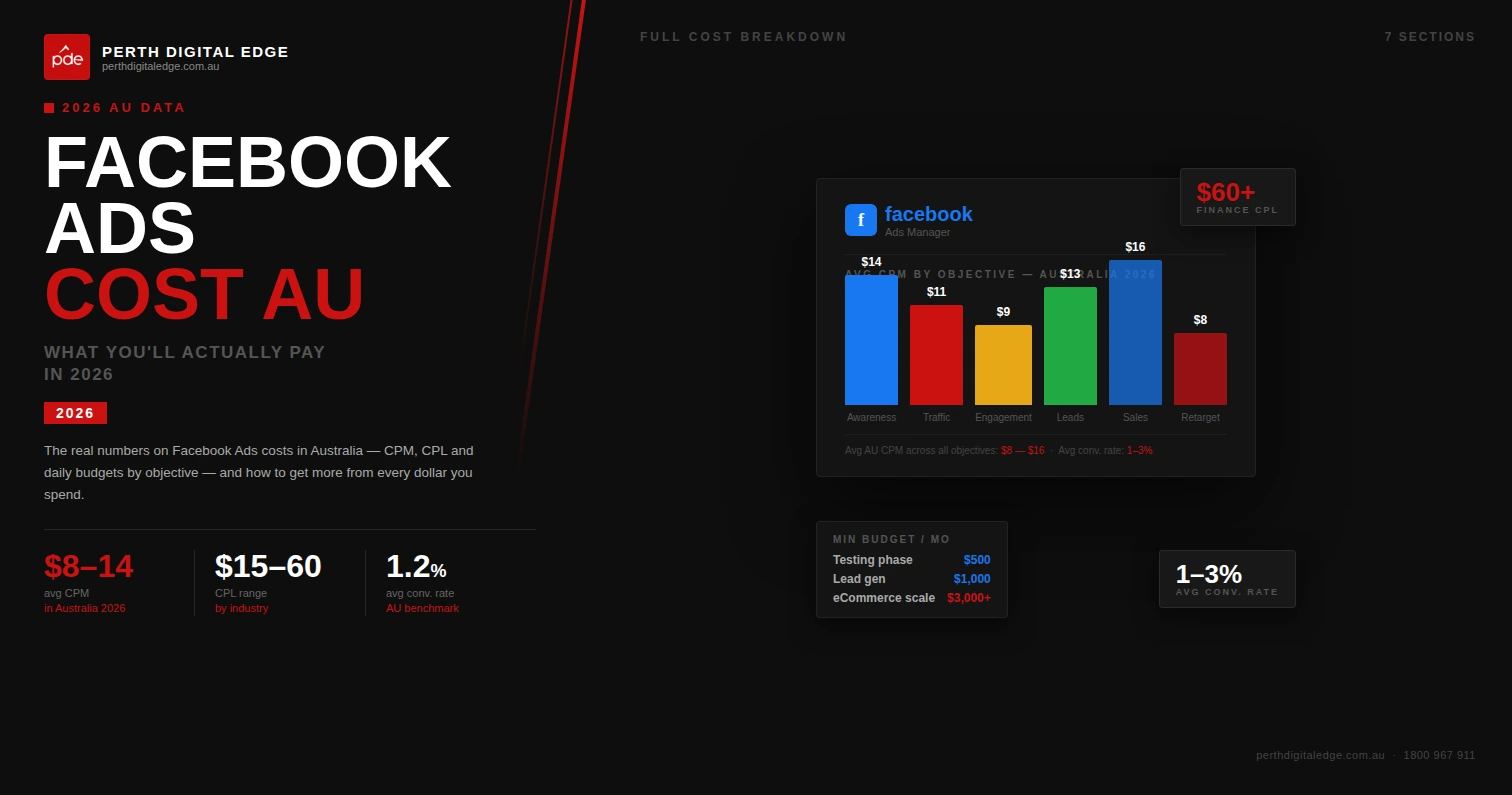
Based on the campaigns we manage at Perth Digital Edge and cross-referencing with industry data, here are the average Facebook ads cost benchmarks Australian businesses should use as a starting point in 2026. The average cost per click across all industries in Australia sits between $0.80 and $2.50. The average CPM (cost per thousand impressions) ranges from $8 to $25. The average cost per lead for lead generation campaigns typically falls between $15 and $65, depending on industry and offer quality.
These average costs shift dramatically by industry. Highly competitive industries like legal services, financial services, and real estate see average ad costs of $3 to $6 per click and $80 to $150 per lead. Trades and home services sit in the middle with average CPC between $1.20 and $3.00. Retail and ecommerce often enjoy the lowest cost per click, sometimes under $1.00, though conversion rates vary based on how well landing page ads are optimised. I have seen well-optimised campaigns in competitive industries outperform benchmarks by 40%, and campaigns in low-competition niches burn through budget because the fundamentals were wrong.
The cost of Facebook ads in Australia tends to run 15% to 30% higher than equivalent US campaigns. The Australian market has a smaller pool of Facebook users relative to advertiser demand, pushing auction prices up. Businesses comparing results to US benchmarks need to account for this difference or risk unrealistic expectations.
Key Factors That Determine Your Facebook Ad Costs
Seven key factors control what you actually pay for Facebook advertising in Australia. Understanding each one gives you levers to pull when you need to reduce costs or scale results.
Your campaign objective is the first and most influential factor. A brand awareness campaign optimised for reach will cost far less per impression than a lead generation campaign optimised for form submissions. Awareness campaigns might deliver a CPM of $5 to $10, while lead generation campaigns typically see CPMs of $20 to $45 because Facebook is showing your ad to the subset of people most likely to convert, not just scroll past.
Audience targeting is the second major cost driver. A broad audience of all Australians aged 18 to 65 interested in “fitness” costs less per impression than narrow audience targeting of business owners in Perth aged 35 to 55. The narrow audience has more advertisers competing for fewer people. However, narrower audiences almost always convert at higher rates, so the cost per result is often lower despite higher CPM. Most businesses see a low CPM on a broad audience and think the campaign is performing well, when the cost per actual customer is much higher.
Ad placements affect cost significantly. Ads in the Facebook News Feed cost more than placements on the audience network or in Stories. Instagram feed placements often cost more than Facebook equivalents. At Perth Digital Edge, we start with automatic placements to let the algorithm gather data, then shift budget toward the ad placements delivering the lowest cost per result after two weeks.
Your bidding strategy determines how Facebook spends your budget. Lowest cost bidding gets you the most results but costs can spike during competitive periods. A cost cap strategy sets a maximum you are willing to pay per result, giving you more predictable costs but potentially limiting delivery when auction prices rise. For most Australian businesses, lowest cost is the right approach until you have enough data to set informed cost caps.
Ad quality and ad relevance directly impact cost. Facebook assigns quality ranking, engagement rate ranking, and conversion rate ranking to every ad. Ads scoring above average pay less in the auction. If your ad resonates with your target audience, you pay less. If it annoys or bores them, you pay more.
Ad fatigue is the silent budget killer. When the same audience sees the same ad repeatedly, engagement drops and costs rise. Once an ad hits a frequency of 3 to 4 for cold audiences, performance degrades. The fix is rotating ad creatives regularly, not increasing your ad budget to fight rising costs.
Seasonality is the final factor. High demand periods drive costs up across the board, but there are also industry-specific cycles. Tax accountants see costs spike from April to June. HVAC businesses pay more in December and January when every Perth household needs aircon. Planning your Facebook ad campaigns around these cycles, front-loading spend in lower-competition months, is how experienced advertisers manage annual campaign costs effectively.
How To Set A Realistic Budget For Facebook Ads
Setting a realistic budget starts with working backwards from your business goals, not forwards from what you think you can afford. If you need 30 new leads per month and your average cost per lead is $40, your minimum monthly ad spend needs to be $1,200 just for lead generation, before factoring in retargeting campaigns, brand awareness, and creative testing.
For local campaigns targeting a single city or region, I recommend a minimum monthly ad budget of $1,500 to $3,000. Below $1,500, the algorithm does not get enough conversion data to optimise, and you spend most of your budget in the learning phase where costs are highest. For businesses targeting multiple cities or running national campaigns, $5,000 to $15,000 per month is a more appropriate starting point based on the volume of conversions Facebook needs to exit its learning phase.
At Perth Digital Edge, we structure every Facebook ad budget across three tiers. The first tier (60% to 70% of total ad spend) goes to primary conversion campaigns: lead generation, ecommerce sales, or booking requests. The second tier (20% to 25%) funds retargeting campaigns showing remarketing ads to website visitors, recent visitor ads to engaged users, and abandoned cart ads for ecommerce. The third tier (10% to 15%) supports testing new audiences, new ad formats, and new concepts. This structure ensures you drive results while building the data pipeline that improves performance over time.
Facebook Ads Vs Other Advertising Platforms
Facebook advertising does not exist in a vacuum. Australian businesses have access to Google Ads, LinkedIn, TikTok, and other advertising platforms, and understanding how facebook advertising costs compare helps you allocate your digital marketing budget wisely.
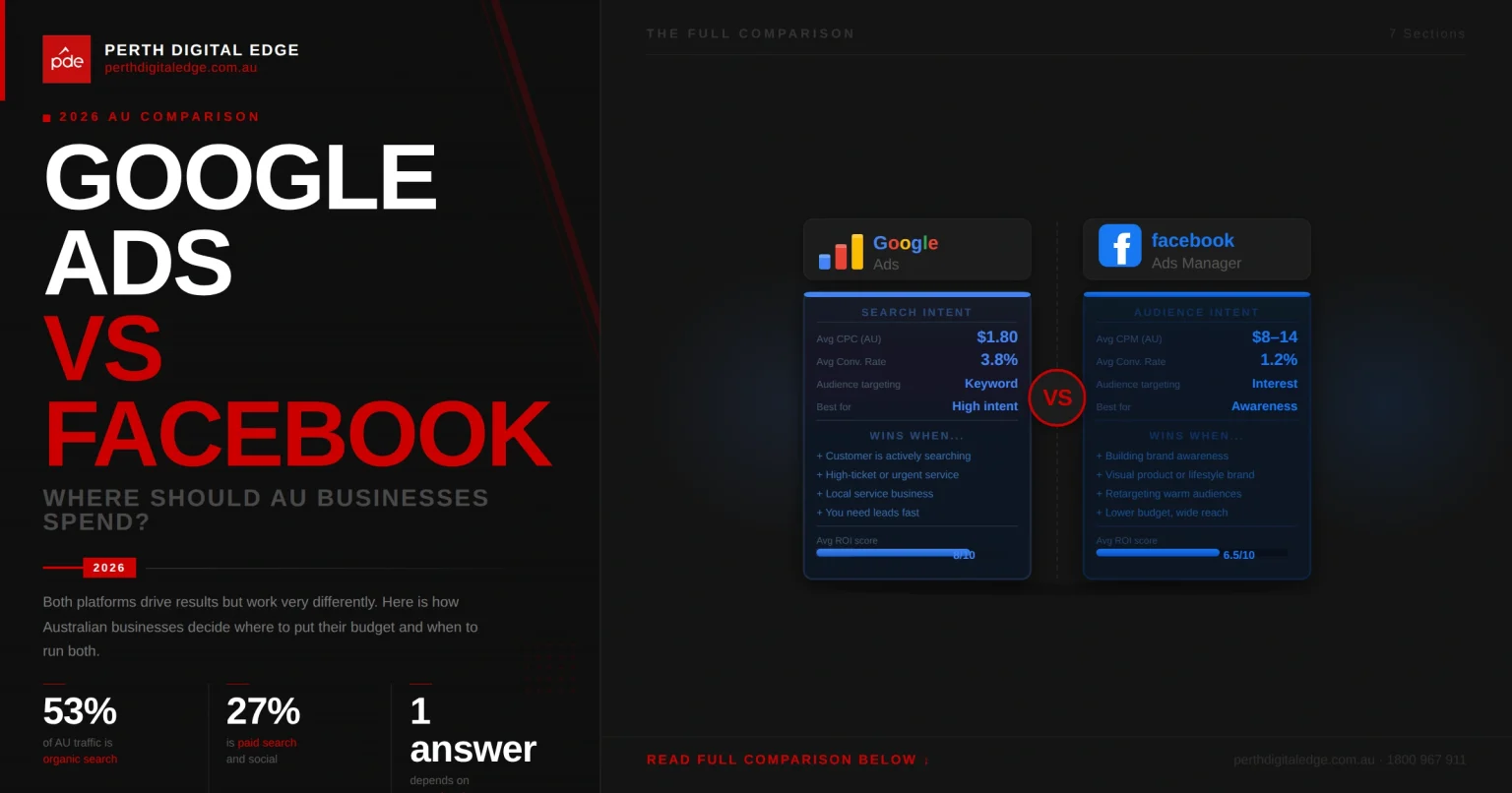
Compared to Google Ads, Facebook typically delivers a lower cost per click but the intent behind that click is different. A Google Ads click comes from someone actively searching for your service. A Facebook click comes from someone whose attention you interrupted while scrolling. The conversion path is usually longer with Facebook, meaning you need to factor in remarketing ads and nurture sequences for a true comparison. For many of our clients, the combination of Google Ads for high-intent searches and Facebook ads for awareness and retargeting delivers the strongest overall return.
LinkedIn advertising costs are significantly higher, often $6 to $12 per click in Australia, but for B2B and legal services targeting professionals, the lead quality can justify the premium. TikTok ads currently offer lower average costs for awareness campaigns, but the platform skews younger and conversion tracking is less mature. For most Australian businesses in professional services, trades, and local retail, Facebook remains the strongest balance of cost, targeting precision, and measurable return among all advertising platforms.
How To Reduce Your Facebook Ad Costs
Reducing Facebook advertising costs is not about spending less. It is about getting more from every dollar you spend. Here are the tactics we use at Perth Digital Edge to consistently drive costs below industry averages for our clients.
Start by fixing your audience targeting. If you are running lead generation campaigns to a broad audience that includes people who will never buy, every impression served to them is wasted ad spend. Use custom audiences built from your customer email list, website visitors, and people who engaged with your content. Layer lookalike audiences on top to find new people who resemble your best existing customers. The more precisely you define your target audience, the lower your costs.
Refresh your ad creatives before ad fatigue sets in. At Perth Digital Edge, we build at least six to eight creative variations per campaign, rotating new ones every two to three weeks. Each variation tests a different angle: one leads with a price point, another with a case study result, another with a testimonial. This keeps ad frequency manageable and gives the algorithm fresh material to optimise against. Businesses running the same ad for months wonder why costs keep climbing. This is why.
Implement proper conversion tracking. Install the Meta Pixel correctly, set up the Conversions API, and configure custom conversions for each meaningful action on your website. When Facebook can see which clicks turn into leads or sales, it gets dramatically better at finding similar converters. I have seen average CPC drop by 30% within two weeks of fixing broken conversion tracking for a client. The data you feed Facebook is the single biggest lever over your campaign costs.
Use ad scheduling to concentrate your ad spend during the hours your target audience is most active and most likely to convert. For a B2B client in Perth, we discovered that running ads between 7am and 9am and again from 12pm to 2pm (when decision-makers check their phones during commute and lunch) produced leads at 40% lower cost than running ads 24/7. Ads Manager gives you the data to identify these windows. Use it.
Test your landing pages relentlessly. A 1% improvement in landing page conversion rate has the same effect as a 1% reduction in CPC. If your landing page ads send traffic to a slow, cluttered page with a weak offer, no amount of Facebook optimisation will save your campaign costs. Every campaign we run includes landing page recommendations because the page after the click matters as much as the ad before it.
Key Metrics To Track In Ads Manager
Knowing your Facebook ads cost is only useful if you track the key metrics that explain why costs are where they are and whether they are delivering a return. Ads Manager provides everything you need, but most advertisers look at the wrong numbers.
Cost per result is your north star metric. Not CPM. Not CPC. The cost per actual business outcome, whether that is a lead, a sale, a booking, or a phone call. A campaign with a $3 CPC that generates leads at $25 each is outperforming a campaign with a $0.80 CPC that generates leads at $90 each. Focus on the end result, not the intermediate metrics that make dashboards look good but tell you nothing about profitability.
Frequency tells you how many times your ad appears to the average person. For cold audiences, keep this below 3. Above 4, you are experiencing ad fatigue: rising costs, declining engagement, and underperforming ads burning budget on people who have decided they are not interested. For remarketing ads targeting warm audiences, frequency can run higher (up to 8 or 10) because those people have already expressed interest.
Return on ad spend (ROAS) determines whether your Facebook ad campaigns are worth continuing. Divide revenue attributed to Facebook ads by total ad spend. A ROAS of 3:1 means every dollar returns three in revenue. For ecommerce, we target a minimum 3:1 at Perth Digital Edge. For lead generation, we calculate ROAS based on average lead value and close rate. If you cannot connect your Facebook advertising spend to revenue, you are flying blind, and blind pilots do not stay in the air for long.
Industry-Specific Facebook Ad Costs In Australia
The average Facebook ads cost in Australia varies so dramatically by industry that a single benchmark is almost meaningless. Here is what we see across the sectors we manage at Perth Digital Edge.
Trades and home services (electricians, plumbers, builders, landscapers) typically see an average CPC of $1.00 to $2.50 and cost per lead of $20 to $55. These local campaigns perform best with before-and-after creative, video walkthroughs of completed work, and offers like free quotes or seasonal discounts. The target audience is homeowners within a defined service radius, and because the geographic targeting is tight, the same audience can be reached affordably with a modest ad budget.
Professional services and legal services are among the most expensive categories. Average CPC ranges from $2.50 to $6.00 and cost per lead from $60 to $150. The audiences are narrow and the competition fierce, but customer lifetime value justifies the higher spend. Educational content campaigns generate leads at 30% to 50% lower cost than direct sales campaigns, because the ad resonates with an audience that wants information before committing.
Ecommerce sees the widest range. Fashion and lifestyle brands with strong creative can achieve CPC under $0.60 and ROAS above 5:1. Higher-ticket items typically see CPC of $1.50 to $3.50 but stronger order values compensate. The key is layering: prospecting with broad audience targeting to create ads that build awareness, retargeting website visitors with product ads, and closing with abandoned cart ads and limited-time offers through custom audiences.
Health, fitness, and wellness businesses sit in the middle range with average CPC of $1.00 to $2.80 and cost per lead of $25 to $65. Gyms, physiotherapists, and wellness practitioners in the Australian market do well with lead generation campaigns offering a free consultation or trial. Video ad formats outperform static images in this category, and campaigns that gather data through lead forms rather than external landing pages convert at higher rates.
Common Mistakes That Inflate Your Facebook Ad Costs
After managing hundreds of Facebook ad campaigns for Australian businesses, I see the same costly mistakes surface repeatedly. Avoiding them is often the fastest way to reduce your advertising costs.
Running campaigns without a clear objective is the most expensive mistake. When business owners create ads by boosting posts, Facebook optimises for engagement, not leads or sales. If you want enquiries, run a lead generation campaign. If you want to drive direct sales, run a sales campaign. The campaign objective tells Facebook which users to show your ad to, and choosing wrong means your ad appears in front of people who will like and comment but never buy.
Targeting too broadly wastes budget on people who will never convert. I audited an account for a Perth mortgage broker targeting all of Australia, ages 18 to 65, interest in “property.” Their cost per lead was $120. We applied narrow audience targeting to homeowners in Perth metro aged 28 to 55 with recent property and finance engagement, and cost per lead dropped to $38 within two weeks. It is not about reaching fewer people. It is about reaching the right people.
Neglecting creative refresh is the mistake that creeps up slowly. Your Facebook ads might perform brilliantly for three weeks, then costs climb and results decline. Most businesses blame the algorithm. In reality, the same ad shown to the same audience loses impact with every repetition. We build creative refresh cycles into every campaign because waiting until performance collapses is far more expensive than proactively rotating creatives on a schedule.
Ignoring the data Facebook provides is the final common mistake. Ads Manager contains everything you need to diagnose underperforming ads and identify which audiences convert at the lowest cost. Too many Australian businesses set campaigns live and check back a month later, by which point thousands of dollars have been spent on what the data would have told them to fix in week one. Reviewing key metrics weekly is not optional if you want to control your Facebook advertising costs.
Frequently Asked Questions
The questions Australian business owners ask most about the cost of Facebook advertising.
How Much Do Facebook Ads Cost Per Day In Australia?
You can start with as little as $5 per day, but that budget is only viable for very small local campaigns. For most Australian businesses, a daily ad spend of $50 to $100 is the minimum to generate enough data for effective optimisation. Below that, campaigns stay in the learning phase longer, meaning higher average costs and inconsistent results. A realistic budget for lead generation campaigns starts at around $1,500 per month.
Why Are My Facebook Ads So Expensive?
The most common reasons for high Facebook ad costs are poor audience targeting, low ad relevance scores from weak creative, ad fatigue from running the same ad too long, a mismatched campaign objective, and broken conversion tracking. Check your ad frequency, relevance diagnostics in Ads Manager, and whether your conversion pixel is firing correctly. In most cases, one of these is the primary culprit.
Are Facebook Ads Worth It For Small Australian Businesses?
For most small Australian businesses, do Facebook ads deliver a positive return? Yes, provided campaigns are structured with a clear objective, defined target audience, and proper tracking. Facebook lets small businesses reach a specific local audience at a fraction of the cost of traditional advertising. A business spending $1,500 to $3,000 per month on well-managed Facebook advertising can generate a consistent pipeline of leads that would cost more through other channels. The key is not budget size but strategy quality.
How Long Does It Take For Facebook Ads To Start Working?
Facebook’s algorithm needs approximately 50 conversion events within a seven-day period to exit the learning phase. For most Australian businesses, the first one to two weeks are a data-gathering phase where costs are higher and results less predictable. Stable performance typically emerges by week three or four. Campaigns running for two to three months with ongoing optimisation consistently outperform new campaigns because the algorithm has accumulated enough data to target your ideal audience with precision.
Should I Manage Facebook Ads Myself Or Hire An Agency?
If your monthly ad spend is under $2,000 and you have time to learn the platform, managing your own Facebook ad campaigns through Ads Manager is viable. Above $2,000 per month, the complexity of managing multiple campaigns, creative rotation, and audience segmentation typically exceeds what a business owner can handle alongside running their business. An experienced digital marketing agency will almost always reduce your average Facebook ads cost while improving results, because they bring systems and platform expertise that take years to develop independently.
Stop Guessing And Start Scaling Your Facebook Ads
Understanding Facebook ads cost Australia benchmarks is a starting point, but benchmarks only tell you what is possible. Turning that into actual leads and revenue requires a strategy built around your business goals, your industry, and your audience. At Perth Digital Edge, we build and manage Facebook ad campaigns for Australian businesses that want measurable results without guesswork. We handle audience research, creative development, campaign structure, bid strategy, and performance tracking so your ad spend generates a return you can see in your revenue, not just a dashboard. If you are spending money on Facebook ads and wondering whether you are getting what you should be, get in touch with Perth Digital Edge for a free Facebook Ads audit.