

Local search rankings quietly decide which Perth businesses get called and which ones get forgotten. When potential customers search for your service, you need to appear prominently in local search results, or they simply pick the competitor who does. Most owners never see the searches they lose. At Perth Digital Edge, we have spent years untangling how search engines actually evaluate local businesses, and the honest picture is messier than most guides admit. Google publishes broad principles but withholds specifics, partly to protect the algorithm from manipulation, partly because even Google’s own engineers adjust the weights over time.
Local SEO ranking factors differ from standard SEO ranking factors. Domain authority and backlinks still influence search rankings, but local search engine rankings depend heavily on business signals, location-based keywords, physical location verification, and how consistently your business information appears across the web. This guide breaks down the individual ranking factors you need to focus on right now to improve your local visibility.
Why Local Search Rankings Matter For Your Business
Here is the part that stings for most small business owners. The local pack dominates search results for service-based businesses, which means position one, two, and three take roughly 70% of all clicks. Position four, the first name below the fold, drops off a cliff. One Perth café owner told us she had been proudly telling friends she was on ‘page one’ for her main keyword for over a year, before realising she was in position seven and effectively invisible. That conversation still bothers us because she had been paying an agency the whole time.
Local customers behave nothing like general web searchers. They have already committed to a geographic area. They want your exact address, operating hours, whether you are open right now, and a quick read on what previous customers say about you. Hesitation is fatal. The average local searcher makes a decision within 90 seconds of opening Google, which means your profile has to do its work in that window or the lead is gone.
Service area businesses especially benefit from understanding local search ranking factors. Whether you are a plumber in Fremantle, an accountant in Subiaco, or a massage therapist in Northbridge, your physical location and service area carry weights that general websites will never experience. Google’s local algorithm applies what engineers internally refer to as proximity weighting, which can push a mediocre business in the right suburb above a better business three suburbs away. That is both the opportunity and the frustration of local SEO.
Google Business Profile And Local Search Visibility
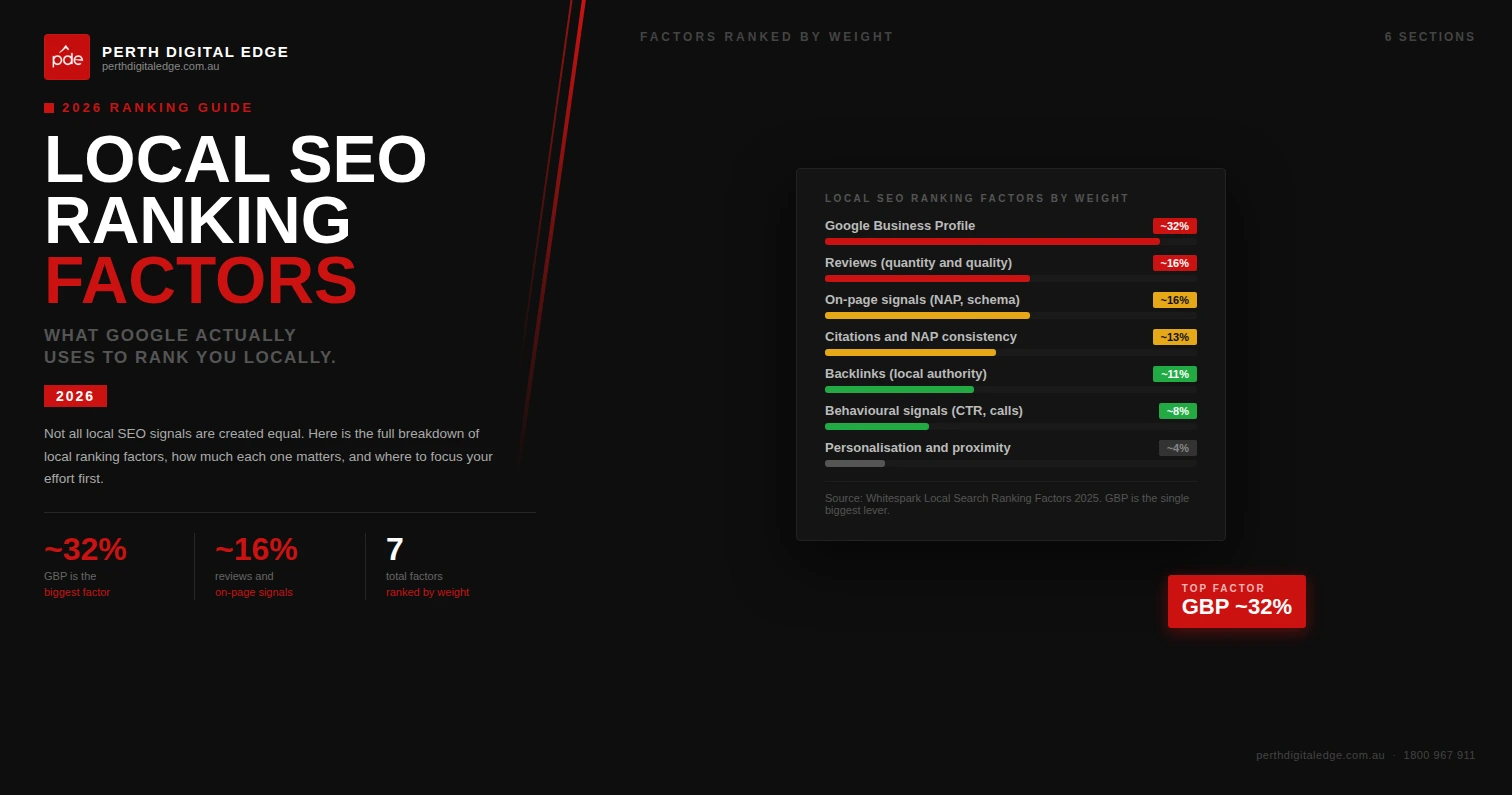
If you asked us which single asset carries the most weight in local rankings, it would be your Google Business Profile. Not because nothing else matters, but because most owners get this wrong first and then wonder why the rest of their effort feels wasted. When people search for local businesses, they first see your profile information, customer reviews, location on Google Maps, business categories, hours, photos, and more. Profiles with errors, gaps, or stale details rarely rank well, regardless of what else you do. There is an interesting sub-pattern we have noticed: businesses that select more than three categories often rank worse than those with two carefully chosen ones, which contradicts the usual ‘more is better’ instinct.
Google Business Profile factors include accurate business name, consistent physical address across all platforms, correct business phone number, accurate operating hours, high-quality photos, complete business description, and properly selected business categories. The business categories you select directly affect which relevant searches and keyword queries show your listing to potential customers. Get these basic signals right first. Everything else builds on this foundation of highly relevant and accurate information.
Ben Tippett from Perth Digital Edge regularly audits Google Business Profile listings for clients and finds the same preventable mistakes repeatedly. Incorrect postcodes, hours that have not been updated in months, miscategorised business categories, and blank fields quietly suppress local visibility more than most owners realise. There is something almost painful about auditing a listing you know is costing someone real customers every week. The upside is that these issues are usually fixable in an afternoon, and the ranking response can come within days rather than months.
Your Google Business Profile is managed separately from your website. Search engines can crawl and evaluate your profile independently. Many small businesses don’t realise how much influence their profile has over local rankings. Customers leave reviews on your profile. Your profile shows prominently on Google Maps. Your profile appears in the local pack. Neglecting your profile means missing the easiest opportunity to improve your local visibility.
Online Reviews And Customer Trust Signals
Online reviews represent a closely guarded secret in how search engines rank local results. More reviews help your ranking significantly. Positive reviews help more than neutral reviews. Recent reviews help more than old reviews. Google’s algorithm evaluates the quantity, quality, sentiment, and recency of all these factors when determining what are the local SEO ranking factors that determine your position.
This is not just about having reviews on your profile. Quantity, sentiment, and recency all matter. A business with ten reviews from last year ranks lower than one with ten recent reviews. Behavioural signals show whether people trust your business and whether you actively manage your reputation.
User generated content like customer reviews becomes search engine ranking fuel. When customers leave detailed reviews mentioning your location, services, and experience, they help Google understand what your business does and whether it delivers. Encouraging more reviews from satisfied customers is effectively required for serious local businesses. The more reviews you have, the higher your ranking potential.
The type of review platform matters significantly. Google reviews on your Google Business Profile carry more weight for local SEO ranking than reviews on Yelp, TrueLocal, or other third party sites. However, reviews everywhere help your ranking. A business with reviews scattered across multiple platforms signals legitimacy and trustworthiness. Focus first on getting Google reviews, then expand to other directories and websites link from those platforms.
Local Citations And Business Directory Listings
Citations are mentions of your business name, address, phone number, and often URL across the web on external platforms. This happens on major business directories, social media platforms, online directories specific to your industry, and local area chambers of commerce. Structured and unstructured citations tell search engines that your business is real, legitimate, and established.
Local citations send business signals that search engines cannot ignore. When your information appears consistently across multiple trusted sources, search engines rank you higher in local search results. The opposite is equally true. Inconsistent information across directories damages your local ranking factors and causes confusion for both search engines and customers.
Getting listed in major Australian directories and local area directories matters significantly. TrueLocal, Yellow Pages Australia, Finder, Business Victoria, and local chambers of commerce all provide important ranking signals. Service area businesses especially need citations in industry-specific directories. A plumber benefits from plumbing directories and related business directories. These listings provide both local backlinks and consistent business information that directly improves your local search engine rankings.
The consistency of your business information across all these local citations is absolutely critical. Your business name must match exactly everywhere. Your phone number must be consistent across all platforms. Your address must be formatted identically on each site. Search engines compare your information across dozens of sources. They can detect discrepancies easily. Tools like Google Business Profile, SEMrush, and Moz help audit your citations across directories. Regular audits ensure you maintain ranking boost potential.
Relevance Through Keywords And Content
On page ranking factors still matter significantly for local SEO optimisation. The keywords you use on your website, your meta descriptions, your heading tags, and the content you publish all affect how search engines match your business to relevant searches and relevant queries. However, local search focuses specifically on location based keywords and service keywords rather than broad generic terms.
When someone searches for local SEO services Perth or plumbing repairs in Fremantle, search engines look for web pages and on page signals that match both the service and the location. Your homepage, service pages, location pages, and local area content must use these relevant keywords naturally without keyword stuffing. Keyword research using Google Keyword Planner, Ahrefs, SEMrush, or Moz tools helps identify what local customers actually search for when looking for your services.
Blog posts and service pages optimised for location based keywords improve your local visibility dramatically. Rather than targeting just SEO, target SEO Perth specifically. Rather than targeting plumbing generally, target plumbing Cannington or plumbing Subiaco. This geographic specificity directly improves where you appear in local search results and increases click through rate from highly qualified local customers who need exactly what you offer.
Content quality matters enormously. Search engines prefer lengthy, helpful original content that answers questions customers ask. A 300-word page ranks worse than a 2000-word guide. Invest in genuine value. This builds authority. This keeps visitors longer. This generates more reviews and social signals.
On Page SEO Signals And Technical Foundation
Your website structure affects how search engines understand and crawl your content. Internal links, proper heading structure with meaningful hierarchy, and clear information architecture help search engines crawl and index your pages efficiently. Mobile optimisation matters more than most owners appreciate, because the majority of local searches now happen on phones, usually from someone walking, driving, or standing outside your door deciding whether to go in.
Page speed, SSL certificates, XML sitemaps, and proper robots.txt configuration are not really ranking boosters anymore. They are closer to baseline expectations. Miss them and you start behind other local businesses in local SERPs, sometimes by a small amount, sometimes by a lot depending on the industry. Your website must load quickly, be secure, and be indexable by search engine crawlers.
Structured data markup for local business schema tells search engines exactly what your business does, where it operates, what hours you keep, and how to contact you. Implementing proper schema markup using JSON-LD or microdata ensures that all your important business information appears correctly in local search results, on Google Maps, and in Google’s knowledge panel when your business appears in search engine rankings.
Local Link Building And Domain Authority
Backlinks still matter, even for local SEO ranking optimisation. A website with higher domain authority tends to rank better than a competitor with a weak linking profile. However, local backlinks carry more weight than random backlinks from unrelated sites far away from your location.
Getting links from Perth-based media outlets, local community websites, industry associations, and local business partners sends stronger signals to search engines than getting links from overseas websites. These locally relevant links improve your authority specifically in your local market. A local backlink from a Perth newspaper website carries more weight for your local business rankings than a link from a site in Sydney or Melbourne.
Local link building involves different tactics than broad SEO link building strategies. Sponsor local events and get mentioned on event websites. Join local business associations and get listed on their member directories. Write guest articles for local publications and blogs. Participate in local networking groups. These activities generate both local backlinks and brand mentions that improve your ranking boost potential in local search results.
Google Maps And Local Visibility
Optimising your presence on Google Maps is critical for local search dominance. Your location shows prominently on maps, your category determines visibility for relevant searches, customer reviews appear directly on your map listing, and your profile information displays to potential customers. A business that ignores maps optimisation is essentially invisible in the local pack.
Keywords in your business description, accurate location information on your profile, regular posts on your Google Business Profile with updates and photos, and management of customer questions all improve how you appear on Google Maps. The local pack rankings pull from the same ranking factors, so improving your maps presence directly improves overall local visibility and your local business rankings in Google’s local pack results.
Encourage customers to check in on Google Maps when they visit. Respond to reviews and comments promptly. Add new photos regularly. Post updates about special offers or new services. All of this activity signals freshness and engagement to search engines, which factors into how you rank in local search engine rankings.
Case Study: Perth Legal Services Firm Achieves Top Rankings
One Perth Digital Edge client, a small law firm based in Subiaco specialising in estate planning and family law, needed to improve their local search rankings significantly. When we first audited their online presence, they ranked completely outside the local pack for their primary service keywords despite operating in Perth for over fifteen years and having many satisfied clients.
The problems were immediately obvious to anyone examining their digital presence. Their Google Business Profile was neglected and outdated. It had an old business name, incomplete business categories, zero customer reviews, and no recent activity. Their website had minimal local content and failed to target location based keywords effectively. They had virtually no local citations in legal directories or local area databases. Their domain authority was weak because they’d never invested time in link building or content marketing.
We implemented a comprehensive local search ranking factors strategy targeting all the important ranking factors that mattered. We rebuilt their Google Business Profile with current information and corrected their business categories to match their actual services. We added their business to Australian legal directories, state law association websites, local business listings, and Perth chamber of commerce directories. We created targeted service pages addressing location based keywords. We developed a content strategy encouraging staff and satisfied clients to leave positive reviews consistently.
The results came in gradually, then all at once. Within four months, the firm appeared in the local pack for multiple relevant local search queries. Within six months, they hit position one for their primary term. Review count jumped from zero to forty-seven. Monthly website traffic from local search sources increased by 312 percent. Phone inquiries from local sources doubled. The managing partner told us, ‘Fifteen years of being good at our jobs, and the missing piece was a form we never bothered filling out properly.’ That reaction is common. Firms this established rarely expect the gap between invisible and dominant to be so procedural.
Different Ranking Factors Deserve Attention
Beyond the majors, several other ranking factors deserve attention. Click through rate from search results affects ranking significantly. Compelling page titles and meta descriptions lift click through from search results, and search engines notice. Better click through rate means higher ranking potential.
Social media signals influence local rankings to some degree. Active profiles on Facebook, Instagram, and LinkedIn send signals about business vitality and engagement, while regular posts show your business is active.
Business matches and verification status matter too. When your information matches across Google, Apple Maps, and other search engines, you gain credibility with both customers and algorithms.
How Many Reviews Does Your Business Need?
The question of how many reviews you need to rank highly is common. The honest answer is how many reviews your local business competitors have in your market. In highly competitive markets, you need more reviews than weak competitors. In less competitive markets, even a few reviews help tremendously.
Quality matters more than quantity significantly. One recent, detailed, positive review beats ten old generic reviews every time. Ask satisfied customers to mention specific details about your service. This generates more helpful user generated content that convinces both customers and search engines that you deliver real value.
Frequently Asked Questions About Local SEO Ranking Factors
What Is The Most Important Local SEO Ranking Factor?
Your Google Business Profile accuracy and completeness sits at the top of the list for most businesses, and everything else builds on that foundation. There are edge cases, particularly in hyper-competitive markets where reviews or links swing things, but as a starting point, fix your profile first before worrying about anything else in your local search engine rankings.
How Many Reviews Do You Need To Rank?
No magic number guarantees ranking in the local pack. Your competitors in your specific market set the bar. More reviews help your ranking potential. More positive reviews help even more. Review recency matters significantly. Three recent reviews beat ten old reviews every time. Focus on getting quality reviews consistently rather than chasing a specific number.
Do Local Backlinks Matter More Than General Backlinks?
For local search rankings specifically, yes, local backlinks matter more. A backlink from a Perth local media outlet carries more weight than a backlink from an international site. However, total link quality and domain authority still influence rankings in all markets. Both matter, but local backlinks deliver more impact for local search results.
Can You Rank In Local Search Without A Physical Address?
Not really. Google’s local pack generally requires a verified physical location and address. Service area businesses can serve multiple geographic areas without maintaining physical offices everywhere, but you need at least one verified physical address to appear reliably in local pack rankings. A handful of exceptions exist for certain categories, but planning around them is risky.
How Long Until Rankings Improve?
Changes to your Google Business Profile can show ranking improvements within days or weeks in local results. New local citations across business directories take weeks to months to propagate through search engines. Content creation and link building improvements typically take three to six months to show meaningful ranking boost results. Starting from a poor position, expect three to six months.
What Tools Help With Local SEO Optimisation?
Google Keyword Planner helps with keyword research for location based keywords and relevant searches. Moz Local helps audit and manage citations across online directories. SEMrush and Ahrefs provide competitive analysis and rank tracking for local search engine rankings. Google Business Profile itself is your most important tool. Local citation management platforms save enormous time managing your information.
Local SEO Is Not A One Time Project
Local search rankings require ongoing optimisation and management consistently. Your competitors are constantly working on their profiles, adding new reviews, creating content, and building links. Your reviews need constant monitoring and responses. Your website content becomes outdated. Your business information needs regular updates across all platforms. Keeping your local business information current and fresh across all online directories means you maintain and improve your local visibility over time.
Successful local ranking factors management means treating local SEO as an ongoing business function and priority, not a one-time implementation project that you forget about after completion. Monthly profile audits, regular review monitoring and responses, consistent content creation, ongoing citation maintenance, and persistent link building keep you competitive in your local market and ahead of competitors working on their search visibility.
Related Local SEO Resources
Our Local SEO Services explains our comprehensive approach.
Learn what Local SEO Means in practical terms for your business.
Get started with our Local SEO Beginner Guide for actionable first steps.
Understand the Local SEO Service Options available to help your business.
Deep dive into Local SEO Citations and how they work for your ranking.
Find out Does Local SEO Still Work and why it matters in 2026.
Start Improving Your Local Rankings Today
Understanding what are the local SEO ranking factors is genuinely the first step toward improvement. Acting on this knowledge systematically is what separates successful local businesses from those that stay invisible in local search results and lose customers to competitors who understand these ranking factors.
Contact Perth Digital Edge today to discuss how we can improve your local ranking factors, optimise your Google Business Profile, build your local citations, and get your business found by more local customers actively searching for your services.