

When a business grows beyond a handful of web pages into thousands of pages across multiple domains, the rules of search engine optimisation change fundamentally. Standard SEO practices that work for small businesses cannot scale to enterprise sites managing tens of thousands of URLs, multiple teams, and complex site architecture. Perth Digital Edge has worked with organisations across Western Australia and nationally where organic search generates seven figures annually, and the operational gap between standard SEO and enterprise SEO is enormous. Enterprise organisations juggle multiple domains, regional variations, and product verticals that demand coordinated attention across teams.
Understanding what does enterprise SEO mean is the first step toward building a strategy that matches the actual complexity of a large-scale online presence. Enterprise SEO is not simply scaling up traditional SEO. It requires fundamentally different thinking about site architecture, content governance, team coordination, and measurement frameworks. When organic search traffic generates millions in revenue annually, small improvements in search engine rankings translate directly to the bottom line.
What Does Enterprise SEO Mean?
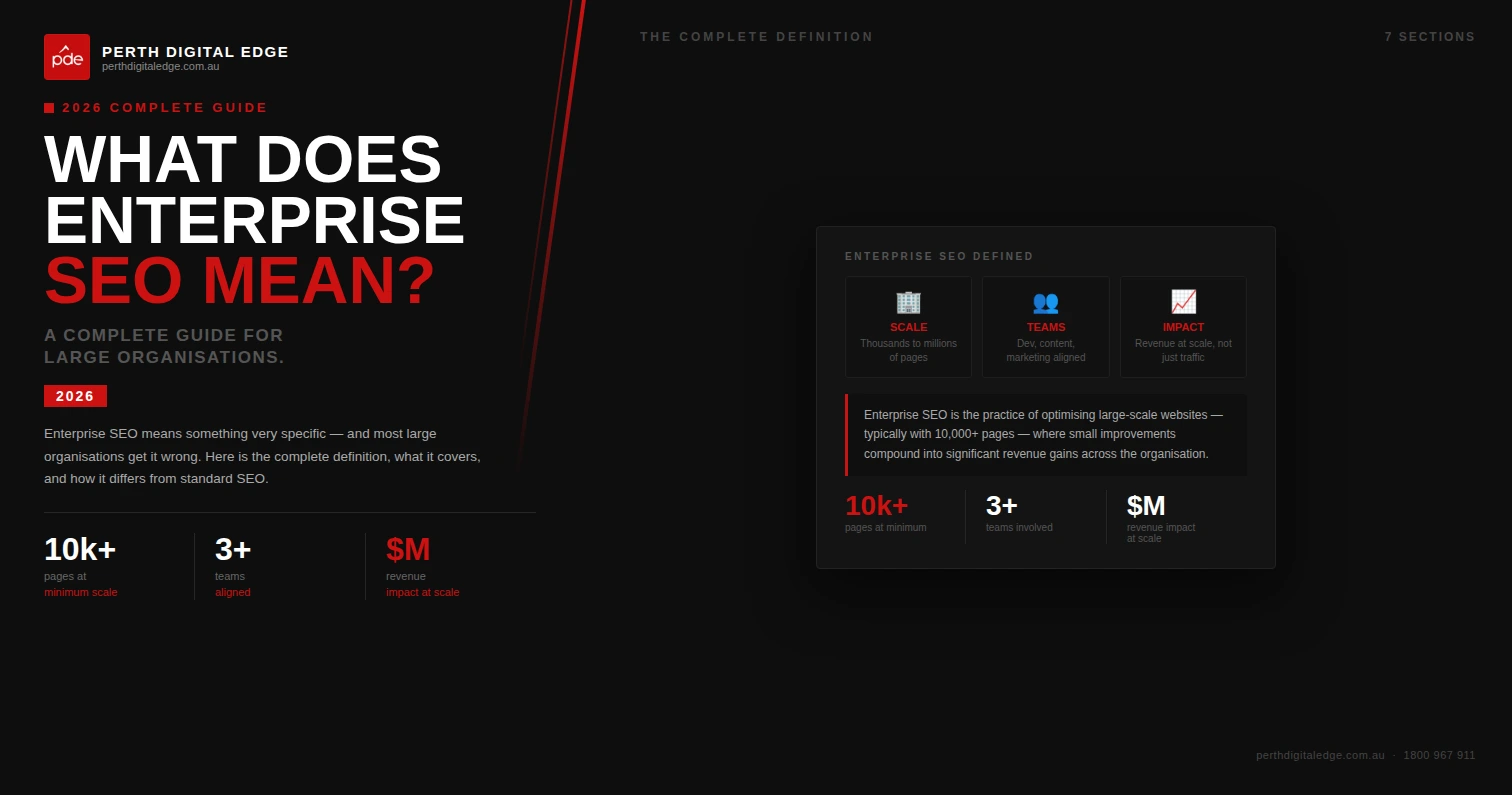
Enterprise SEO is the practice of managing search engine optimisation for large-scale websites, typically those with thousands of web pages, multiple domains, or significant brand authority in competitive industries. Enterprise SEO differ from traditional SEO primarily in scope and complexity. Where standard campaigns might target 50 keywords across 30 pages, enterprise SEO deals with thousands of keyword targets across sprawling site architectures that require coordination between multiple teams.
Every SEO change on enterprise sites affects thousands of pages simultaneously. A single template modification can alter meta descriptions, internal links, and structured data across tens of thousands of URLs overnight. This scale transforms routine SEO tasks into high-stakes decisions requiring careful planning and cross-departmental sign-off. Enterprise organisations invest significantly in SEO platforms to monitor changes in real time because algorithmic penalties cascade across entire online presence. Enterprise SEO means treating websites as complex systems where content creation requires governance frameworks and SEO performance demands enterprise-level analytics integration.
Enterprise SEO strategies account for competitive realities small businesses never face. When multiple enterprise businesses invest heavily in search engine results pages visibility, winning requires sophisticated competitive intelligence. Enterprise organizations must understand how competing enterprise brands structure their content, which long tail keywords they dominate, and where gaps exist for relevant keywords in the market. Enterprise SEO teams spend considerable effort on ongoing competitive analysis, combining on page SEO with off page SEO to implement SEO strategies that outperform rivals.
For organisations evaluating whether they need this level of support, Perth Digital Edge’s enterprise SEO services are built for businesses operating at this scale across Australia.
How Does Enterprise SEO Differ From Traditional SEO?
The fundamental principles remain identical. Search engines still evaluate relevance, authority, and user experience. Keyword research still drives content strategy. Technical SEO still determines whether search engine crawlers can access and index your content. The difference is operational complexity. Enterprise SEO strategies operate within constraints traditional SEO never encounters: regulatory requirements, brand consistency rules, multiple approval chains, technical debt from legacy platforms, and the volume of content requiring simultaneous optimisation. Enterprise SEO requires tools and processes specifically designed to operate within these constraints without sacrificing quality or speed.
Traditional SEO for small businesses typically involves one person or a small agency managing a single domain with straightforward site architecture. Enterprise SEO requires orchestrating efforts across multiple domains spanning international markets, with enterprise SEO teams including dedicated strategists, technical specialists, content creators, and project management professionals. Enterprise websites comprise thousands of pages organised across multiple subdomains or entirely separate domains. Managing this architecture requires constant attention to canonicalisation rules, internal link strategies, and crawl budget optimisation. Small business SEO treats these as afterthoughts; enterprise SEO treats them as foundational.
At the enterprise level, automation, scalability, and governance become non-negotiable. Enterprise SEO strategies use platforms like Conductor and BrightEdge to push changes across thousands of pages through templated systems. Teams monitor thousands of keyword positions through analytics tools integrated with Google Analytics and Google Search Console, often layering Ahrefs rank tracking for competitive benchmarking. Success requires measurement across dozens of dimensions: organic traffic by segment, keyword rankings by category, technical health scores from Screaming Frog crawls, crawl efficiency via Botify, and revenue attribution by source. Enterprise SEO platforms consolidate these metrics into dashboards serving different audiences.
Another critical difference is timeline, and this one catches people off guard. Traditional SEO shows results within three to six months. Enterprise SEO journey typically unfolds over twelve to eighteen months because the sheer volume of change is proportionally larger. Moving thousands of pages up in search engine results pages takes time, coordination, and sustained effort. Enterprise SEO success means establishing brand authority across thousands of long tail keywords while defending positions on competitive high-value terms. Patience is not optional at this scale.
Key Components Of A Winning Enterprise SEO Strategy
Building a winning enterprise SEO strategy requires addressing several tightly coupled components. Each demands specialist attention, and neglecting any one undermines the others. Without strong technical foundations, content excellence cannot be discovered. Without governance frameworks, scaling becomes chaos. Without measurement, improvements cannot be justified to leadership. These are not abstract concerns; they are the exact failure points we diagnose in enterprise audits month after month.
Scalable Technical SEO
At enterprise level, technical SEO extends beyond fixing broken links and submitting sitemaps. Enterprise websites require automated monitoring of crawl budget allocation across thousands of pages, management of complex JavaScript rendering, handling of multi-language hreflang implementations, and coordination of site architecture changes affecting entire sections. A single misconfigured canonical tag can propagate across thousands of product pages, causing significant traffic drops that require weeks to recover.
Enterprise SEO platforms include automated crawl budget analysis identifying where search engines waste cycles on low-value pages. Freeing crawl capacity to focus on priority content yields significant search engine rankings improvements without creating new content. Proper internal link architecture requires systematic thinking about where important pages receive internal links and how to prevent link authority diluting across thousands of unimportant pages. These questions have enormous SEO performance implications at enterprise scale.
Content Creation At Scale
Enterprise companies need to create content serving target audiences across every buyer journey stage, across multiple product lines, regions, and languages. This is not about publishing more blog posts. It requires building content systems that translate successful content patterns into repeatable frameworks. Enterprise SEO teams coordinate with content departments to ensure every piece is optimised, internally linked, and aligned with broader SEO strategies. The ability to translate successful content from one market to another is a defining capability of mature enterprise SEO operations.
Enterprise content creation requires governance frameworks preventing business units from creating competing content that cannibalises search engine results pages visibility. Content calendars, keyword ownership matrices, and production workflows allow dozens of teams to create content simultaneously without cannibalisation. Without proper governance, thousands of pages compete internally for the same keyword positions.
Link Building And Brand Authority
For enterprise brands, link building shifts from cold outreach to authority-driven attraction. Large organisations already have significant brand authority, but converting that brand recognition into high quality backlinks requires strategic digital marketing leveraging existing industry position, research partnerships, and media relationships. Enterprise SEO focuses on earned links rather than purchased or traded links. In the Australian market specifically, relationships with publishers like AFR, The Australian, and industry bodies in mining, finance, and education carry substantial link value.
Enterprise brands typically attract links through thought leadership content, original research, industry partnerships, and media coverage. Publishing original research on industry trends earns links from hundreds of publications simultaneously. This authority-driven approach scales better and creates sustainable competitive advantages, generating high quality backlinks that search engines reward.
Cross-Team Coordination And Project Management
Perhaps the most underappreciated component of enterprise SEO success is project management. When marketing efforts involve multiple teams including marketing, development, legal, and product, the ability to manage priorities, timelines, and dependencies becomes critical. Enterprise SEO tools include workflow features because managing SEO across an enterprise environment demands structured collaboration between web developers, content teams, and legal reviewers all working simultaneously.
Enterprise organisations often fail at SEO initiatives because project management processes break down. An SEO change that could deploy in one week takes months due to approval delays, lack of clear ownership, and unclear dependencies between teams. Building the right governance structure, defining clear approval workflows, and establishing shared metrics can dramatically accelerate SEO progress. Enterprise SEO requires people and processes, not just tools.
Enterprise SEO Tools And Platforms
Basic SEO tools cannot handle enterprise-scale data. Enterprise SEO platforms like Conductor, BrightEdge, and seoClarity are purpose-built to manage volume and complexity. These SEO tools integrate with google analytics, google search console, and internal data systems providing unified SEO performance views across multiple domains. Enterprise SEO platforms prioritise scale, data integration, and cross-team visibility.
An enterprise SEO platform typically costs between five hundred and five thousand dollars per month depending on functionality and keywords tracked. For enterprise organisations managing millions in organic search revenue, this investment is justified because it enables teams to make faster decisions and avoid costly mistakes. A single technical error caught by enterprise SEO platform monitoring before propagating saves tens of thousands in lost traffic. Enterprise SEO requires this monitoring because error costs scale with website size.
The investment in these platforms is significant, which is why understanding how much enterprise SEO costs before committing resources is critical for planning.
Evaluate enterprise SEO solutions on four criteria: data integration capability, automation features, reporting flexibility for multiple teams, and the platform’s ability to surface actionable insights rather than just dashboards. The right enterprise SEO platform should make your SEO team faster and more accurate, not just better informed. Look for platforms allowing custom reporting because different stakeholders need different data views. Executives care about organic revenue and traffic trends. Technical teams care about crawl efficiency and indexation rates. Content teams care about keyword performance by topic cluster.
Integration with internal systems matters. Enterprise SEO requires connecting tools to analytics platforms, CRM systems, revenue attribution models, and internal databases. Platforms unable to integrate force SEO teams to work in isolation, leading to misaligned priorities.
Why Is Enterprise SEO Important?
Enterprise SEO important because the stakes are proportionally massive. When your website generates millions in organic search revenue, a 5 percent drop in organic traffic can wipe out a quarter’s growth target overnight. Enterprise SEO solutions protect that revenue by maintaining search engine rankings across competitive industries where multiple enterprise businesses are investing heavily. For many enterprises, organic search is their largest customer acquisition channel. In Australian financial services, it accounts for 40 percent or more of new customer revenue. This makes enterprise SEO a boardroom priority rather than a marketing tactic.
Enterprise organisations face unique challenges. Algorithm updates affect thousands of pages simultaneously. Competitors with dedicated SEO company partnerships target the same high-value keywords. Internal politics and slow approval processes can delay critical SEO efforts by months. Enterprise SEO requires not just technical expertise but also change management skills and stakeholder alignment capabilities.
One WA-based enterprise client came to us managing 14,000 pages across three domains with zero SEO governance. Content teams in different business units had created 2,300 pages cannibalising the same 40 keyword clusters. After implementing a keyword ownership matrix and consolidating duplicate content, organic traffic increased 34 percent in seven months without publishing a single new page. When enterprise SEO journey begins with proper governance structure, results compound across marketing strategies. An enterprise implementing proper crawl budget optimisation makes search engines more efficient at discovering new content. Foundational improvements often generate more organic traffic growth than tactical campaigns.
Enterprise SEO protects and extends your organisation’s most valuable marketing asset: organic search visibility. In an era where paid advertising costs continue rising and alternative channels become saturated, organic search remains the most cost-effective customer acquisition channel. Enterprises that manage SEO properly gain compounding advantages as search engine rankings become entrenched and brand authority grows. Enterprise SEO success becomes a long-term competitive moat that grows stronger over time rather than a fixed campaign.
Enterprise SEO And Answer Engine Optimisation
The search landscape is evolving, and enterprise organisations need to prepare for answer engine optimization alongside traditional search engine optimisation. AI-powered search experiences are changing how potential customers interact with google search results. Enterprise brands with structured data, authoritative content, and strong topical coverage are best positioned to be cited by these systems. Answer engine optimization represents a fundamental shift in how enterprise organisations should think about content strategy beyond traditional search engine results pages.
Answer engine optimization favours brands that demonstrate clear expertise and provide comprehensive, authoritative information on topic clusters. An enterprise organisation with detailed product information, technical documentation, research findings, and expert commentary is far more likely to be cited by AI-powered search systems than a competitor with thin, generic content. This is why enterprise SEO teams are increasingly investing in structured data implementation, topical authority building, and comprehensive content coverage.
For a deeper look at the foundational concepts that underpin enterprise-scale work, our guide on what enterprise SEO involves covers the core principles in detail.
Enterprise SEO strategies incorporating answer engine optimization protect visibility as search landscape shifts. This means structuring content for direct answers, implementing schema markup, and ensuring sites serve as authoritative sources AI systems trust. Audit content against what AI systems would cite. Ensure proper depth of coverage, authoritativeness, and structured data before relying entirely on traditional search rankings.
Frequently Asked Questions
Below are common questions from enterprise organisations exploring SEO at scale, reflecting operational and strategic realities of enterprise SEO.
What Size Business Needs Enterprise SEO?
Enterprise SEO becomes necessary when a business manages thousands of pages, operates across multiple domains, or requires multi-team coordination. Most enterprises recognise the need for dedicated SEO strategy between 10,000 and 50,000 pages. Some large enterprises with millions of pages continue basic practices until material revenue impact occurs. Enterprise platforms managing multi-domain implementations, international variations, and governance structures are essential at scale.
Can We Manage Enterprise SEO In House?
Some organisations build internal enterprise SEO teams; others partner with an enterprise SEO agency. The best approach depends on existing resources and website complexity. Many use a hybrid model where agencies handle strategy and technical work while marketing teams manage content. Building internal capability requires specialists understanding both algorithms and business context, plus people staying current with search engine changes. Partnering initially while building capability often yields better results than building everything internally from scratch.
How Long Does Enterprise SEO Take To Show Results?
Enterprise SEO requires patience. Initial technical improvements appear within eight to twelve weeks. Meaningful keyword movement takes four to eight months. Full success usually takes twelve to eighteen months. Phase One focuses on technical fixes (three months). Phase Two focuses on content optimisation (three to six months). Phase Three focuses on competitive positioning (twelve months and beyond).
How Much Does An Enterprise SEO Team Cost?
Internal enterprise SEO teams cost three hundred thousand to over one million pounds annually, including salaries, platforms, and training. Enterprise SEO agencies cost five thousand to fifty thousand pounds monthly depending on scope. Most organisations use a hybrid approach: small internal teams oversee strategy whilst external agencies provide specialist expertise.
What Metrics Should We Use To Measure Enterprise SEO Success?
Enterprise SEO success metrics should tie to business outcomes. Track organic traffic growth by segment, keyword rankings for priority keywords, search visibility relative to competitors, organic customer acquisition cost, and SEO performance across product categories. Organisations measuring purely on rankings often optimise for wrong outcomes. Build measurement frameworks around business outcomes: revenue, customer acquisition, market share, or brand awareness.
Ready To Build Your Enterprise SEO Strategy?
Enterprise SEO is fundamentally different from traditional SEO. It demands different tools, processes, and expertise. Organisations investing in proper strategy, capable teams, and right processes gain compounding competitive advantages. Those treating SEO as a traditional tactic struggle to generate proportional results.
Enterprise SEO success requires alignment across multiple dimensions: organisational alignment where different teams understand how their work affects overall SEO strategy, technical alignment where your architecture supports your content and business strategy, and competitive alignment where you understand how to position your brand relative to competing enterprise businesses in your market. We build enterprise SEO strategies for organisations across Australia that need search engine optimisation at scale.
Perth Digital Edge’s approach to enterprise SEO combines deep technical expertise with business strategy thinking honed across WA’s mining, property, healthcare, and education sectors. We diagnose the specific constraints and opportunities affecting your organisation’s organic search performance, then build a realistic roadmap for addressing them given your resources, timeline, and competitive landscape. We work across your entire organisation to build alignment, remove obstacles, and create the conditions for measurable organic growth.