

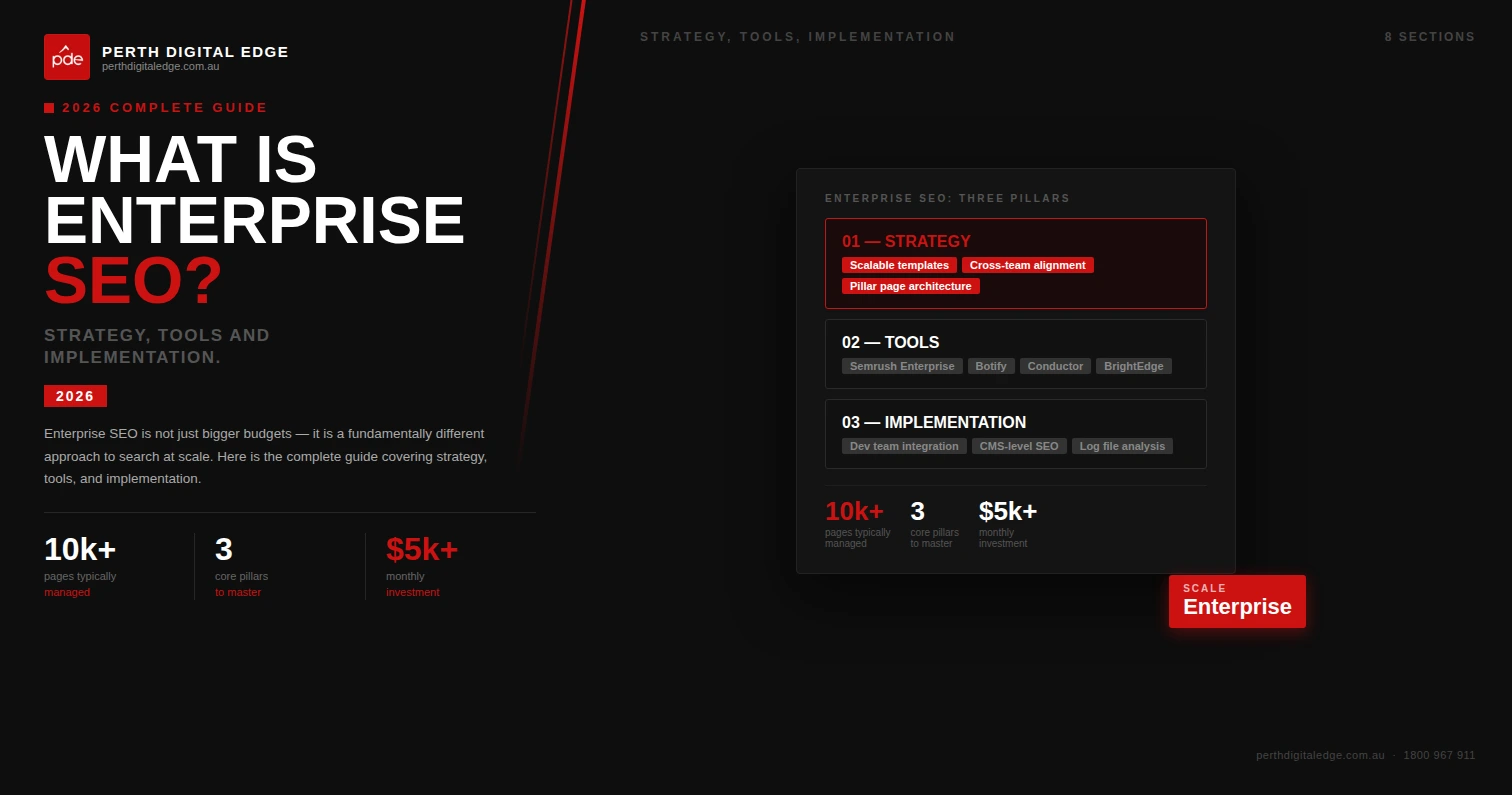
What is enterprise SEO in practical terms? It is a distinct approach to search engine optimisation built for organisations managing enterprise level websites with thousands or millions of pages, complex site architecture, and multiple teams contributing to the same online presence.
This guide explains what enterprise SEO actually involves, how it differs from traditional SEO, and what a winning enterprise SEO strategy looks like in practice. Perth Digital Edge has delivered enterprise SEO strategies for organisations across Western Australia’s mining, property, education, and healthcare sectors, and the operational reality is worlds apart from standard campaigns. Enterprise SEO demands systematic approaches, dedicated enterprise SEO teams, and purpose-built enterprise SEO platforms that handle scale and complexity across modern enterprise sites.
Defining Enterprise SEO
Enterprise SEO is search engine optimisation applied to enterprise level websites with thousands or millions of pages, multiple domains, and complex technical environments. Enterprise companies manage pages across multiple content teams, requiring coordination with web developers, marketing teams, legal departments, and executive stakeholders.
What makes enterprise SEO distinct is execution at scale. The fundamentals of keyword research, technical SEO, link building, and content creation apply, but operational complexity multiplies significantly. Risk management alone, where a single template error can affect millions of pages, demands different processes, tools, and expertise.
Enterprise SEO differs fundamentally in resource allocation and measurement. Rather than optimising for a handful of keywords, enterprise organizations manage thousands of keyword rankings across multiple audiences and geographic markets in search engine results pages. Standard SEO practices that serve small operations cannot scale to this level. This requires enterprise SEO platforms integrating with business intelligence systems and reporting on executive concerns: conversion rates by segment, organic search revenue, and cost per acquisition compared to paid advertising channels.
For a detailed breakdown of what this discipline involves at a strategic level, our guide on what enterprise SEO means explores the full scope.
How Does Enterprise SEO Differ From Traditional SEO?
Enterprise SEO differ from traditional SEO in scale, coordination, and risk. Enterprise websites manage thousands of pages and multiple domains including international sites and ecommerce sites. Enterprise SEO teams work alongside developers, product teams, and external agencies, requiring sophisticated workflow management and enterprise SEO tools. Risk is proportionally greater: a single template error or configuration mistake can affect millions of pages simultaneously.
Enterprise organizations target thousands of keywords across multiple product lines, geographic regions, and customer segments. Where a small business might rank for 30 keywords, an enterprise organization tracks thousands of keyword rankings across different markets and audiences. Timeline for improvements extends much longer than traditional SEO campaigns: six to eighteen months is typical for meaningful results.
Enterprise SEO also faces unique constraints that traditional SEO does not. Enterprise businesses operate within legal frameworks, compliance requirements, and brand guidelines that govern how content can be created and optimised for their target audience. Regulated industries like pharmaceuticals or financial services require legal and compliance review before publishing optimised content. These constraints mean winning enterprise SEO strategy requires deep understanding of the business context, not just search engine optimisation knowledge. Digital marketing at this scale demands teams that understand both search engine rankings and organisational dynamics.
The Pillars Of Enterprise SEO Strategy
A winning enterprise SEO strategy rests on several tightly coupled components, each demanding specialist attention and ongoing investment. These components reinforce one another to build durable organic search positions across enterprise level websites serving millions of pages and diverse audience segments. Neglect one and the others lose effectiveness; we have seen this pattern repeat across dozens of enterprise audits.
Technical SEO At Scale
Technical SEO for enterprise sites extends well beyond basic audits. It encompasses crawl budget management across thousands of pages, site architecture optimisation, duplicate content resolution at scale, internal linking strategies distributing authority across priority pages, and structured data implementation enhancing search engine visibility. Enterprise SEO efforts in the technical space require constant monitoring because enterprise platforms frequently push updates affecting search engine optimization outcomes.
Managing site architecture at enterprise scale requires strategic thinking about URL structure, content organisation, and page relationships. Each choice affects how crawl budget gets allocated and how search engines understand content relationships. Enterprise SEO teams work with web developers to test architectures against real search engine visibility metrics before implementing.
Duplicate content at scale presents significant challenges. When enterprise organizations operate multiple domains or syndicate content across sections, the same content may appear in multiple locations. Enterprise SEO solutions involve canonical tags, proper redirects, and parameter handling through google search console to signal intentional mirrors versus accidental duplicates.
Content Strategy And Creation
Enterprise SEO requires content creation systems, not just content. Teams build frameworks allowing content teams to create efficiently at scale while maintaining quality and keyword alignment. The ability to translate successful content from one market, product line, or format to another is a hallmark of mature enterprise operations. This requires managing the site’s ability to handle large volumes without creating duplicate content issues.
A mature content strategy establishes templates, guidelines, and approval workflows empowering content teams while protecting search visibility. Rather than centralising management, enterprises delegate ownership to business units understanding their markets. The SEO team’s role becomes establishing frameworks, providing keyword recommendations, and identifying gaps. This distributed model accelerates creation but requires clear processes and regular communication between SEO and content teams.
Link Building And Off Page SEO
At enterprise level, link building leverages the organisation’s existing brand authority, industry relationships, and media presence. Enterprise brands attract high quality backlinks through thought leadership, data-driven research, and strategic partnerships with publications like AFR, industry journals, and peak bodies relevant to Australian markets. Off page SEO includes monitoring the backlink profile through Ahrefs or SEMrush, disavowing toxic links, and ensuring link equity flows efficiently to priority pages.
Enterprise organizations publish research, thought leadership, or industry reports that naturally attract links. The SEO team amplifies these assets, ensures discoverability, and builds relationships with journalists and analysts. When substantial link equity accumulates, the team strategically directs authority toward priority pages through careful internal linking, managing how link value flows through site architecture. Regular backlink audits identify suspicious patterns that might trigger search engine penalties.
Data Management And Analytics
Enterprise SEO relies on data management systems aggregating information from Google Search Console, Google Analytics, enterprise SEO platforms, and internal business intelligence tools. The SEO team must track performance across thousands of keyword rankings, monitor algorithm changes, and report on organic search performance in ways that resonate with executive stakeholders.
The data challenge differs fundamentally from standard SEO. Where smaller operations might track 50-100 keywords manually, enterprise teams need automated systems continuously monitoring thousands of keyword rankings across multiple regions and tracking search engine results page features. Enterprise SEO platforms integrate with google analytics to connect keyword rankings with actual conversions, answering the question executives care about: what is the business impact of our SEO efforts?
Enterprise initiatives require sophisticated segmentation. Teams need to understand SEO performance separately for each product line, geographic market, brand, and customer segment. They need the ability to drill down from overall organic traffic trends into specific pages, keywords, or topics driving changes.
Enterprise SEO Tools And Platforms
Managing SEO across enterprise level websites requires purpose-built enterprise SEO platforms like BrightEdge, Conductor, seoClarity, and Botify. These enterprise SEO tools integrate with Google Analytics and Google Search Console to monitor SEO performance at scale, automate routine SEO tasks, and coordinate SEO initiatives across multiple teams and business units. Supplementary tools like Ahrefs for backlink analysis, Screaming Frog for technical crawls, and SEMrush for competitive intelligence round out the typical enterprise stack.
Enterprise SEO platforms provide centralised command and control for SEO initiatives across multiple domains, allowing a single team to monitor search visibility across an entire digital footprint. They automate technical audits of millions of pages, identify issues that would take months to discover manually, and offer workflow management features. Many leading enterprise SEO tools now include AI capabilities identifying patterns in search performance. Investment runs tens of thousands of dollars annually, requiring careful evaluation of your specific enterprise SEO solutions needs.
Building Enterprise SEO Teams
Enterprise SEO teams include strategists, technical specialists, content professionals, and project managers. Teams may operate in-house, through an enterprise SEO agency partnership, or hybrid. We have structured teams for Perth-based enterprises where the internal marketing team handles content creation while Perth Digital Edge manages technical SEO, link building, and platform reporting.
A typical structure includes an SEO Director owning strategy and results, technical SEO specialists managing site architecture, content strategists overseeing creation, data analysts managing platforms and reporting, and project managers coordinating initiatives.
Budget planning is critical when structuring teams. Our guide on enterprise SEO costs provides detailed pricing frameworks to help with resource allocation.
Effective enterprise SEO requires clear ownership, defined processes, and regular communication across teams. The SEO team must have executive sponsorship, budget for enterprise SEO platforms and tools, and authority to influence site architecture and content decisions. Building success requires structural alignment giving the team both responsibility and decision-making authority.
Unique Challenges In Enterprise SEO
Enterprise SEO faces unique challenges that smaller operations never encounter, and some of them are genuinely maddening. Slow approval cycles mean changes can take months. Legacy technology creates technical debt constraining SEO efforts. Budget competition with paid advertising creates tension. International sites require multilingual SEO strategies multiplying complexity. Maintaining consistent SEO practices across business units with different priorities proves challenging. One Australian enterprise client had an SEO recommendation in legal review for nine weeks while competitors published freely on the same topic.
The approval cycle challenge is particularly acute in regulated industries. A pharmaceutical company must navigate legal, compliance, and medical review before making content changes. This means enterprise SEO strategies in regulated sectors must plan for extended timelines and focus on opportunities providing value despite approval delays.
Technical debt from legacy systems creates ongoing constraints. Many organizations run decades-old platforms never designed for SEO. URL structures may not be optimisable. Content management systems may not support canonical tags or structured data. Enterprise SEO solutions work within these constraints while building the business case for platform upgrades.
Budget competition between digital channels creates tension impacting enterprise SEO initiatives. When competing for budget with Google Ads or social media, the SEO team must demonstrate return on investment clearly. We helped one WA enterprise build an attribution model showing organic search delivered a $14 cost per acquisition versus $67 from paid channels, which secured a 40 percent increase in SEO budget the following financial year. Enterprise organizations attributing revenue to organic search and calculating cost per acquisition can make informed budget decisions balancing paid reach with long-term organic search value.
Frequently Asked Questions
What Is The Difference Between Enterprise SEO And Regular SEO?
Enterprise SEO differ from regular SEO in scale, complexity, and operational requirements. Enterprise SEO manages enterprise sites with thousands or millions of pages, multiple domains, and complex technical environments requiring dedicated enterprise SEO tools, enterprise SEO teams, and structured project management processes. Regular SEO targets smaller websites with manageable architecture. Beyond technical differences, enterprise SEO requires different business practices, approval processes, financial models, and success metrics.
What Seo Tools Do Enterprise Organizations Actually Need?
Enterprise SEO platforms must handle scale, provide technical diagnostics across millions of pages, integrate with existing business systems, and offer collaboration features supporting multiple teams. The best enterprise SEO tools provide keyword tracking across thousands of terms, competitive analysis comparing your search visibility against competitors, content recommendations based on search results performance, and workflow management allowing non-technical stakeholders to submit SEO requests. Budget roughly 30,000 to 200,000 dollars annually depending on digital footprint size, keywords tracked, and specific features needed.
Do We Need An Enterprise SEO Agency?
If your organisation manages enterprise level websites with significant organic search revenue, operates across multiple domains, or lacks internal specialist resources, partnering with an enterprise SEO agency provides access to expertise, enterprise SEO platforms, and established processes that take years to build internally. An SEO company with genuine enterprise experience understands unique challenges of enterprise environments. Most enterprises find hybrid approaches work best, combining internal ownership with external specialist execution.
How Do We Measure Enterprise SEO Success?
Enterprise SEO success is measured through organic traffic growth, keyword rankings improvement across target keywords, organic search revenue attribution, and technical health metrics. The SEO team should track performance using enterprise-level analytics tools integrated with google search console and google analytics. However, the most important metric is ultimately business impact. An enterprise SEO initiative improving rankings and traffic but not improving conversions, customer acquisition costs, or revenue is not truly successful. Enterprise SEO reporting must connect search engine metrics back to business outcomes.
How Long Before We See Results From Enterprise SEO?
Enterprise SEO typically shows initial results within 90 days for quick wins like technical fixes, but meaningful organic traffic and revenue improvements usually take six to eighteen months. This extended timeline reflects time required for search algorithms to re-index sites after changes and for new content to build authority. Enterprise organizations should plan for multi-year SEO roadmaps.
Start Building Enterprise Search Visibility
Enterprise SEO is the discipline of building and protecting organic search performance at scale. It requires specialist expertise, purpose-built tools, and operational processes designed for complexity. Perth Digital Edge’s enterprise SEO services are built specifically for organisations across Western Australia and nationally that have outgrown standard approaches and need search engine optimisation matching the scale of their operations.
The most successful enterprise organizations understand that enterprise SEO is not simply larger-scale traditional SEO. It requires different thinking about site architecture, different content management approaches, and different organizational structures. When executed properly, enterprise SEO creates durable organic search positions that drive traffic and revenue for years, compounding value in a way no paid channel can replicate.