
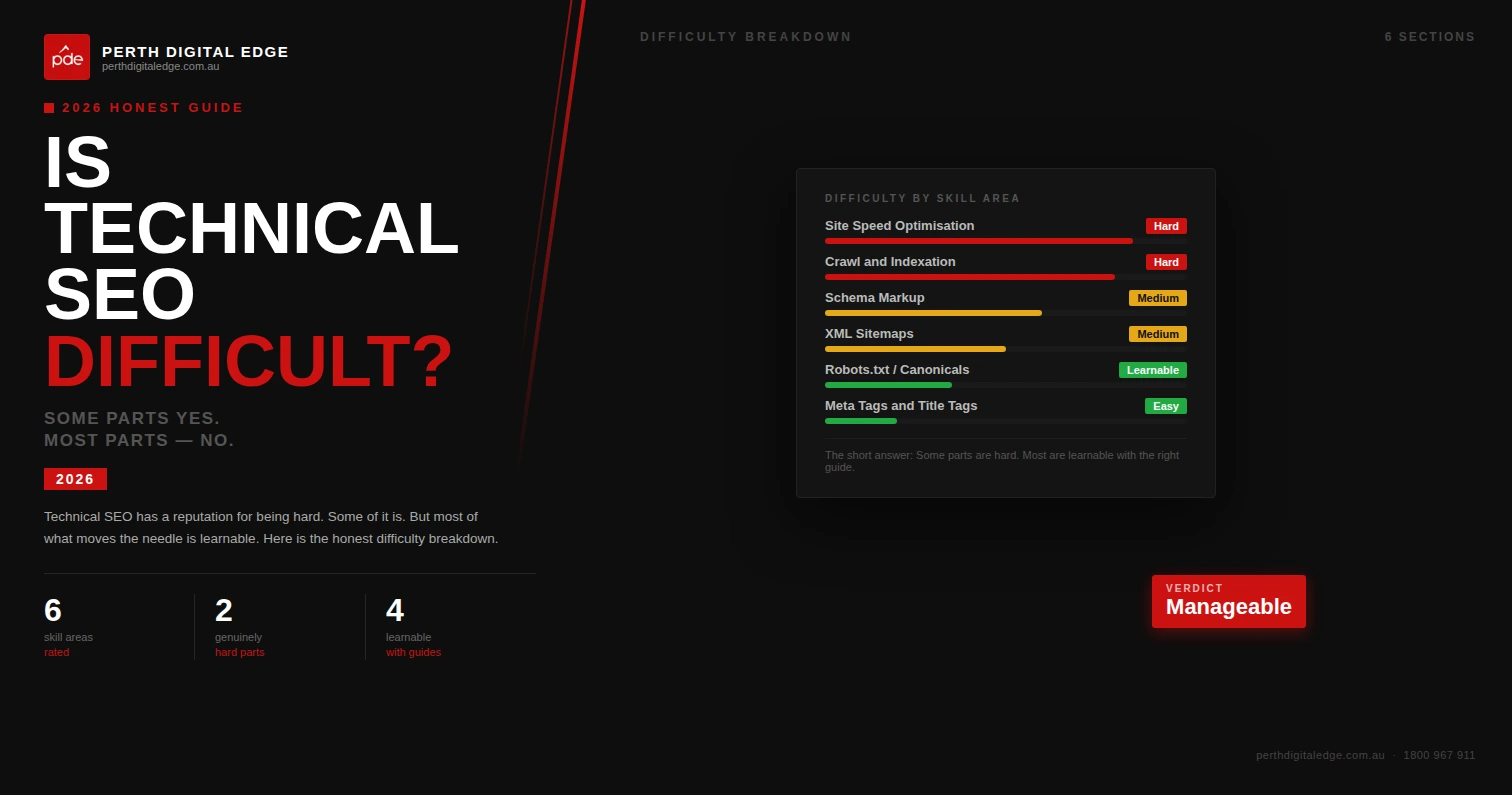
Is technical SEO difficult? It depends on how deep you want to go. After more than a decade running technical projects at Perth Digital Edge, our honest answer is that technical SEO covers a wide range of work, some of which is approachable for any motivated website owner and some of which demands specialist knowledge, experienced judgement, and the right tools. Basic tasks like setting up Google Search Console, submitting XML sitemaps, and fixing obvious broken links are straightforward. Advanced work like redirect chain untangling, canonical link elements across multi-region sites, large-scale internal linking audits, and core web vitals optimisation is genuinely hard and takes years to master.
This guide walks through exactly which parts of technical SEO are easy, which parts are difficult, and how we approach each category on real client projects. By the end, you should have a clear picture of what you can tackle yourself and what needs specialist help.
What Technical SEO Actually Involves
Technical SEO focuses on how search engines work, how search engines like google send crawlers out to reach your web pages, and how effectively your site can be indexed and rendered. It covers site speed, page speed, mobile friendly design, mobile optimization, structured data, internal linking, site structure, broken links, duplicate content, canonical tags, canonical link elements, xml sitemaps, the robots.txt file, and the way technical elements interact with the content layer. Some parts overlap with web developers’ daily work, while others sit firmly inside the SEO discipline. Understanding what search engine optimization really involves is the first step to deciding whether it is difficult for you specifically.
A strong technical SEO foundation affects how pages rank, how ranking signals flow through the site, and how well content quality actually translates into visibility. Even high quality content underperforms when search engines cannot reach it. That is why every experienced SEO team starts with technical work before turning to content creation, content marketing, or link building.
Technical SEO ensures that search engines can crawl, index, and render every important page on the site without hitting obstacles. When the technical layer is clean, the rest of your overall SEO strategy has room to breathe. When it is broken, even high quality content cannot earn the rankings it deserves, and SEO efforts across on page and off page seo underperform because the site simply cannot fire on all cylinders.
The Easy Parts Of Technical SEO
Not every part of technical SEO is hard. Plenty of tasks are approachable for business owners without a technical background, especially if they are willing to learn a handful of tools.
Setting Up Google Search Console
Google Search Console is free, well-documented, and essential for any website. Setting it up takes twenty minutes and gives you direct signals from Google about crawling and indexing, coverage, manual actions, and core web vitals. Every business website should have Search Console installed and checked regularly.
Submitting An XML Sitemap
Creating an XML sitemap and submitting it through Google Search Console is another easy win. Most CMS platforms generate sitemaps automatically, and Google Search Console gives clear feedback on whether the sitemap is being processed correctly. This one task helps search engines find important pages faster.
Finding Broken Links
Running a basic site crawl with a free tool will find broken links quickly. Fixing them is usually as simple as updating the target URL or adding a 301 redirect. Tools like Screaming Frog (free up to 500 URLs) make this approachable for smaller sites.
Adding Basic Structured Data
Plenty of CMS platforms and plugins add basic structured data automatically. Article schema, organisation schema, and FAQ schema can all be deployed with a few clicks or a copy-paste of JSON-LD into the template. For simple business websites, this layer of technical SEO is not difficult at all.
The Difficult Parts Of Technical SEO
Other parts of technical SEO demand genuine technical knowledge, experience with SEO tools, and years of exposure to how search engines work. These are the tasks where business owners usually hit walls and need specialist support.
Core Web Vitals And Site Speed Optimisation
Hitting the core web vitals thresholds for site speed and website speed is genuinely difficult on most websites. It involves front-end optimisation, server-side caching on the web server, image pipelines, critical CSS, deferred JavaScript, and cooperation between developers and content editors. We have watched teams spend months on this kind of technical optimisation without moving the needle because they missed a single render-blocking script. For Eco Style Pool Renovations, our work took PageSpeed from 27 to 86, but the work required deep inspection of every script, template, and asset on the site. Even a single slow page can drag down the perception of the entire site in the eyes of search engine algorithms.
Canonical Tags On Large Sites
Canonical link elements sound simple. In practice, getting them right across a large site with thousands of multiple pages, filters, tags, and translations is surprisingly hard. A single mistake can send link equity to the wrong URL or suppress important pages from search results. On ecommerce audits, we almost always find canonical tag problems that require careful planning before being touched.
Redirect Chains And Migration Work
Redirect chains accumulate over time as sites change platforms and URLs. Cleaning them up without breaking existing traffic requires spreadsheet discipline and a clear map of every old URL. Site migrations are among the hardest technical SEO projects to execute without losing organic traffic, which is why we manage them end-to-end with multiple checkpoints during the process.
Internal Linking Architecture
Internal linking sounds basic but doing it well across a large site is a genuine discipline. The balance of contextual anchors, the distribution of link equity to certain pages, and the way topic clusters reinforce each other all require experienced judgement. Poorly thought out internal linking can suppress important pages without anyone realising it.
Duplicate Content At Scale
Duplicate content across multiple versions of the same page, different URL parameters, printer-friendly pages, and mobile variants can be complex to untangle. Ecommerce sites often have the same content rendering under dozens of URLs because of filters, sort orders, and pagination, which creates thousands of duplicate pages that block search engines from ranking the correct version. Resolving this without losing rankings requires experience and careful testing, and it sometimes means using meta rules to block search engines from crawling low-value filter URLs entirely.
Structured Data At Scale
Basic schema markup is easy. Implementing structured data across thousands of product pages or article pages while keeping it valid and current is a different challenge entirely. Schema mistakes can disqualify pages from rich results and occasionally trigger manual actions. We audit schema rigorously on large sites because the downside is real.
Log File Analysis
Reading server logs to see how search engines crawl the site is one of the most powerful technical SEO techniques. It is also one of the least approachable without technical knowledge. Log file analysis reveals crawl patterns, wasted crawl budget on certain pages, and opportunities to guide Googlebot to the content that matters. We use it on larger projects to find problems that no other tool would reveal.
Tools That Make Technical SEO Easier
The right SEO tools can take some of the difficulty out of technical SEO. A small set of tools covers most of the work we do on audits, and learning them is worth the investment.
Google Search Console
This is the free, official source of truth for how Google sees your site. We use it on every project to track coverage, performance, crawling and indexing, and core web vitals. No technical SEO project should start without it.
Google Analytics
Google Analytics gives you behavioural data that complements Google Search Console. We use it to understand how users interact with the site, which pages lose them, and where technical improvements produce measurable results in organic traffic and conversions.
Screaming Frog
Screaming Frog is the industry standard crawler. It finds broken links, duplicate content, missing meta descriptions, and redirect chains across the entire website. Setting it up is straightforward, but interpreting the output takes practice.
PageSpeed Insights
PageSpeed Insights measures core web vitals using both lab data and field data. It tells you what is slowing down your pages and gives specific recommendations. The recommendations are easy to read but not always easy to implement without a developer.
Ahrefs And SEMrush
These paid tools add competitive data, backlink analysis, and keyword research that inform the wider overall SEO strategy. They also flag technical issues that other tools might miss.
How Our Team Approaches Technical SEO
Our approach at Perth Digital Edge blends all of the above into a repeatable workflow. Every project starts with discovery: we pull data from Google Search Console, run Screaming Frog, check PageSpeed Insights, and manually review the site on desktop and mobile devices. We look at search queries in Google Search Console to understand what user intent the site is currently matching and where there are gaps between the content and what people search for.
From there, we build a prioritised action list that separates critical fixes from minor improvements. Critical items include anything preventing indexing, anything hurting core web vitals, and anything causing duplicate content at scale. Secondary items address smaller efficiencies. Implementation happens either through our web development team or by handing the action list to the client’s developers with detailed specifications. Post-implementation, we verify every fix with a fresh crawl and monitor performance for at least two weeks to confirm the changes took effect.
The Castle Security project illustrates how this process plays out. When we started, they were invisible for competitive terms. Six months of technical work plus aligned content marketing took them to 109 keywords on page one and lifted traffic by 364%. For Wholistically Healthy, a similar process lifted organic traffic 118% and conversion rate 51%. None of this would have been possible without addressing the technical aspects first.
What Business Owners Get Wrong
The biggest mistake we see is treating technical SEO as an afterthought. Businesses invest in content creation, content marketing, and link building without ever fixing the underlying technical issues. The result is predictable. Content published on a broken site never earns the rankings it deserves. Link building campaigns from other websites waste authority on pages that cannot rank anyway. Product pages fail to trigger rich results because schema markup is missing or broken. The signals that Google actually uses to evaluate how users and search engines interact with your site keep telling the wrong story.
We have seen businesses spend six figures on content production across a year and see organic traffic fall in that same period because their technical foundation was quietly collapsing underneath them. Fixing the technical problems and then investing in content usually produces better returns than investing in content without technical work.
Is Technical SEO Getting Harder Or Easier
Technical SEO has become more nuanced over the years, not necessarily harder. Tools have improved, Google’s documentation is clearer, and automated checks catch a lot of obvious issues. At the same time, Google’s expectations keep rising. Core web vitals became a ranking factor. Mobile-first indexing became the default. Structured data expanded to cover more page types. Each of these shifts adds work to the technical SEO discipline, which is why staying current is part of the job. Our team at Perth Digital Edge invests significant time in ongoing training, monitoring industry updates, and testing new approaches on our own websites before rolling them out to clients.
This is also why we rarely recommend running technical SEO as a one-off project. The discipline keeps moving, and a site that passes all the checks today might be behind by next quarter. Ongoing technical monitoring is how we keep clients ahead of the curve.
Another common mistake is treating technical SEO as a one-off task. Websites accumulate technical debt constantly. Plugin updates introduce new issues. CMS updates change canonical behaviour. Content editors publish pages with incorrect meta tags. A technical SEO project that treats the work as a one-time sprint produces short-term wins that fade as new issues appear. We recommend ongoing monitoring through Google Search Console plus a full audit at least annually.
Is It Worth Learning Technical SEO Yourself
This is a question every business owner eventually asks. Our answer is nuanced. Website owners who learn SEO basics make better decisions about hosting, platforms, templates, and content structure. It also helps you spot when something is going wrong before it costs you rankings. Learning SEO to the level of a specialist is a bigger investment and only worth it if you run a large site or plan to build websites for other businesses. Most people never need that depth, they simply need enough knowledge to work alongside an experienced partner.
The value of a little technical knowledge compounds. Knowing how a title tag affects click-through rate, how internal links shape authority flow, and how page SEO signals combine with off page SEO will save you from costly mistakes during content briefs, migrations, and redesigns. Even understanding a single concept like site links in the search results can change how you think about structuring pages on your site.
For most business owners, the right balance is learning enough to make informed decisions and partnering with specialists for the difficult parts. Having a team you trust to handle the technical side lets you focus on your actual business.
If you want a deeper understanding of the specific problems we look for on audits, our article on what are technical SEO issues walks through the most common ones in detail. And our broader what is technical SEO guide covers the whole discipline from scratch.
Technical SEO On Larger Sites
Technical SEO difficulty scales with site size. A small business website with fifty pages has a manageable set of technical issues. An ecommerce site with twenty thousand product pages has thousands of potential duplicate content issues, complex canonicalisation requirements, and significant crawl budget problems that do not exist on smaller sites. Large publishers dealing with multiple languages, syndicated content, and breaking news have their own unique challenges around fresh content discovery and canonical strategy. These larger sites always require specialist support.
For large sites, we often spend the first month simply mapping the site and understanding how the technical foundations interact with content and business rules. Only then can we make meaningful recommendations about what to change. Rushing this stage on a large site almost always causes problems. Our team builds a clear picture of how users and search engines currently move through the site, then overlays the technical data on top to find where product pages and other pages are underperforming.
Multi-language sites add another layer. When a site runs in multiple languages, we need to make sure hreflang is correct, canonical tags do not accidentally consolidate different-language versions to a single one page, and that relevant content appears in the right market. These are the sorts of projects where a strong technical SEO background genuinely saves weeks of troubleshooting.
Frequently Asked Questions
The questions we hear most from business owners weighing up whether to tackle technical SEO themselves.
Do We Need A Developer To Do Technical SEO?
For basic work, no. Most CMS platforms let you handle the fundamentals without touching code. For more advanced work like core web vitals, schema at scale, or site architecture changes, having access to a developer (or an SEO team with development capability) is essential.
How Long Does It Take To Learn Technical SEO?
Learning the basics takes a few weeks of focused study. Learning enough to audit a large ecommerce site confidently takes years of experience. The gap between basic and advanced technical SEO is wide, and closing it requires time spent on real client work.
Can Technical SEO Be Done Remotely?
Yes. Technical SEO is almost entirely remote work. We run audits, implement fixes, and monitor performance for clients across Australia without ever visiting their offices. The tools and data are all cloud-based, so geography is not a limitation.
What Happens If We Ignore Technical SEO?
Rankings stagnate, organic traffic drifts downward, and every other SEO investment produces less value than it should. Over time, competitors with cleaner technical foundations move ahead even if their content is weaker. Ignoring technical SEO has a real cost, even if it is invisible in the short term.
Is Technical SEO Worth The Investment?
Yes, in most cases. Technical SEO produces the biggest early wins of any SEO investment because it removes friction between your content and the people searching for it. The return on a well-run technical SEO project is usually clear within three months.
Final Thoughts And Next Step
So, is technical SEO difficult? Parts of it are, and parts of it are not. The basics are approachable for any motivated business owner, and learning them is genuinely worth the effort, especially when you need to evaluate how your site compares to other websites in the same space. The advanced work is genuinely hard and benefits enormously from experienced specialists. If you want an expert team to handle the difficult parts while you focus on running your business, our technical SEO services in Perth cover the full spectrum of technical work from audits through to ongoing support. Contact our team for a free initial review of your site. We will walk through exactly what needs attention, give you clear priorities, and help you decide which parts you can tackle yourself and which parts are worth handing over to us.