

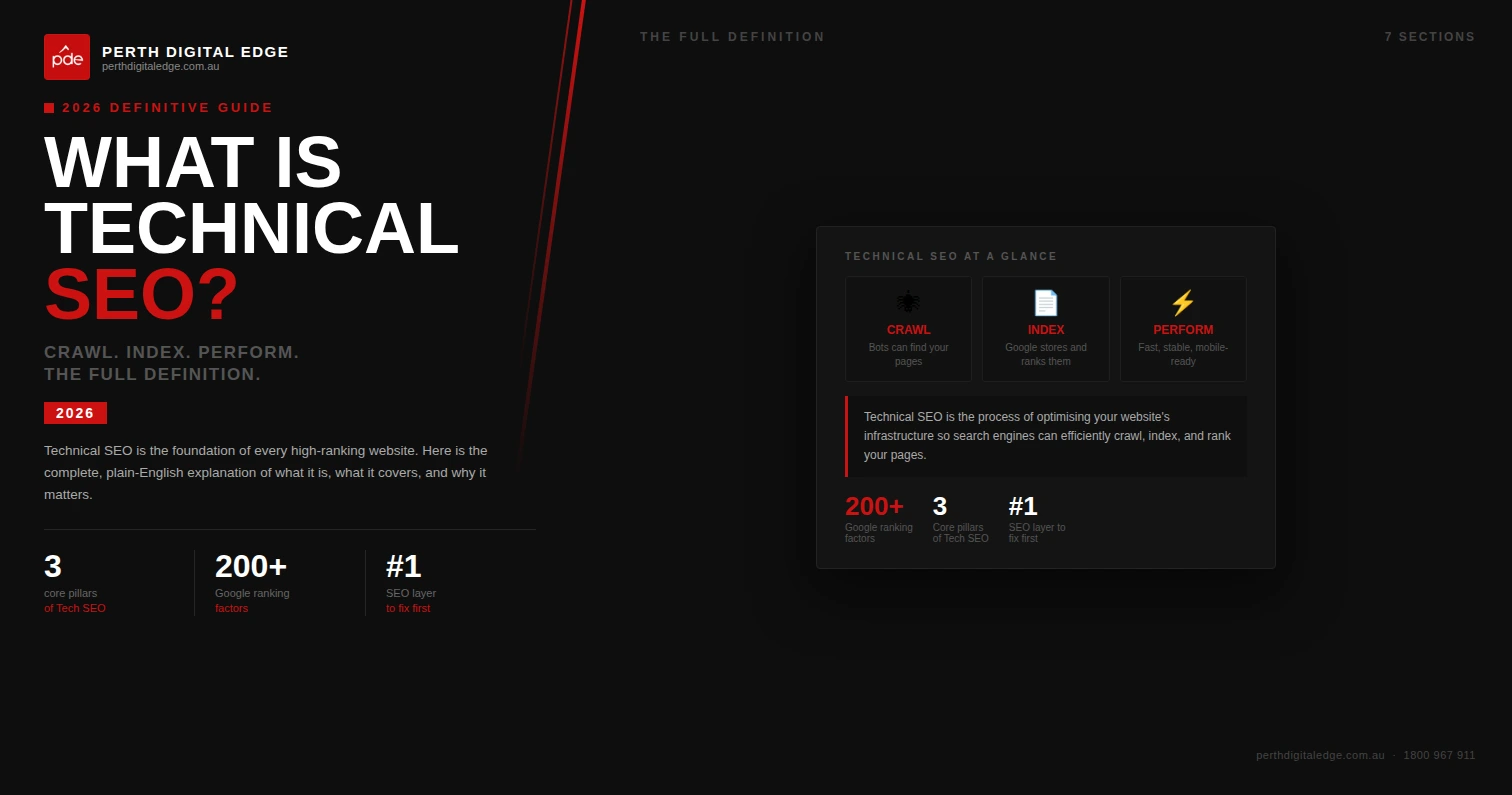
What is technical SEO, and why does it matter so much for modern websites? The short version is this: technical SEO refers to everything that happens at the website’s technical elements level to help search engines crawl, render, index, and rank your pages. The long version is what this guide is for. Our team at Perth Digital Edge has spent more than a decade running technical projects for Australian businesses out of our Wanneroo base, and we have watched the same mistakes quietly erode years of hard work again and again. We have also watched clean technical work turn a flatlining Joondalup plumber into the most visible trade in his postcode inside a single quarter.
This blog post takes you through what technical SEO involves optimizing, the core web vitals that matter most, the most common technical SEO issues we see, and the technical SEO checklist our team runs against every site before we start writing a single line of content. If you are a website owner trying to master technical SEO, this guide walks through every layer we look at during a real audit.
Technical SEO Defined
Technical SEO is the branch of search engine optimization that helps search engines understand a website’s content, structure, and purpose. Where on page SEO focuses on the content of individual pages, and off page SEO focuses on backlinks and authority, technical SEO deals with how users and search engines actually interact with the website. It covers site speed, site structure, mobile friendliness, crawl budget, indexation, structured data, canonical tags, the XML sitemap, the robots.txt file, and a handful of other technical aspects that determine whether your pages can even appear in search results at all.
Why is technical SEO important, and does technical SEO matter for every site? Yes. Without it, every other effort is limited before it begins. High quality content cannot earn search rankings if the page never gets indexed. Backlinks cannot pass full link equity if canonical URLs are misconfigured. Product pages cannot trigger rich snippets without schema markup. Good technical SEO is the layer that lets the rest of the seo strategy actually earn its keep. Across multiple pages on a modern site, these technical SEO elements compound into real seo performance gains that show up as improved search engine visibility in your analytics.
What Technical SEO Involves Optimizing
Technical SEO involves optimizing a wide range of elements, and not all of them are equal in impact. A proper technical SEO audit starts with the items that have the biggest effect on search engine visibility and works down to the smaller refinements. Below is the technical SEO checklist our team follows on every engagement.
Site Speed And Core Web Vitals
Website speed is one of the most visible ranking factors Google applies. Core web vitals measure three specific elements: largest contentful paint lcp, which tracks when the biggest element on the page finishes loading; cumulative layout shift cls, which measures how stable the page is as it loads; and interaction to next paint, which tracks responsiveness. Slow pages and jumpy layouts push visitors back to the search engine results pages, and Google reads that as a negative signal. When we rebuilt the site for Eco Style Pool Renovations, PageSpeed score climbed from 27 to 86 and organic leads followed.
Crawling And Indexing
Search engines crawl the web constantly, and search engine crawlers and search engine bots need a clear path through your site to find the important pages. We check that the XML sitemap is complete, the txt file at robots.txt is not accidentally set to block search engines from content, and that internal links on the site create a clear route from the homepage to every relevant page among the relevant pages on the site. We also look for duplicate pages that split authority across multiple versions. Canonical tags tell search engines which URL is the preferred version so link equity consolidates where it should and so confused search engine bots do not pick the wrong target. Technical SEO ensures that every crawl budget decision works in your favour, and the checklist helps search engines crawl the site efficiently.
Mobile Friendliness And Mobile Devices
Google uses the mobile version of a site first when deciding rankings, which makes mobile friendliness a non-negotiable part of the technical brief. We test templates on real mobile devices, not just emulators, and confirm that tap targets, fonts, and layouts work at every screen size. A website that feels clumsy on a phone will lose rankings regardless of how strong its desktop experience is.
Structured Data And Schema Markup
Implementing structured data helps search engines understand what each page is about in a way that plain HTML cannot. Schema markup enables rich snippets, knowledge panels, and other enhanced listings in search engine results pages. For a professional services site, organisation schema, service schema, and FAQ schema are the three we deploy most frequently. For ecommerce, product and review schema add significant lift to click-through rates.
XML Sitemap And Site Architecture
An XML sitemap is a machine-readable map of every URL you want indexed. We submit it through Google Search Console and monitor coverage reports to spot issues early. Site architecture is the human-readable equivalent. A flat, logical architecture helps search engines and visitors find important pages quickly. A messy architecture buries content and wastes crawl budget.
Canonical Tags And Duplicate Content
Duplicate content shows up on roughly eight out of every ten sites we audit. It can appear through URL parameters, trailing slashes, pagination, ecommerce filter pages, or HTTP and HTTPS versions of the same page. Canonical tags tell search engines which is the preferred version so authority consolidates instead of splitting across duplicate URLs. Handled properly, this single fix has saved dozens of our clients from ongoing ranking stagnation.
Broken Links And Redirects
Broken links waste crawl budget and frustrate users. We run Screaming Frog to find every broken link on the site, internal or external, and either fix the target URL or 301 redirect to the right destination. We also audit redirect chains, because chains longer than two hops bleed authority and slow down page loading.
HTTPS, Security, And Secure Website Signals
A secure website is not optional in 2026. HTTPS is a confirmed ranking signal and browsers flag non-secure sites aggressively. We check SSL certificates, mixed content warnings, and security headers on every audit and ensure nothing is undermining the site’s technical trust signals.
Core Web Vitals In Detail
Core web vitals deserve their own section because they sit at the intersection of user experience and search engine algorithms. Largest contentful paint (LCP) measures loading speed for the biggest visible element. Anything above 2.5 seconds is flagged as needing improvement. Cumulative layout shift measures visual stability. If a button moves just as you try to tap it, that is CLS at work and it frustrates users. Interaction to next paint measures how snappy the site feels when someone clicks or taps. We use PageSpeed Insights as a starting point, then dig deeper with Chrome DevTools and browser caching configuration to improve each metric.
Common Technical SEO Issues We See
Certain technical problems come up again and again, regardless of industry or platform. Multiple versions of a page that should be consolidated under one canonical URL. Broken links that leak link equity. Missing XML sitemap entries for important pages. Slow page speed from oversized images or render-blocking scripts. Duplicate pages generated by faceted navigation on ecommerce stores. Improper use of meta robots tags that prevent search engines from indexing the same content they should be able to see. Each of these issues individually can cost rankings, and together they can cripple a website’s technical SEO.
Our companion article on what are technical SEO issues lists every problem in detail, with the diagnostic steps to find them and the fixes we recommend.
How Technical SEO Affects Search Rankings
Technical SEO is a ranking factor in its own right, but its bigger role is to amplify every other ranking signal. High quality backlinks cannot pass full link equity if the site has canonicalisation problems. Relevant keywords cannot help pages rank if the pages are not indexed. Relevant search queries cannot match your content if search engines cannot read it properly. Good technical SEO produces higher search engine rankings across the board by letting search engine algorithms see your content the way you intended it to be seen.
When we corrected technical problems for Castle Security, a Perth security installer, organic traffic lifted 364% and 109 keywords reached page one of Google within six months. For Wholistically Healthy, improved technical SEO drove 118% more organic traffic and a 51% lift in conversion rate. These kinds of gains happen because technical fixes remove the friction between good content and the people who should be seeing it. Technical SEO focuses on removing anything that would confuse search engines, and every small fix compounds across the site.
One example we saw recently: a client had redirect loops preventing search engine bots from reaching their most important service pages. Fixing the redirects and the update internal links pointing to those pages took two hours. Within four weeks, organic traffic to those pages had tripled. These small technical SEO wins add up quickly when you know where to look.
Technical SEO And User Experience
Technical SEO and user experience are increasingly the same thing. Google’s algorithms have grown more sophisticated at measuring how users actually experience a page, and slow, unstable, or confusing pages get downgraded. By improving site speed, mobile friendliness, structured data, and crawling and indexing, we make the site better for humans and better for search engines at the same time. We rarely have to choose between optimising for one or the other.
The Technical SEO Audit Process
Our technical SEO audit process follows the same workflow on every project. First, we pull data from Google Search Console on coverage, performance, and core web vitals. Next, we run a full Screaming Frog crawl to map every URL on the site and surface broken links, duplicate content, missing meta descriptions, and orphan pages. We run PageSpeed Insights against the most important pages, test mobile responsiveness on real devices, and manually review the site structure, internal linking, and schema markup.
Once we have all the data, we build a prioritised action list that separates high-impact fixes from cosmetic tweaks. Our SEO specialists either implement the fixes through our web development team or hand the list to the client’s developer. The goal is always the same: remove every technical barrier between your content and the people searching for it.
What Website Owners Often Get Wrong
Many website owners chase content volume or backlink quantity without ever addressing the technical layer. We have seen businesses publish hundreds of web pages and blog posts while the site continues to underperform because canonical tags are missing, the XML sitemap is broken, or core web vitals are failing. Others get distracted by every new tactic on the industry blog circuit without ever finishing the fundamentals. The technical SEO that matters is unglamorous: clean crawling, clean indexing, fast loading, mobile-friendly, properly structured, and well-linked internally. Nail those web pages and every other investment pays off harder.
Enabling search engines to understand your site quickly is the whole point of this work. Every technical decision we make is about making the web pages on your site more readable for crawlers and more usable for humans. When these goals are aligned, rankings follow almost automatically.
Technical SEO In A Perth Context
Running technical SEO out of Perth has its own peculiar flavour. We work with resources consulting firms in West Perth, cafes along the Swan River, pool builders in Joondalup, and tradies covering everything from Cottesloe down to Mandurah. Each of these businesses faces the same structural disadvantage: Perth is over two thousand kilometres from the nearest capital, which means we cannot borrow the passive brand lift that a Melbourne or Sydney business gets simply from being mentioned in national press. Our WA customers need their websites to work harder because there are fewer shortcuts available. That is why the technical layer matters so much for us specifically. It is the one lever we control completely, and it compounds quietly for years.
There is a quiet frustration that comes with watching a genuinely better Perth business lose search visibility to an east-coast operator with a slicker developer team. We have sat across the kitchen table from Wanneroo business owners asking why their phone stopped ringing, and the answer is almost always a technical issue introduced six months earlier by an update nobody thought twice about. The relief on their face when the traffic starts coming back is one of the reasons we still do this work.
Technical SEO And Content Strategy
Technical SEO never sits in isolation. Content strategy, link building, and technical work should reinforce each other. We have watched brands publish excellent thought leadership content only to see it buried because orphan pages and broken canonical tags prevented the site from surfacing it properly. Technical cleanup unlocks the value of content that already exists, which means every engagement we run starts with diagnosis before we recommend any new content at all.
The payoff is compounding. When existing content is finally crawlable, indexable, and renderable, search engines reassess the entire site in weeks. That is where the most dramatic early-stage wins come from in a technical project.
If you are wondering how technical work sits alongside content, links, and local optimisation, our guide to the 4 types of SEO explains how each category contributes to the bigger picture.
How Technical SEO Evolves Over Time
Technical SEO is not something you set and forget. Search engines update their algorithms dozens of times a year, and each update can reshape which technical factors matter most. Core web vitals went from a niche performance metric to a ranking signal in the space of eighteen months. Mobile-first indexing quietly became the default. HTTPS moved from a nice-to-have to a must-have. Our team at Perth Digital Edge keeps our methodology up to date through ongoing training, monitoring industry publications, and running quarterly audits on our own client portfolio to spot patterns early. This lets us react to changes before they cost clients rankings.
We also track changes in Google’s documentation, attend industry conferences, and experiment on our own websites before rolling new approaches out to clients. Technical SEO rewards teams that treat it as an evolving discipline rather than a one-time checklist.
Frequently Asked Questions
Common questions we hear from business owners learning about technical SEO for the first time.
Is Technical SEO The Same As Web Development?
No, but the two overlap. Technical SEO uses web development techniques to solve search visibility problems, while web development is broader and covers everything involved in building a website. A good technical SEO specialist works closely with developers but focuses specifically on how the site performs in search engines.
What Tools Do You Use For Technical SEO?
Our core toolset includes Google Search Console, Screaming Frog, PageSpeed Insights, Ahrefs, and Chrome DevTools. For larger projects we add log file analysis and dedicated core web vitals monitoring.
How Long Does Technical SEO Take To Work?
Some technical fixes produce results within days, especially when they unlock indexing for important pages that were previously blocked. Other fixes, like rebuilding site architecture or improving core web vitals, can take two to three months to show full impact as search engines re-crawl and re-evaluate the site.
Do Small Websites Need Technical SEO?
Yes. Small websites often benefit most because the technical issues tend to be simpler and the competitive gap is easier to close. A clean, fast, well-structured small website will often outrank a larger competitor with worse technical hygiene.
Can Technical SEO Improve Conversion Rates?
Absolutely. Faster loading, clearer navigation, and cleaner structured data improve both organic rankings and on-site conversions. We regularly see conversion rate improvements of 20% to 50% after a full technical cleanup.
Final Thoughts And Next Step
Technical SEO is the foundation that makes every other part of your search strategy work. Whether you are just starting out or trying to understand why your established site has stalled, getting the technical side right will always produce the biggest returns per dollar invested. If you want a professional team to audit your site, prioritise the fixes, and implement them properly, explore our technical SEO services in Perth or contact our team for a free initial review. We will walk through exactly what is holding your site back and give you a clear roadmap for improving search engine visibility.