

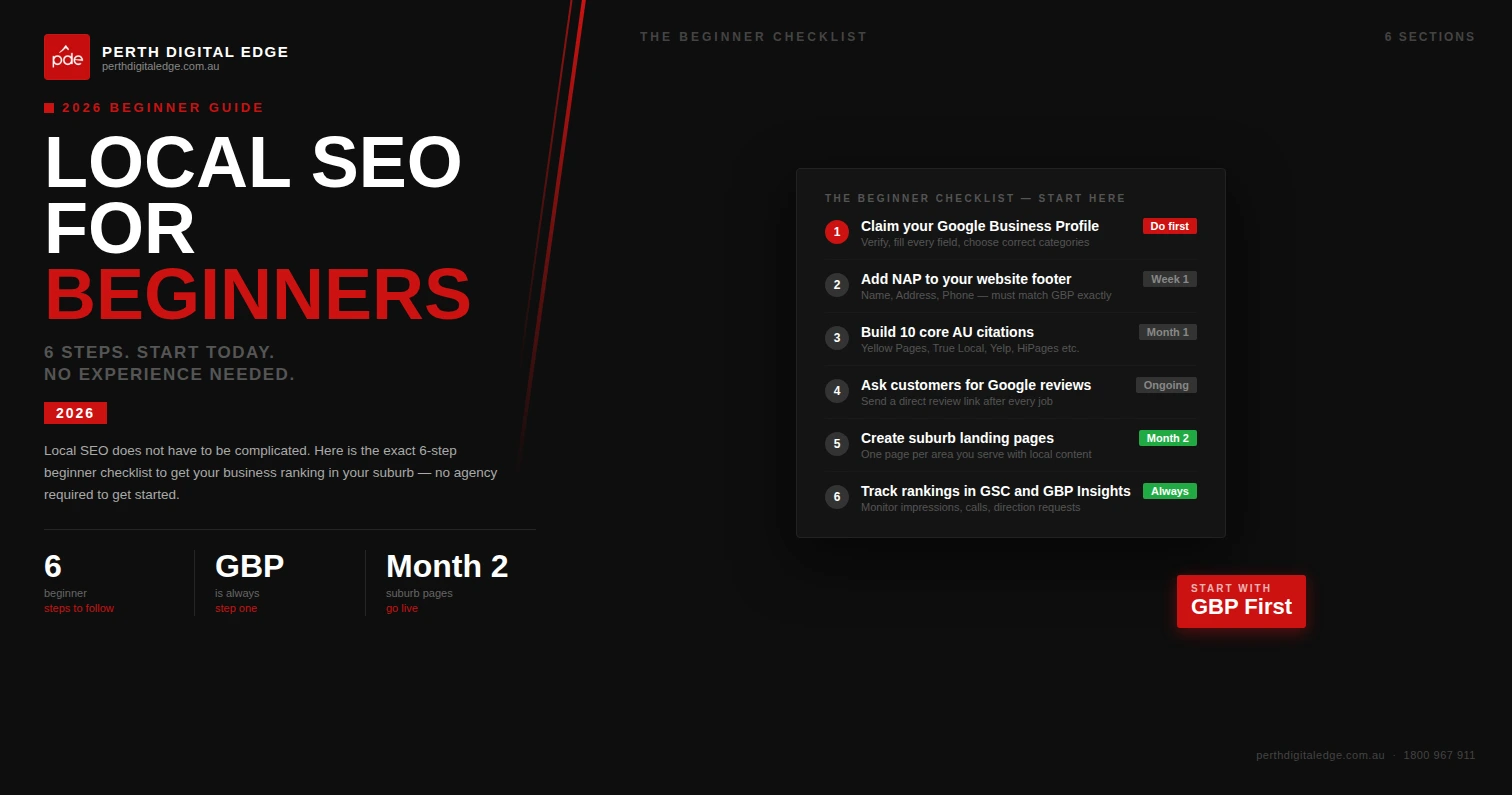
If you are a small business owner who has never touched local SEO, this guide is written for you. Not for marketers, not for agencies. For the person who runs a business, knows their trade inside out, and just wants to understand why the competitor down the road keeps showing up on Google while they do not. Local search engine optimisation can feel technical, but the basics are genuinely straightforward once someone explains them without jargon.
At Perth Digital Edge, Ben Tippett and our team have walked dozens of business owners through exactly this process. From tradies in Joondalup who had never logged into Google to cafe owners in Leederville who thought SEO was something only big companies needed. This digital marketing approach works regardless of business size, and we are going to show you how to get started.
What Is Local SEO?
Local SEO optimises your online presence to attract nearby customers. When someone types ‘dentist near me’ or ‘best coffee in Fremantle’ into their phone at 7am, search engines serve up local search results that match their location. Your goal is showing up in those results instead of a competitor.
Unlike traditional SEO, which targets broad national audiences, local searches focus on a specific physical location. This distinction matters because people searching locally are rarely browsing. Someone searching ’emergency plumber’ at 11pm is not researching plumbing. They have water coming through a ceiling. They want to call someone now. That buying urgency is why local SEO converts so much better than most other marketing channels.
Why Local SEO Matters For Your Business
Over 46% of all search queries have local intent on mobile devices and computers. When you show up in the local pack and local search results, you capture high-intent searches before competitors do. Local businesses investing in proper SEO strategy see dramatic website traffic improvements and generate qualified leads that convert to paying customers. Your online visibility depends on understanding local search engine optimization fundamentals.
Here is something worth sitting with. The difference between ranking first and ranking fifth in the local pack is not a 20% gap. It is closer to a 70% gap in actual clicks. A business in position five may as well be on page two. That is the uncomfortable truth most agencies avoid explaining.
Start With Your Google Business Profile
Your Google Business Profile is the single most important thing you can fix this week. It appears directly in local search results and Google Maps, and yet we regularly audit established Perth businesses who have never claimed theirs, or who claimed it three years ago and forgot the login. One Nedlands accountant told us she had been losing leads for two years to a competitor whose profile had 80 reviews and better photos, while hers sat empty. She fixed it in an afternoon.
Claim and verify ownership through Google’s verification process. Make sure your business name, address and phone number are correct and consistent everywhere online. Fill in every field: categories, hours, website URL, description. Upload high quality images of your storefront, products and team. Google favours businesses with strong visual content.
Keep everything up to date. Update hours before holidays, announce events, respond to customer messages quickly. Active Google Business Profile management signals to search engines that you are a thriving local business operating in your area.
Local Keyword Research: Finding What People Search For
Local keyword research is where you stop guessing and start listening. This is how you discover what exact search queries your potential customers actually use when looking for your products or services, not what you assume they type.
Start with Google Keyword Planner (completely free) to see search volume for specific local keywords. Look for terms combining your service with location: ‘plumber in Perth’, ’emergency plumber Fremantle’, or ‘accountant in Perth CBD’. These local intent searches are where real business opportunity lives.
Use Google Maps to see what people search for in your area. Type relevant keywords into the search box and check autocomplete suggestions. These are real, frequently searched organic search results coming from actual users. Modifiers like ‘near me’, ‘best’, ‘affordable’, and ’emergency’ convert extremely well because they indicate buyer readiness. A Subiaco hairdresser we worked with discovered her customers searched ‘balayage near me Perth’ far more than ‘hair colourist Subiaco’, which she had been targeting for years. That one insight changed her bookings. Compare this to Google Ads searches which show different intent patterns.
Analyse search queries in Google Search Console once you get initial traffic. This powerful tool shows the exact search terms bringing visitors to your website. You’ll discover surprising searches you hadn’t considered. Create a spreadsheet tracking your service, location modifiers, and intent modifiers. The bigger your keyword list, the more search rankings you can capture across different variations.
On-Page Optimisation For Local SEO
Your website content must be optimised for the local searches you want to rank for. Weave local keywords and location information naturally throughout your site, and understand the local SEO ranking factors that influence search visibility on Google’s search results pages.
Start with your homepage. Include your business name, address and phone number prominently. Write helpful website content that answers questions your local audience actually asks. Do not keyword-stuff. People are reading, not just search engines.
Create multiple pages if you serve different geographical areas. A tradesperson serving Perth and suburbs needs separate pages optimised for each local area. This helps search engines understand your geographic reach and improves your local rankings.
Use high quality images throughout. Photos of your business, team, projects and customers appear in Google Maps and make your business more trustworthy. Also make your website mobile-friendly. Over 60% of local searches happen on phones, and slow, non-mobile-friendly sites lose customers and rankings.
Building Local Citations And Links
Local citations are mentions of your business name, address and phone number appearing on other websites. Google uses these citations to verify your business information is legitimate and to determine your local search rankings. The more consistent citations you have, the more trustworthy you appear to search engines.
List your business in major Australian online listings including Google My Business, True Local, Yellow Pages, Hotfrog, and industry-specific directories relevant to your business type. Consistency across these local directories matters enormously. Your name, address and phone must match exactly everywhere. Even small variations will confuse search engines and damage your local queries rankings.
Local link building differs from traditional SEO link strategies. Instead of hunting generic backlinks, focus on sites linking to local businesses in your area. Partner with local business associations, sponsor community events, get mentioned in local news, and contribute expert comments to local publications. These local links carry tremendous weight with search engines and signal that you are a relevant, trustworthy business in your community.
Online Reviews: The Thing Most Owners Avoid
Here is what we hear all the time from owners: asking customers for reviews feels awkward. We understand, but that awkwardness is costing you money. Online reviews are crucial local ranking factors that directly influence your visibility. Google heavily weights positive reviews and review quantity when determining local search results and map pack rankings. Skip this step and you are handing business to whichever competitor asked first.
More positive reviews mean higher rankings and more clicks. A business with 150 five-star reviews will substantially outrank a similar business with 20 reviews, assuming all other factors are equal.
Ask customers actively. After each purchase or service completion, send a follow-up email with a direct link to your Google Business Profile review form. Every friction point reduces your review volume.
Respond personally to every review, positive and negative. Negative reviews will not destroy your local SEO rankings if you respond professionally and resolve issues. This shows potential customers you care about your reputation.
Never fake reviews or ask friends and family to review you. Google’s algorithms detect these patterns and will penalise your business.
Local SEO Case Study: The Perth Cafe Success Story
A small Perth cafe was buried in local search results when they came to us. They ranked on page three for ‘best cafe Perth’ and were not appearing in the local pack at all.
We optimised their Google Business Profile, added 40 high quality images, rewrote website content targeting ‘specialty coffee Perth’ and ‘brunch near me’, built 15 citations in local directories, and implemented a review request strategy emailing every customer. They went from 8 reviews to 97 in 90 days.
In twelve weeks, they moved to position two in the local pack for ‘best cafe Perth’ and jumped into top three positions for 13 different local keywords. Website traffic increased 290%. Foot traffic increased an estimated 45% based on customer surveys. You do not need complex tactics, just consistent execution of fundamentals.
Common Local SEO Mistakes To Avoid
Inconsistent business information is the biggest mistake. When your name, address and phone appear differently across directories and your website, search engines get confused. Spend time ensuring everything matches exactly.
Ignoring negative reviews damages your reputation and rankings. The solution is responding professionally and trying to resolve the issue.
Neglecting mobile optimisation loses enormous amounts of traffic. People searching ‘plumber near me’ are ready to hire immediately. If your website doesn’t work on phones, you’ve lost the sale.
Keyword stuffing hurts you. Cramming location into every sentence looks unnatural. Write for humans first. Keywords should feel natural within helpful content.
Local SEO Tools That Actually Work
You don’t need expensive software to succeed with local SEO. Start with these powerful free tools that deliver real insights.
Google Search Console shows every search query bringing visitors to your site, how often you appear in search results, and your average ranking position. Use it to discover unexpected local keywords and monitor your local search rankings over time.
Google Analytics reveals which pages attract local customers, what they do on your site, and whether they convert. Identify your best-performing pages and improve the underperformers.
Google Maps often surfaces keyword ideas the paid tools miss. Search your main service keywords and competitor business names to see what currently appears and which Perth suburbs show up in autocomplete alongside your service. That is Google telling you where demand concentrates.
Google Keyword Planner shows search volume for different local keyword variations. Combine your primary service with locations and intent modifiers to find the highest-volume, lowest-competition opportunities available in your specific market. These free tools are genuinely sufficient for most small business owners starting their local SEO strategy and looking to perform keyword research effectively.
FAQ About Local SEO For Beginners
How Long Does It Take To See Local SEO Results?
Most businesses see noticeable changes within 4-6 weeks of performing keyword research and optimising. Significant ranking improvements take 8-12 weeks. Patience matters because local queries and local searches reflect genuine local competition in your area.
Do You Need A Website For Local SEO?
A Google Business Profile can attract customers, but a website lets you rank for more local keyword variations, tell your story, and capture leads more effectively. It’s an investment that pays off.
Can You Do Local SEO Myself?
Yes. Claiming your Google Business Profile, getting citations, asking for reviews, and writing location-specific content are all doable yourself. It takes time, but it’s definitely possible.
Does Local SEO Still Work?
Yes. Local SEO is more important than ever. Google prioritises local results, and people search locally constantly before purchasing. For service-based and location-dependent businesses, local SEO delivers better returns than most marketing strategies.
How Do You Know What Local Searches My Customers Are Doing?
Use Google Search Console to see actual search queries bringing traffic. Use Google Keyword Planner to check search volume. Check Google Maps autocomplete suggestions. These show real search behaviour.
What’s The Most Important Local Ranking Factor?
Accurate business information combined with recent reviews. An up-to-date Google Business Profile with consistent information everywhere, plus active review generation and proper business hours listed, outperforms almost everything else. Focus on these core elements before pursuing more advanced tactics.
Related Local SEO Resources
For a deeper dive into local SEO strategy, check our complete guide to what local SEO means.
Learn about the specific ranking factors that influence local search results.
Explore our detailed breakdown of local SEO services and what they involve.
Get the full story on local citations and their role in local search.
Read our analysis of whether local SEO still works in the current market.
See our complete range of local SEO services tailored for Australian businesses.
Your Next Steps
Local SEO requires consistent effort but isn’t complicated. Claim and optimise your Google Business Profile. Build citations. Ask customers for reviews. Write helpful, location-specific content.
These basic steps separate you from most of your target audience competition. The reality in Perth is that most businesses still have not bothered doing the fundamentals properly, which means genuine opportunity is sitting there waiting. That gap will close eventually, as it already has in Sydney and Melbourne, but right now the runway is longer than you might think.
Ready to take your local SEO further? Contact Perth Digital Edge today. We’ll audit your local presence and show exactly what’s holding you back.